

Sound signals and the lookout in restricted visibility
1The lesson in plain words
In fog you often hear a ship before you see her. Report every whistle, bell or gong: what you heard, how often, and its rough direction.
Listen as well as look
Rule 5 asks for a lookout by hearing too. Report every sound signal: whistles, bells, gongs, and the sound of engines or breaking waves. Say what you heard and its rough direction: ‘Fog signal, one prolonged blast, about two points on the port bow.’ The OOW must know at once, because a fog signal heard forward of the beam may call for action under Rule 19.
Count and time
A short blast lasts about one second; a prolonged blast lasts four to six seconds. Under way means not anchored, made fast ashore or aground. Making way means moving through the water. In fog, an ordinary power-driven vessel making way gives one prolonged blast at intervals of no more than two minutes. If under way but stopped through the water, she gives two prolonged blasts about two seconds apart, at the same maximum interval. Count each group and report it.
Bells and gongs
For ships of 20 m or more, the standard anchor signal is rapid bell ringing for about five seconds, at intervals no longer than one minute. At 100 m or more, the bell is forward, followed immediately by a rapid gong aft for about five seconds. Aground, add three distinct bell strokes before and after the rapid ringing. Smaller craft and some ships working at anchor have different signals. Report the complete pattern and approximate direction; never infer position from sound alone.
Sound can mislead
In restricted visibility, a signal’s apparent direction may be misleading, and a nearby vessel may not be heard. Give an approximate direction and never treat silence as proof that nothing is there.
Signals in sight
For a power-driven vessel under way and in sight, one short blast means ‘I am altering course to starboard’; two mean ‘to port’; three mean ‘I am operating astern propulsion’, using propulsion to drive backwards. This can slow a ship still moving ahead. For any vessels in sight and approaching each other, five or more short, rapid blasts mean the sender cannot understand another vessel’s intentions or actions, or doubts enough is being done to avoid collision. Report every signal at once.
2Key data
- Short blast
- About 1 second
- Prolonged blast
- 4 to 6 seconds
- Fog: power-driven, making way
- 1 prolonged blast at intervals of not more than 2 minutes
- Fog: power-driven, under way, no way through the water
- 2 prolonged blasts, about 2 s apart, every 2 minutes or less
- Standard anchor signal, ships ≥20 m
- Rapid bell ~5 s each minute; ≥100 m: then rapid gong aft ~5 s
- Five or more short, rapid blasts
- Intentions/actions unclear, or collision-avoidance action in doubt
3Key points
- 1
Report every sound signal: what you heard, how many blasts and the rough direction.
- 2
Short blast about 1 second; prolonged blast 4–6 seconds.
- 3
Standard signals, ships ≥20 m: rapid bell at anchor; add three strokes before and after if aground. Report the full pattern.
- 4
Sound direction in fog is unreliable, and silence is no proof that nothing is there.
- 5
In fog, keep your post away from your own ship’s noise and report at once.
4Frequent mistakes
Wrong: In fog I only report signals I can place exactly.
Right: Report every signal at once with an ‘about’ direction. The apparent direction can be misleading.
Wrong: No signal heard, so no vessel is near.
Right: A nearby signal may be masked. Keep listening and looking, and report anything you hear.
Wrong: Two prolonged blasts mean a vessel at anchor.
Right: Two prolonged blasts mean a power-driven vessel under way but stopped through the water. For ships ≥20 m, the standard anchor signal is a rapid bell, plus a gong aft at ≥100 m.
5Practice case & exam keys
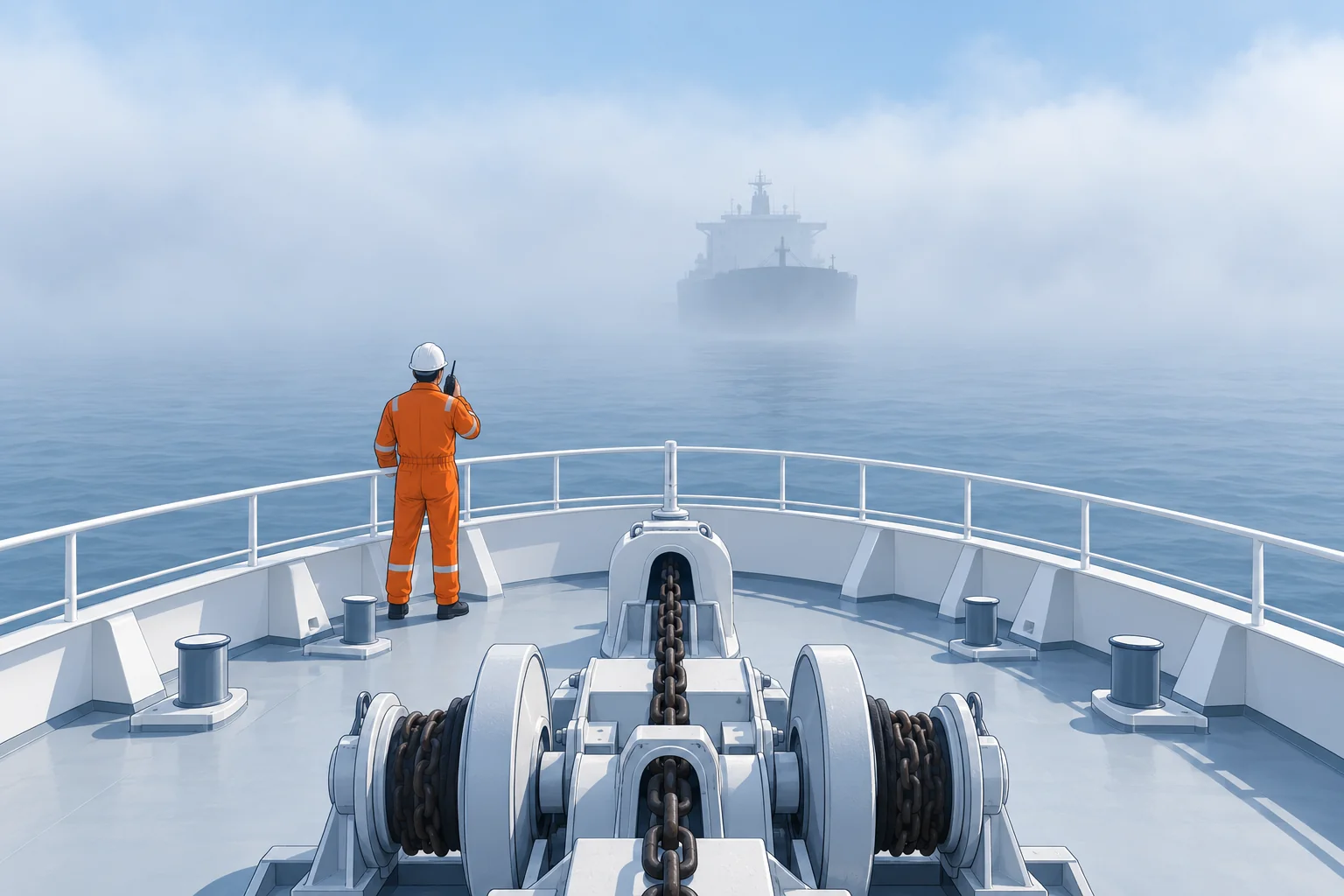
Thick fog. On the forecastle you hear one prolonged blast, apparently a little to starboard of right ahead. About two minutes later you hear it again, louder. What do you report, and when?
Show the answer
At the first blast, report: ‘Bridge, forecastle: one prolonged blast, about fine on the starboard bow.’ Repeat until acknowledged. After the second blast, update: ‘Same signal, about two minutes later, sounding louder.’ Do not wait to establish the interval before reporting. Give the direction as an estimate; sound can mislead. Keep listening and looking.
Exam keys
- Short ≈ 1 s; prolonged 4–6 s. Power-driven under way: ≤2 min; standard anchor/aground bell, ships ≥20 m: ≤1 min.
- Power-driven: 1 prolonged = making way; 2 = stopped through water. Standard anchor/aground signal, ships ≥20 m: rapid bell.
- Sound’s apparent direction can be misleading: report every signal with an approximate bearing.
Finish this unit
When you've read it, match the terms, then answer three questions. Get them all right to finish the unit; opening the page alone doesn't count.
My notes for this unit
No notes