

On-board phrases: watch, engines, anchor and lines
1The lesson in plain words
On board, the SMCP fixes how you hand over the watch, give engine orders and work the anchor and lines. Each order is repeated, done and reported.
Handing over
The officer handing over says ‘You have the watch now’; the relieving officer confirms ‘I have the watch now’. Brief position, course and speed, draught and under-keel clearance, compass errors, traffic, aids, equipment, weather, orders and special events. Having the conn means directing the ship’s movements; the pilot can have the conn while you keep the navigational watch. The master’s presence alone does not transfer the watch.
Engine orders
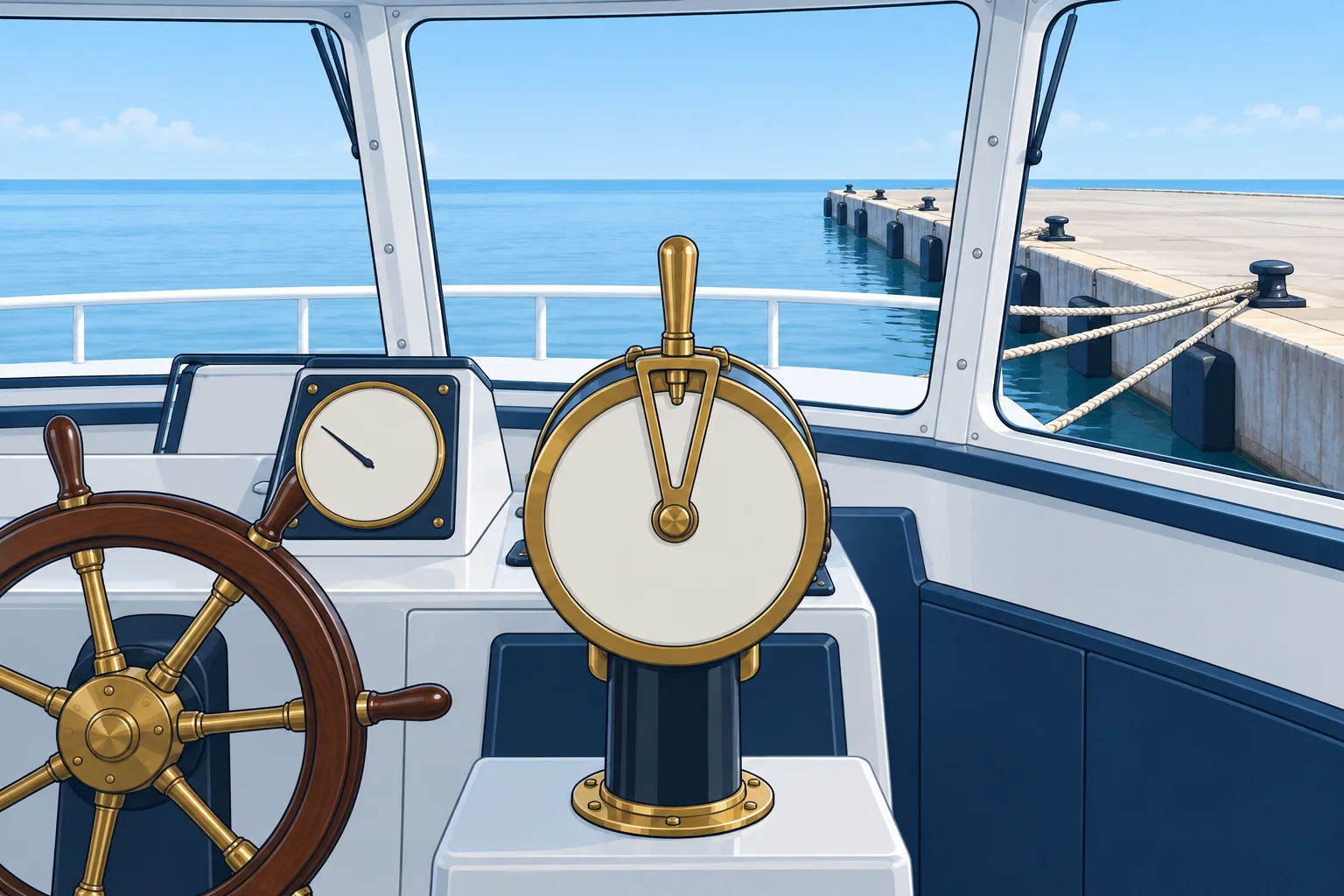
You repeat orders at the engine-order telegraph (the control used to send engine orders). The officer of the watch (OOW) checks they are carried out at once. The steps are dead slow, slow, half and full, ahead or astern; ‘Stop engine’; ‘Emergency full ahead’ or ‘astern’. ‘Stand by engine’ means engine room ready to manoeuvre and the bridge manned to relay orders. ‘Finished with engines’ means no more manoeuvring. Wheel orders are in Watch keeping for ratings.
Twin screws and thrusters
With two propellers, add ‘both’ for both shafts: ‘Slow astern both’. Name one shaft to use it alone: ‘Half ahead port’. To stop both main engines, say ‘Stop all engines’. Thruster orders are ‘Bow thruster full to port’, ‘Stern thruster half to starboard’ and ‘Bow thruster stop’. Stop a thruster with its own order.
Anchor phrases
‘Stand by port anchor’ means prepare it; ‘Let go port anchor’ means release it. A shackle is a chain length; cable means anchor chain. ‘Cable leading ahead’ means the chain runs forward; ‘up and down’ means vertically below the bow. ‘Brought up’ means the anchor holds the ship.
Mooring phrases
‘Send out the head line’ means pass the forward mooring line ashore. ‘Heave away’ means haul in. ‘Make fast fore and aft’ means secure the lines forward and aft. ‘Single up forward and aft’ means reduce to the ordered mooring lines, then await letting-go orders.
Closed loop
Every order works as a closed loop: give the order, hear it repeated, see it done, hear it reported and confirm. Bridge: ‘Half astern.’ Telegraph: ‘Half astern.’ Then: ‘Engine half astern.’ Bridge: ‘Thank you.’ If you hear no repeat, or a different order, give it again at once. Emergency phrases follow the same pattern: ‘Operate the general emergency alarm.’
2Key data
- Watch handover
- ‘You have the watch now.’ / ‘I have the watch now.’
- Engine steps
- Dead slow, slow, half, full: ahead or astern
- Stand by engine
- Engine room ready to manoeuvre; bridge manned for orders
- Twin screws
- Add ‘both’; but ‘Stop all engines’
- Finished with engines
- No more manoeuvring
- Single up
- Reduce to the lines and springs ordered before letting go
3Key points
- 1
After briefing, confirm transfer. If the master says ‘I have the watch now’, reply ‘You have the watch now’.
- 2
Every engine order is repeated at the telegraph and checked by the OOW.
- 3
Use ‘both’ for twin shafts, a side for one shaft, and ‘Stop all engines’ for main engines; stop thrusters separately.
- 4
Close every loop: order, repeat, act, report, confirm.
4Frequent mistakes
Wrong: Hand over the watch with ‘OK, she’s all yours.’
Right: Use the fixed exchange, ‘You have the watch now’ – ‘I have the watch now’, so there is no doubt who has accepted the navigational watch.
Wrong: On a twin-screw ship, order ‘Slow astern’ when you mean both engines.
Right: Say ‘Slow astern both’. Without ‘both’, the order is incomplete on a twin-screw ship.
Wrong: Accept silence after an engine order as confirmation.
Right: Expect the repeat and the report. If you do not hear them, give the order again and check the indicator.
5Practice case & exam keys
During berthing, both main engines are slow astern and the bow thruster is half to port. The master orders ‘Stop all engines.’ You repeat it, but the port shaft still shows astern. What do you report, and what happens to the thruster?
Show the answer
Set both main engines to stop, check their response and report: ‘Port engine still running astern.’ Do not report ‘All engines stopped’ until verified. The bow thruster remains half to port until separately ordered ‘Bow thruster stop’. Repeat that order, carry it out and report. The master confirms each report. Clarify the order if ‘stop everything’ was intended.
Exam keys
- Watch handover: ‘You have the watch now’ – ‘I have the watch now’.
- Engine orders repeated at the telegraph; OOW checks they are carried out at once.
- Twin screws: ‘both’; single shaft named; ‘Stop all engines’.
- ‘Stand by engine’ and ‘Finished with engines’ start and end manoeuvring.
Finish this unit
When you've read it, answer three questions. Get all three right to finish the unit; opening the page alone doesn't count.
My notes for this unit
No notes