

The grab bag
1The lesson in plain words
A grab bag holds what the liferaft pack lacks: ways to call, signal, see and stay well. It must float, be easy to see and be ready by the cabin entrance.
The bag itself
A grab bag is a waterproof bag kept near the companionway, the cabin entrance, ready to take into the raft. Choose one that floats, has a bright colour, carries the boat’s name and has a lanyard (securing cord) and clip so you can attach it to yourself or the raft. One person is given the job of bringing it.
Calling and signalling
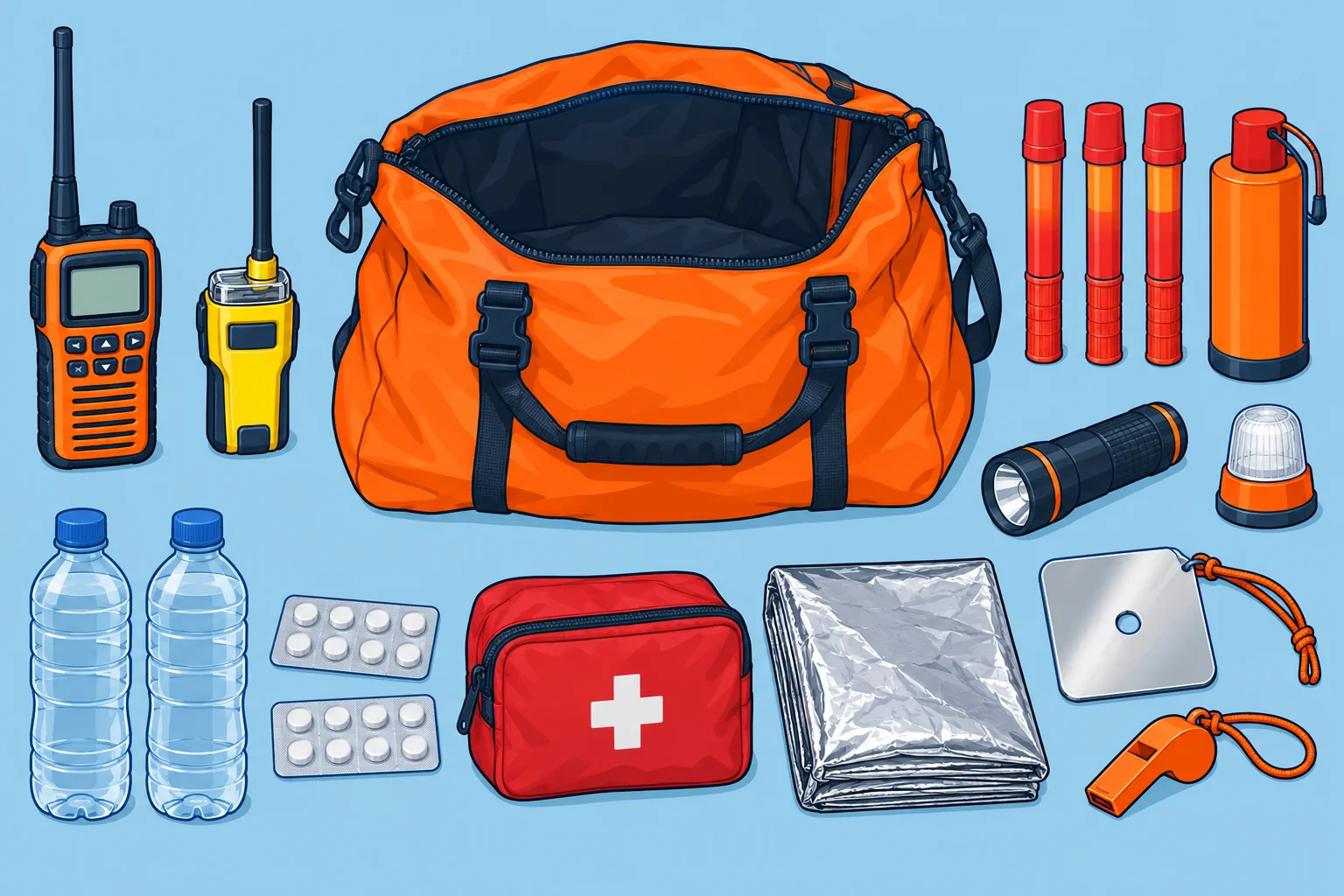
Pack a waterproof handheld VHF marine radio, ideally with a digital distress-alert button (DSC) and satellite positioning (GNSS), plus spare batteries. Add a personal locator beacon (PLB) or the EPIRB if kept separately, and a SART, a beacon that helps rescuers locate you nearby. Pack flares, orange smoke, a waterproof torch, flashing strobe light, signal mirror and whistle. A phone in a waterproof pouch may help near the coast.
Staying alive
Add water in sealed bottles (aim for 2 litres per person as extra emergency water), seasickness tablets, a first-aid kit, personal medicines, spare glasses, sunscreen, a hat, thermal protective aids (insulating survival bags), energy bars, a knife and tape. Check that sealed water bottles float; a little air helps.
Keep it ready
Check the contents and batteries at the start of each season and before passages. Brief the crew on where it is. Keep copies of passports and boat papers inside. Do not overload it: a bag too heavy to lift will be left behind. A second container of water can be tied to the raft.
2Key data
- Must
- Float, be bright, carry the boat’s name, have a lanyard and clip
- Call
- Handheld DSC VHF, PLB or EPIRB, SART, phone in pouch
- Signal
- Flares, orange smoke, strobe, torch, mirror, whistle
- Survive
- Water, seasickness tablets, first aid, medicines, thermal aids
3Key points
- 1
The grab bag must float, be bright, named and have a lanyard and clip.
- 2
Call: handheld DSC VHF, PLB or EPIRB, SART.
- 3
Signal: flares, smoke, strobe, torch, mirror, whistle.
- 4
Survive: water, seasickness tablets, first aid, medicines, thermal aids.
- 5
One person’s job; check contents and batteries each season.
4Frequent mistakes
Wrong: The liferaft pack has everything, so a grab bag is optional.
Right: Raft packs are minimal. The grab bag adds radio, beacons, water, medicines and more signals.
Wrong: Pack it as full as possible with tins of food.
Right: Water matters far more than food, and a heavy bag gets left behind.
5Practice case & exam keys
Preparing for a two-day passage, you find the grab bag holds old flares, a handheld VHF with a flat battery and no water. What do you change?
Show the answer
Replace out-of-date flares and dispose of the old ones properly. Charge the VHF and add spare batteries, or a second radio. Add sealed water, seasickness tablets, crew medicines, a torch and strobe, a PLB, a knife, a mirror and thermal aids. Check it floats with its lanyard and clip, then show the crew where it is.
Exam keys
- Grab bag: floats, bright, named, lanyard and clip, by the companionway.
- Contents: handheld DSC VHF, PLB or EPIRB, SART, flares, strobe, mirror, whistle.
- Water, seasickness tablets, first aid, personal medicines, thermal aids, knife.
- Check before passages; assign a person to take it.
Finish this unit
When you've read it, answer three questions. Get all three right to finish the unit; opening the page alone doesn't count.
My notes for this unit
No notes