

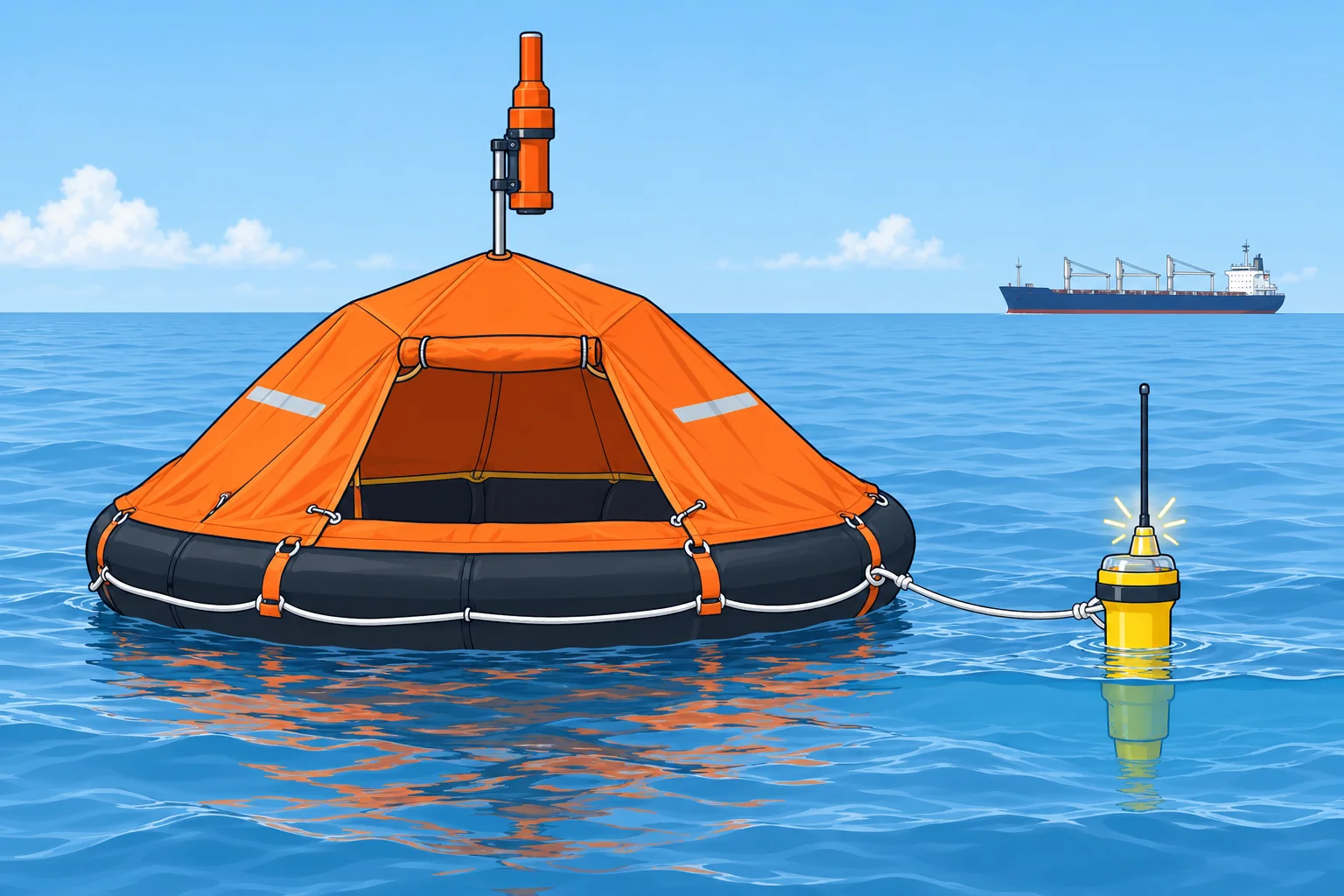
Using EPIRB, SART and PLB in survival
1The lesson in plain words
Leave the EPIRB on and floating as directed. Switch on the SART and mount it high. Keep a PLB’s antenna upright and clear of the water.
EPIRB
Switch on the EPIRB and leave it on. It sends a 406 MHz satellite alert with its identity and, if GNSS-equipped, its satellite position. GNSS means satellite positioning. Its 121.5 MHz signal helps rescuers home in. Follow its instructions: a float-free model works best floating on its lanyard, tied to the raft, antenna upright. Some show a Return Link Service (RLS) light when the alert has been received.
SART
Switch on the SART (search and rescue transponder) and mount it high on its pole or the canopy. Height improves range. A radar SART answers a ship’s or aircraft’s 9 GHz radar: a line of 12 dots appears on their screen, leading from your position outwards. An AIS-SART shows as a special target on AIS, the automatic identification system used to display vessel positions. Use the SART alongside the EPIRB.
PLB
A PLB (personal locator beacon) works like a small EPIRB for one person, usually for at least 24 hours. Most must be switched on by hand and held with the antenna up, out of the water. Keep a PLB ready as backup and follow rescuers’ instructions. Do not cycle an active distress beacon on and off to save power.
Other signals
Keep the handheld VHF dry. When rescuers are nearby, call on Channel 16 with your position, then listen for instructions. Use the signal mirror in sunshine; it can be seen far away. Use flares and orange smoke when rescuers could see them; follow each device’s instructions.
2Key points
- 1
EPIRB on and left on: 406 MHz alert plus 121.5 MHz homing.
- 2
A float-free EPIRB works best floating on its lanyard, antenna up.
- 3
Radar SART: 12 dots on rescuers’ radar; AIS-SART on AIS screens.
- 4
Switch on the SART alongside the EPIRB and mount it high: range depends on height.
- 5
PLB: switched on by hand, antenna up and out of the water.
3Frequent mistakes
Wrong: Switch the EPIRB off once you hear it has been received.
Right: Leave it on. Rescuers use its signals to home in on you until you are found.
Wrong: The SART is as effective lying on the raft floor.
Right: Its range falls sharply near the water. Mount it as high as possible.
4Practice case & exam keys
Your EPIRB and radar SART have been on for six hours. The SART is mounted high and the EPIRB’s RLS light confirms receipt. A crew member suggests switching both off to save power. A ship appears on the horizon. What do you do?
Show the answer
Leave both devices on. RLS confirms receipt, not that rescue has launched. Check that the radar SART remains mounted high and the EPIRB is deployed as instructed. Call the ship on Channel 16 with the handheld VHF, giving your position, and follow its instructions. Use a flare when the ship is close enough to see it.
Exam keys
- EPIRB: 406 MHz satellite alert with identity and position if equipped; 121.5 MHz homing; leave on.
- RLS light confirms the alert was received, not that rescue has launched.
- Radar SART: 12 dots on X-band (9 GHz) radar; AIS-SART on AIS; switch on and mount high alongside EPIRB.
- PLB: manual, antenna up, usually at least 24 hours.
Finish this unit
When you've read it, answer three questions. Get all three right to finish the unit; opening the page alone doesn't count.
My notes for this unit
No notes