

Flag, port and coastal states in the conventions
1The lesson in plain words
The flag state certifies your ship. Port states inspect foreign ships. Coastal states organise routeing, reporting and traffic services.
The flag state
The flag state turns the conventions into law, surveys the ship and issues the statutory certificates: the certificates a convention requires. It may delegate surveys to a recognised organisation (RO), usually a classification society, under the RO Code. It still answers for the result. The Casualty Investigation Code requires a marine safety investigation into every very serious marine casualty: total loss of a ship, a death or severe environmental damage.
The port state
Main conventions let parties inspect foreign ships in their ports: SOLAS I/19, MARPOL article 5, STCW I/4, Load Lines, MLC and BWM. This is port state control (PSC). Initial checks include certificates, records and ship condition. Clear grounds are evidence of non-compliance, such as a broken lifeboat davit (the device used to launch the boat) or inability to perform essential duties. They justify a more detailed inspection. Serious deficiencies can lead to detention.
No more favourable treatment
Several conventions, such as MARPOL, STCW, the MLC and the SOLAS 1988 Protocol, contain a no-more-favourable-treatment clause. A port state applies the same standards to ships of states that have not joined. Choosing a flag outside a convention does not let a ship escape its rules in a party's port.
The coastal state
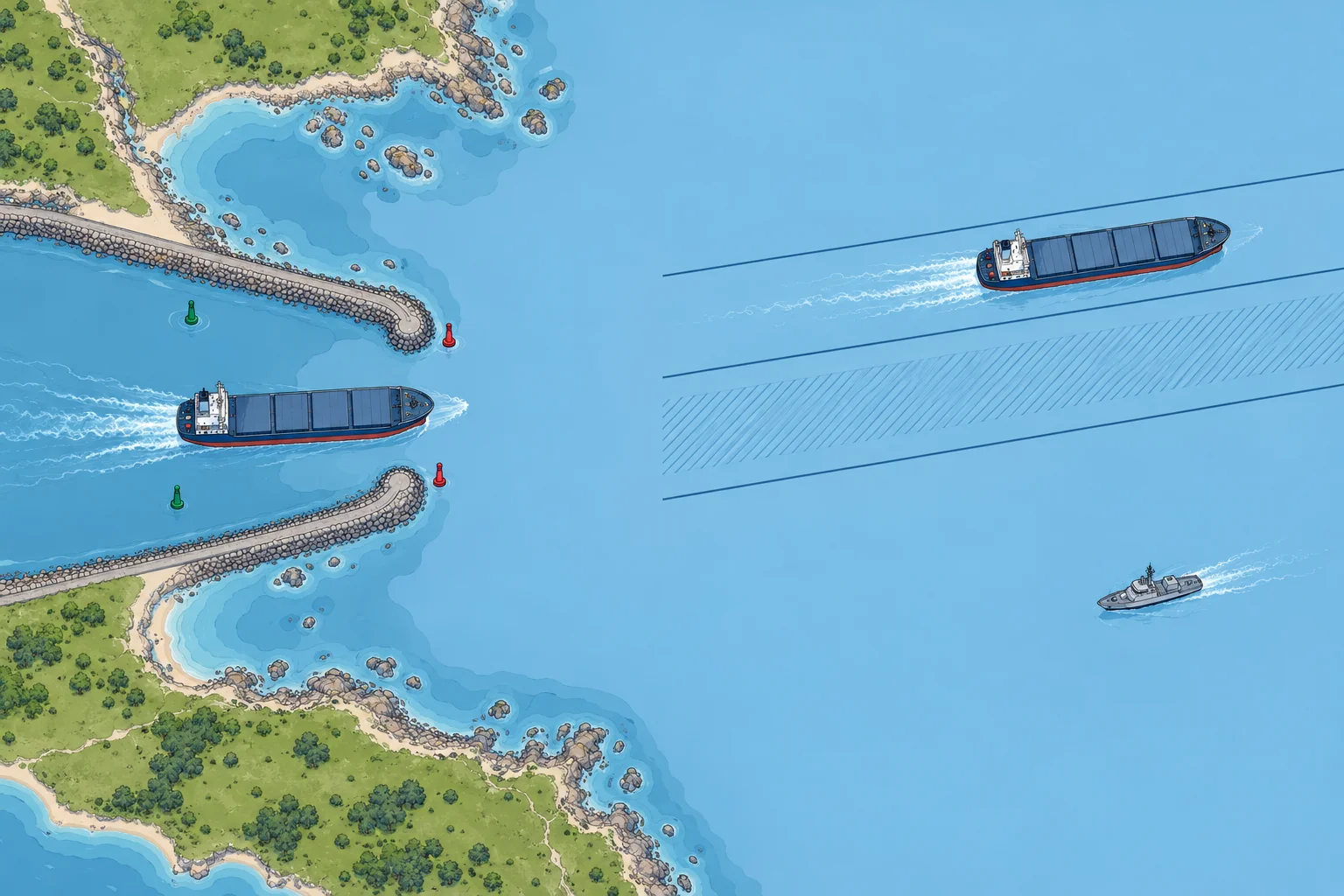
Coastal states use ships’ routeing under SOLAS V/10, ship reporting systems under V/11 and vessel traffic services (VTS) under V/12. IMO adopts international routeing systems and mandatory reporting systems. Governments establish VTS using IMO guidelines; individual VTS do not require IMO adoption. A VTS provides traffic information and support. Check whether a routeing system is mandatory and which ships it covers.
Where you fit
As an officer you meet all three roles in one voyage. The flag's rules follow the ship everywhere. The coastal state's reporting and routeing apply as you pass. The port state checks you on arrival. Knowing which convention gives which state its power helps you answer an inspector calmly and correctly.
2Key data
- Flag state
- Law, surveys, certificates, casualty investigation
- Recognised organisation
- Surveys on the flag's behalf under the RO Code
- PSC powers
- SOLAS I/19, MARPOL art. 5, STCW I/4, MLC, LL, BWM
- Clear grounds
- Evidence of non-compliance, including crew or equipment deficiencies
- Coastal state tools
- Routeing V/10, ship reporting V/11, VTS V/12
3Key points
- 1
The flag state certifies; it may delegate surveys to an RO but keeps the responsibility.
- 2
Initial PSC checks include certificates, records and ship condition; clear grounds justify a more detailed inspection.
- 3
No more favourable treatment: non-party flags get the same standards.
- 4
Coastal tools: routeing V/10, reporting V/11 and government-established VTS under V/12.
4Frequent mistakes
Wrong: A class society that issues a certificate becomes the responsible state.
Right: The RO acts for the flag state. The flag remains responsible under the convention.
Wrong: A ship flagged in a non-party state is exempt from that convention in port.
Right: Under the no-more-favourable-treatment clause, the port state applies the same standards.
Wrong: Valid certificates prevent an inspector from checking the ship’s general condition.
Right: Initial checks include certificates, records and ship condition. Clear grounds justify a more detailed inspection; valid certificates are no reason to disregard evident defects.
5Practice case & exam keys
In a party’s port, your non-party-flag ship has apparently valid ballast documents, but the inspector finds contradictory treatment logs. The master says certificates prevent further checks. Is that right?
Show the answer
No. No-more-favourable treatment lets the port apply the BWM standards relevant to your ship despite its flag’s status. Initial PSC checks include certificates, records and ship condition. Contradictory logs can be clear grounds for a more detailed inspection; valid documents do not remove that power.
Exam keys
- Flag: law, surveys, certificates; RO Code; Casualty Investigation Code.
- Port: PSC clauses in each convention; clear grounds for a more detailed inspection.
- No more favourable treatment for ships of non-parties.
- Coastal: routeing V/10, reporting V/11, VTS V/12.
Finish this unit
When you've read it, answer three questions. Get all three right to finish the unit; opening the page alone doesn't count.
My notes for this unit
No notes