

 See units
Designated security duties: access control, searches and security equipment (STCW A-VI/6-2)
Restricted areas and watching the ship
1The lesson in plain words
Only authorised people may enter restricted areas. Secure these spaces and watch the ship and nearby water to help detect threats early.
What they are
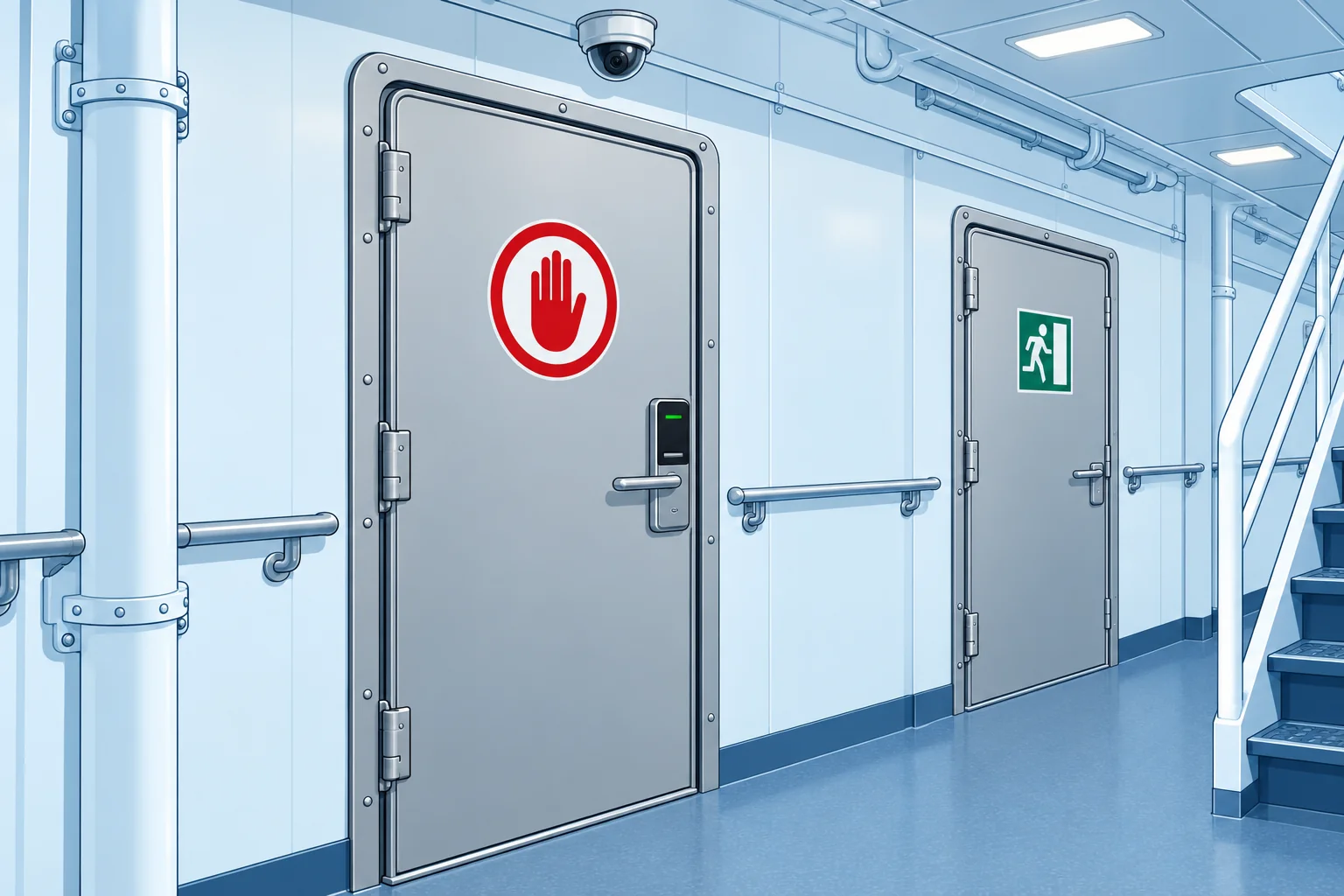
Restricted areas are spaces the plan protects because an intruder could take control of the ship, damage it or hide something there. Typical examples are the navigation bridge, machinery spaces and other control stations, spaces with security and surveillance equipment, ventilation and air-conditioning systems, access to drinking water tanks and pumps, spaces with dangerous goods, cargo pump rooms, cargo spaces and stores, and crew accommodation.
Marking and locking
Restricted areas are marked with signs saying that entry is restricted and that unauthorised presence is a breach of security. Doors are locked or watched, and keys and codes are controlled. Fire escape routes must stay usable from inside: security locks must never trap people in a fire. Check doors and seals during your rounds and report any that are open or damaged.
Watching the ship
The plan sets how the ship and the area around it are monitored: deck watches and patrols, lighting, alarms and closed-circuit television (CCTV). At night, light the decks, the ship's side and the water around it, especially on the side away from the quay, without dazzling the bridge or other ships. Vary your patrol times and routes so nobody can predict them.
The waterside
Watch for small boats approaching or drifting near the ship, divers, people climbing mooring lines or the anchor chain, and anything thrown aboard. At anchor, keep a watch all round and on the anchor chain.
Higher levels
At level 2 expect more patrols, especially when activity on board is low, and waterside watch from the ship or by boat patrols arranged with the port. At level 3 restricted areas may be guarded continuously.
2Key data
- Typical restricted areas
- Bridge, machinery spaces, security equipment, drinking water
- Fire escapes
- Must stay usable; locks never trap people inside
- Patrols
- Vary the time and route
- Lighting
- Decks, ship's side and water, without dazzling the bridge
3Key points
- 1
Restricted areas include the bridge, machinery spaces, security equipment and drinking water.
- 2
They are marked, locked or watched; escape routes must stay usable from inside.
- 3
Light the decks, the ship's side and the water, especially the offshore side.
- 4
Vary patrol times and routes; watch for small boats, divers and climbers.
- 5
Higher levels mean more patrols, waterside watch and guards.
4Frequent mistakes
Wrong: Chain the emergency escape door shut to keep intruders out.
Right: Security must never block a fire escape. Use locks that open from inside, alarms or watches.
Wrong: Patrol at exactly the same times each night so the log looks tidy.
Right: Fixed patrols are easy to predict. Vary your times and routes.
5Practice case & exam keys
On a night patrol alongside, you find the door to the steering gear room unlocked and the restricted-area sign lying on the deck. Nobody has a permit to work there.
Show the answer
Do not enter alone. Report at once to the officer of the watch by radio with the location. Stay at a safe distance, watching the door, until help arrives. The SSO will decide whether to search the space and check for tampering. Record the time and what you found in your patrol report.
Exam keys
- Restricted areas: bridge, machinery and control spaces, security equipment, ventilation, drinking water, dangerous goods, cargo, stores, accommodation.
- Marked, locked or watched; escape routes kept usable.
- Monitoring: patrols, lighting, alarms, CCTV and waterside watch.
- Vary patrols; more at level 2; guards possible at level 3.
Finish this unit
When you've read it, answer three questions. Get all three right to finish the unit; opening the page alone doesn't count.
My notes for this unit
No notes