

 See units
Personal safety, social responsibilities and preventing violence and harassment (STCW A-VI/1-4)
Enclosed spaces and permits to work
1The lesson in plain words
The air in a closed tank can kill you in seconds without warning. Never enter without a permit, and never rush in after someone who has collapsed.
What they are
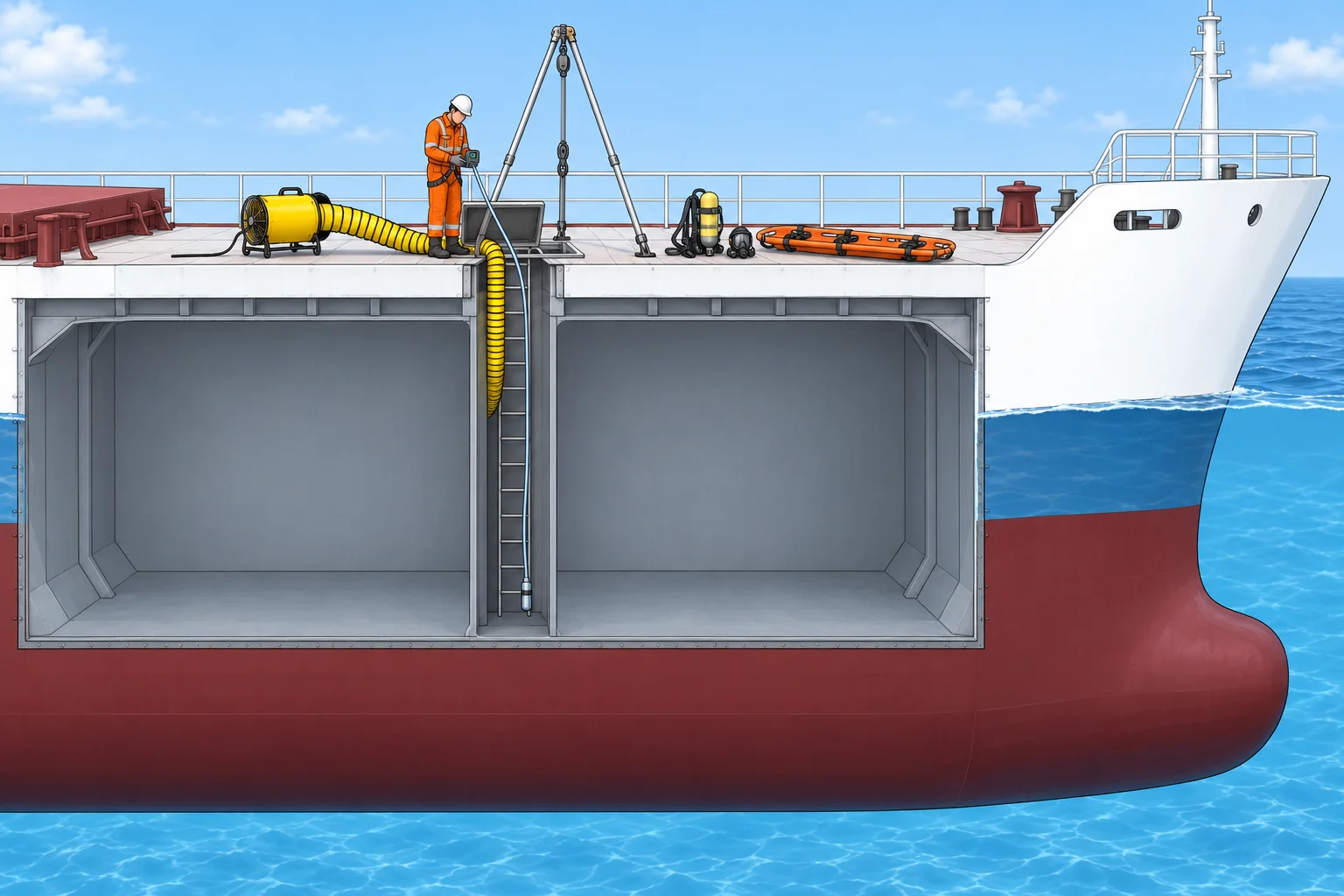
An enclosed space has limited openings, poor ventilation or is not designed for people to work in continuously, and may hold a dangerous atmosphere. Examples are cargo holds, tanks and chain lockers (spaces for anchor chain). A space connected to one of these, even through a closed door, can share its atmosphere.
Why they kill
Rust can use up oxygen, and inert gas, used to prevent fires, can displace it. Too much oxygen makes fires start more easily and burn fiercely. The air can also contain toxic gas, such as hydrogen sulphide or carbon monoxide, or flammable gas from fuel. You cannot rely on sight or smell to detect these hazards. Very low oxygen can make you collapse after one or two breaths.
The rules
SOLAS (the international ship-safety convention) requires a portable atmosphere tester (XI-1/7) and entry and rescue drills at least every two months (III/19). The International Maritime Organization (IMO) issued recommendations MSC.581(110) in 2025, replacing A.1050(27). Never enter alone. Ventilate, then test from outside: oxygen first, flammable gas next, toxic gas last. Some flammable-gas sensors read too low without enough oxygen. Before entry, oxygen must read 20.9 %, with safe flammable and toxic readings. A safe reading alone does not authorise entry.
The attendant and rescue
An attendant stays at the entrance, keeps in contact with those inside and raises the alarm if anything goes wrong. The attendant never goes in. If someone collapses, raise the alarm and wait for the rescue team with breathing apparatus: many enclosed-space victims are people who went in to help.
Permits to work
A permit to work is a signed form from an authorised officer confirming that precautions are in place before a dangerous job. Common permits are enclosed-space entry, hot work (welding, cutting, grinding outside the workshop), electrical isolation with lock-out tag-out (a personal lock and tag on the isolating switch), and work aloft or over the side. Do only the work the permit allows. The deck procedure, signatures and validity are in Ropes: deck work safely.
2Key data
- Required oxygen reading
- 20.9 % by volume (MSC.581(110))
- Testing order
- Oxygen → flammable → toxic
- Entry and rescue drills
- At least every two months (SOLAS III/19)
- Atmosphere tester
- Carried on board under SOLAS XI-1/7
- Entering alone
- Never
3Key points
- 1
Enclosed spaces may have too little or too much oxygen, or toxic or flammable gas.
- 2
Never enter without a permit, ventilation and a tested atmosphere: oxygen, flammable, toxic.
- 3
The required oxygen reading is 20.9 %; entry alone is not permitted.
- 4
The attendant stays outside. Raise the alarm; only the trained, equipped rescue team enters.
- 5
Permits cover hot work, enclosed spaces, isolation with lock-out tag-out and work aloft.
4Frequent mistakes
Wrong: The hatch has been open all morning, so the tank is safe to enter.
Right: An open hatch is no proof of safety. Entry needs all shipboard precautions, not just a permit and gas readings.
Wrong: If my mate collapses inside, I go straight in to pull him out.
Right: Raise the alarm and wait for the rescue team with breathing apparatus, or you may be the second victim.
Wrong: Flammable gas can be tested first; oxygen does not matter for the reading.
Right: Test oxygen first: some flammable-gas sensors read too low in low oxygen.
5Practice case & exam keys
You are the attendant while two crew members work inside a ballast tank. One stops answering. From the entrance, you can see the person lying at the foot of the ladder.
Show the answer
Stay outside and raise the alarm immediately. Give the exact location and say someone has collapsed. Tell the other crew member to leave if able. Keep contact and guide the trained rescue team to the entrance. Do not attempt entry yourself.
Exam keys
- Enclosed space: limited openings, poor ventilation, not for continuous work; may have too little or too much oxygen or hold toxic or flammable gas.
- Permit, ventilation and testing in the order oxygen, flammable, toxic; 20.9 % oxygen.
- Drills at least every two months; tester carried under SOLAS XI-1/7; IMO guidance MSC.581(110).
- The attendant never enters; rescue only by a team with breathing apparatus.
Finish this unit
When you've read it, answer three questions. Get all three right to finish the unit; opening the page alone doesn't count.
My notes for this unit
No notes