

What an officer can check, and what visitors are fined for
1The lesson in plain words
Under applicable law, officers can board to check papers, gear and alcohol. Check local navigation, beach and reserve rules before you visit.
Local law applies in local waters
Local navigation, beach, pollution and protected-area rules apply in internal waters (waters landward of the baseline) and the territorial sea (up to 12 NM seaward of it). The baseline is the reference line for measuring sea limits. Flag-state requirements still matter; entering another country's waters does not automatically impose all its equipment rules. Coast guards, maritime police and port authorities may stop and board pleasure boats under applicable law.
What they check
Expect checks of the required registration, insurance certificate, skipper's licence and ID, and radio authorisation. Officers may count lifejackets and flares, check expiry dates, and test the skipper for alcohol. Many European countries use 0.5 g/l of blood (grams per litre); limits and exceptions vary. Check the local rule before you take charge and stay fit to steer.
Beaches and swimmers
Follow local speed and exclusion rules. France normally caps speed at 5 knots within 300 m of shore; lower limits may apply. In Spain, buoyed bathing zones exclude leisure navigation; the 3-knot rule applies to unbuoyed bathing strips. Portugal normally excludes boats within 300 m of bathing beaches, except authorised access. Use designated access channels along their length, roughly perpendicular to the shore, at the posted speed. Keep out of swimming zones.
Nature and pollution
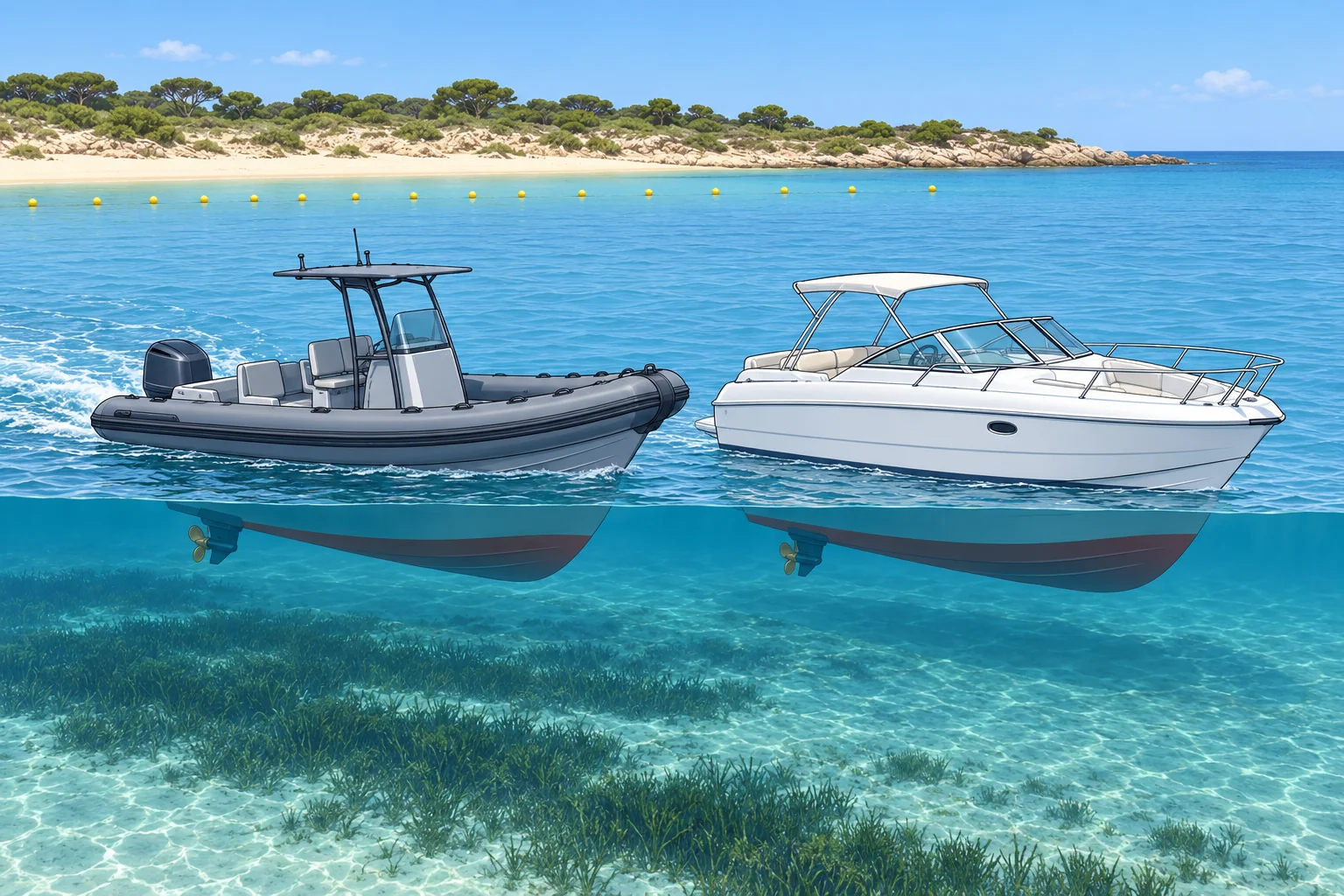
Marine reserves may ban anchoring, fishing or entry. In the Mediterranean many places forbid anchoring on seagrass meadows (Posidonia), which grow back very slowly. Sewage discharge is banned near the coast and in harbours in most countries, and throwing plastic overboard is banned everywhere.
How to stay out of trouble
Before you leave, read the local rules for the area you visit: the harbour master's notices, the marina and the local pilot book. Keep the papers together in a waterproof folder. The country units of this module give each country's details.
2Key data
- Territorial sea
- Up to 12 NM from the baseline (UNCLOS)
- Alcohol (common limit)
- 0.5 g/l blood in many European countries
- Beach strip, France
- General maximum 5 knots within 300 m; lower local limits may apply
- Spain, unbuoyed bathing strips
- 3 knots maximum; buoyed bathing zones exclude leisure boats
3Key points
- 1
Applicable local navigation, beach, pollution and protected-area rules apply to visiting foreign boats too.
- 2
Officers may check required registration, insurance, licence and ID, radio papers, gear and alcohol.
- 3
Slow down near beaches and keep out of buoyed swimming zones.
- 4
Do not anchor on seagrass where it is banned, and respect marine reserves.
- 5
Read the harbour master's notices and local rules before you go.
4Frequent mistakes
Wrong: A foreign-flag boat only follows the law of its own flag.
Right: Follow applicable local navigation, beach, pollution and protected-area rules too. Flag-state requirements still matter.
Wrong: Alcohol limits only apply to drivers on the road.
Right: Skippers can face alcohol limits and testing too. Check the local limit before you take charge and stay fit to steer.
Wrong: I can anchor anywhere outside a harbour.
Right: Reserves and seagrass meadows often ban anchoring. Check the local rules and use mooring buoys where provided.
5Practice case & exam keys
In French coastal waters, a patrol stops you 200 m off a beach at 8 knots. Your required papers are at home. You plan to anchor near seagrass. What should you correct and check?
Show the answer
Reduce to 5 knots or any lower posted limit. Carry your required papers in a form the relevant authority accepts: originals, authorised copies or official digital records. Before approaching the seagrass, check local anchoring restrictions. Choose permitted sand or an authorised mooring.
Exam keys
- Follow applicable coastal-state rules in internal waters and the territorial sea, which may extend up to 12 NM.
- Checks may cover required papers, qualification, ID, radio authorisation, gear, expiry dates and alcohol.
- Beach strips: slow speed (France: 5 knots within 300 m); stay out of swimming zones.
- Respect reserves, seagrass anchoring bans and discharge bans.
Finish this unit
When you've read it, answer three questions. Get all three right to finish the unit; opening the page alone doesn't count.
My notes for this unit
No notes