

Where the SeeSchStrO applies, and how it sits on top of the KVR
1The lesson in plain words
Germany's coastal waters, estuaries and the Kiel Canal follow the KVR (the COLREG) plus a national rule book: the SeeSchStrO. Where they differ, the SeeSchStrO wins.
Two rule books at once
On German coastal waters you follow the KVR (Kollisionsverhütungsregeln, Germany's name for the COLREG) and the SeeSchStrO (Seeschifffahrtsstraßen-Ordnung, the seaways traffic order). The SeeSchStrO says the KVR apply unless it states otherwise. So learn the KVR first; this lesson covers the German additions. The version in force was last amended on 18 September 2024.
Which waters
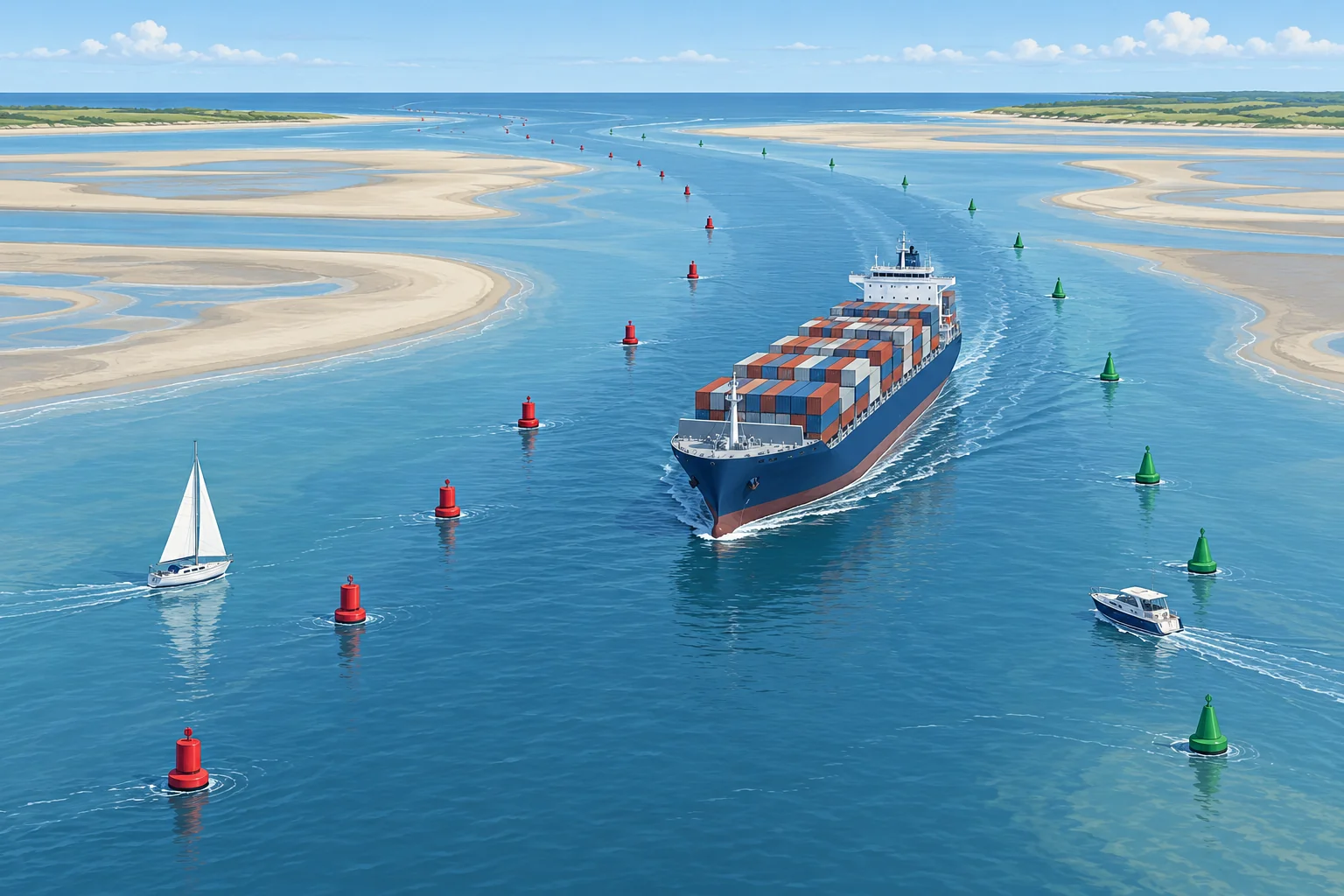
The Seeschifffahrtsstraßen (federal seaways) reach from the coast at mean high water to 3 nautical miles (NM) seaward of the baseline, the line used to measure the territorial sea. They also include the buoyed outer fairways in the territorial sea and listed river stretches: the Elbe up to Hamburg's port, the Weser up to Bremen, the Trave up to Lübeck, the Warnow and the Kiel Canal, among others. The Ems estuary has its own order. Hamburg's port has its own port rules.
Out to 12 NM
Beyond the general 3 NM boundary, outside buoyed outer fairways, only selected SeeSchStrO provisions apply. These include basic duties, signs, public-service exemptions, use of roadsteads (designated anchoring areas), dangerous-goods separation and police powers. The KVR still apply.
Listen to the traffic centres
Germany's estuaries are watched by Verkehrszentralen (traffic centres of the federal waterways administration). If your boat has a VHF radio, you must listen to their traffic information, given in German and on request in English. Then you must take it into account at once.
Alcohol and drugs
Do not skipper or perform bridge, deck or engine duties at or above 0.5 ‰ blood alcohol, 0.25 mg/l breath alcohol or 3.5 ng/ml THC in blood serum. THC is the main intoxicating substance in cannabis. Impairment bans these activities below those figures too. The substance-based ban has an exception for medicines taken as prescribed; impairment remains prohibited. These rules also cover jet skis, kites and windsurfers. Passenger-ship masters must start duty free of alcohol’s effects and drink none while on duty underway.
2Key data
- Seaward limit
- 3 NM beyond the baseline, plus buoyed outer fairways
- Alcohol and THC limits
- Alcohol: 0.5 ‰ blood / 0.25 mg/l breath; THC: 3.5 ng/ml serum
- Passenger-ship master on duty
- No drinking on duty underway; no alcohol effects at duty start
- Collision rules
- KVR (COLREG) apply unless the SeeSchStrO says otherwise
3Key points
- 1
The KVR apply everywhere; the SeeSchStrO adds to them and wins where the two differ.
- 2
Seaways run 3 NM beyond the baseline and up the listed estuaries and the Kiel Canal.
- 3
Outside buoyed outer fairways, only selected SeeSchStrO rules apply between 3 and 12 NM.
- 4
With VHF on board, listen to the traffic centre and promptly take its information into account.
- 5
Alcohol limit: 0.5 ‰ blood or 0.25 mg/l breath, also for jet skis and windsurfers.
4Frequent mistakes
Wrong: German coastal waters have their own collision rules instead of the COLREG.
Right: The KVR are the COLREG. The SeeSchStrO adds local rules and overrides the KVR where it expressly differs.
Wrong: Below 0.5 ‰ you are always fine to steer.
Right: Anyone impaired by alcohol or drugs may not steer, whatever the number. The 0.5 ‰ value is the hard limit, not a free pass.
5Practice case & exam keys
Your 9 m yacht has VHF. You plan to enter the Elbe fairway. The traffic centre reports a deep-draught ship approaching your entry point. You can wait safely outside its track. What do you change, and why?
Show the answer
Delay entry and wait in the safe water until the ship has passed. Keep listening and reassess before entering. Having VHF means you must listen to the traffic information and promptly take it into account; being a small pleasure boat gives no exemption.
Exam keys
- SeeSchStrO § 1: seaways to 3 NM beyond the baseline; KVR apply unless the SeeSchStrO says otherwise.
- § 3: VHF-equipped boats must listen to the Verkehrszentrale and promptly take its information into account.
- § 3(4): 0.5 ‰ / 0.25 mg/l alcohol and 3.5 ng/ml THC limits, also for jet skis, kites, windsurfers.
- Ems estuary and Hamburg's port follow their own rules.
Finish this unit
When you've read it, answer three questions. Get all three right to finish the unit; opening the page alone doesn't count.
My notes for this unit
No notes