

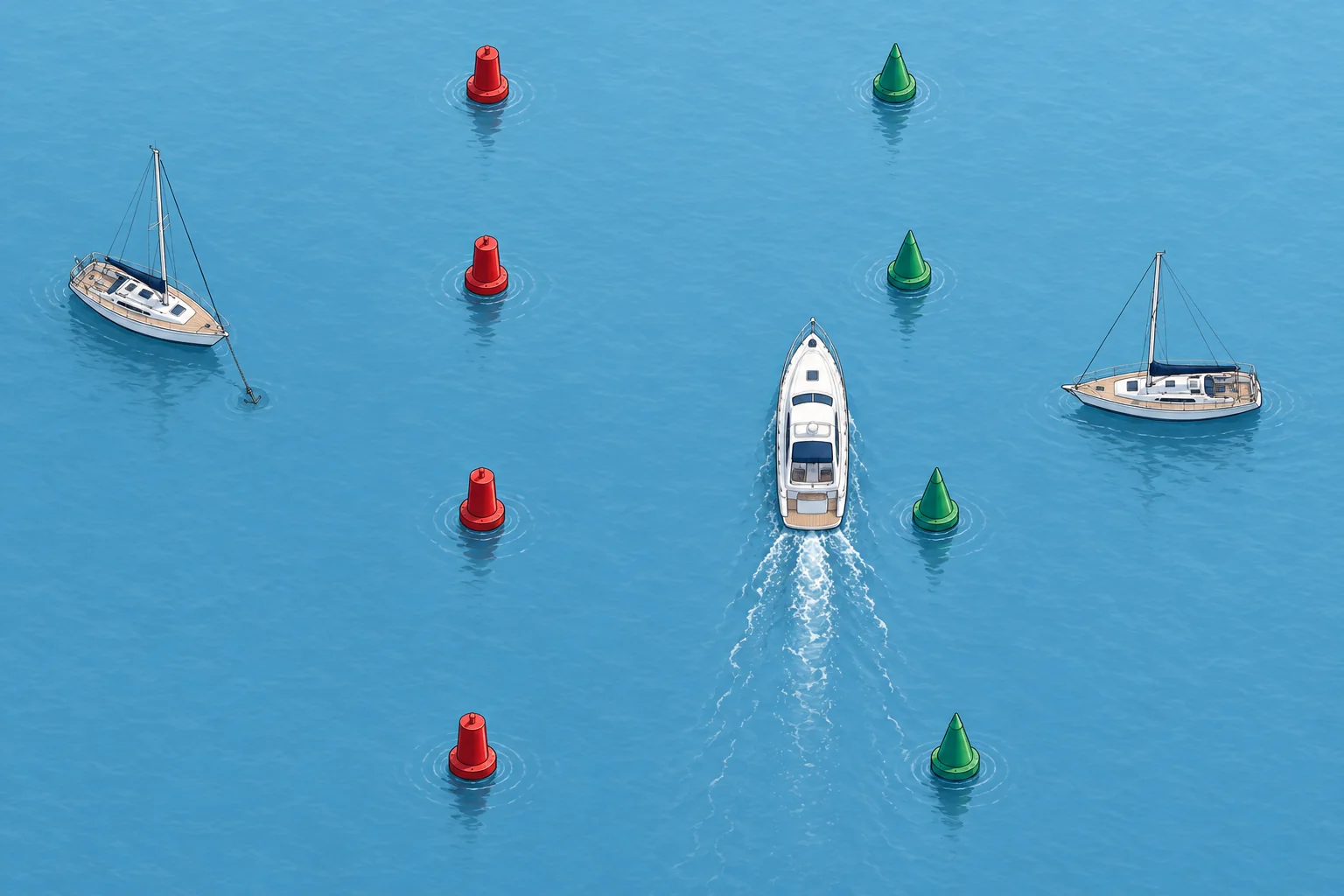
Fairway rules: keep right, give way to fairway traffic, don't anchor
1The lesson in plain words
In a German Fahrwasser the boat following the fairway has priority. Entering, crossing or turning means waiting, whatever your size or rig.
What a fairway is
A Fahrwasser (fairway) is water marked by lateral signs, or unmarked inland water meant for through navigation. Every fairway counts as a narrow channel under KVR Rule 9. Its starboard side is normally to your right coming from sea. Where it joins two sea areas or waters separated by shoals, the reference approach is from north through west, excluding south. If that fairway is strongly curved, its northernmost entrance sets the direction for the whole fairway. Check the chart.
Keep right, pass port to port
Keep to the right in your direction of travel, as far as safe. Outbound, this is the fairway's port side as defined from sea. Meet port to port by altering to starboard. Normally overtake to port; use starboard only when required. Do not overtake at narrows, blind bends, before or inside locks, near moving cable ferries or in prohibited stretches. Outside the fairway, make clear you are not using it.
Who has priority
A boat following the fairway has priority over boats that enter it, cross it, turn in it or leave a berth or anchorage. That holds even if the fairway boat could go elsewhere. It replaces the KVR crossing and sail-versus-power rules. Sailing boats that are not following the fairway apply the KVR among themselves, as long as they do not hinder fairway traffic.
Narrow places
If a narrowing cannot safely take both boats at once, or a sign prohibits meeting, the boat going with the current has priority. At slack tide, priority goes to the boat previously going against the stream. Wait outside until the other boat has passed.
No anchoring
Do not anchor in the fairway except in a permitted roadstead, a designated anchorage. Outside it, anchoring is banned at narrows and blind bends; within 300 m of floating equipment, wrecks, obstructions, cables and pipelines; within 100 m before or after tidal barriers; off harbour entrances, landing places, locks and sluices; in Kiel Canal approaches; and on ferry, bridge or locally prohibited stretches. In poor visibility, keep 300 m from overhead power lines.
2Step by step
Crossing a busy German fairway
- 1
Wait outside the buoy line and look both ways along the fairway.
Every boat following the fairway has priority over you.
- 2
Show early that you will wait; slow or hold position safely outside the fairway.
The give-way boat must show by its behaviour that it will wait.
- 3
Pick a gap that lets you cross without anyone changing course or speed.
You must not hinder fairway traffic, so judge the gap generously.
- 4
Once you have a safe gap, cross directly, allowing for wind and current.
Keep your time in the fairway short and make your intention clear.
- 5
Once across, stay outside the buoy line.
Outside the fairway you must make clear you are not using it.
3Key points
- 1
Every buoyed fairway counts as a narrow channel: keep right in your direction of travel.
- 2
Boats following the fairway have priority over those entering, crossing, turning or leaving a berth.
- 3
That priority overrides the KVR sail-over-power rule: a yacht crossing must wait.
- 4
If boats cannot safely pass simultaneously at a narrowing, or meeting is prohibited, the boat with the current has priority.
- 5
No anchoring in the fairway except in designated anchorages; many places outside it are banned too.
4Frequent mistakes
Wrong: Under sail I always stand on against a motor vessel, also when crossing a fairway.
Right: Fairway priority replaces the KVR sail-over-power rule. A yacht crossing or entering the fairway gives way to every boat following it.
Wrong: Overtaking is free on either side if there is room.
Right: Overtake on the other boat's port side as a rule; to starboard only when the situation requires it. Do not overtake at narrows or blind bends, before or inside locks, near moving cable ferries, or in prohibited stretches.
Wrong: A quick lunch stop at anchor beside the channel buoys is fine.
Right: Stopping for lunch does not remove the anchoring bans. Being outside the buoys does not make anchoring legal. Check the chart and local notices for cables, pipelines, entrances and other exclusions. Choose a permitted spot clear of the fairway.
5Practice case & exam keys
Under sail, you want to cross the buoyed Jade fairway. A motor cruiser approaches from your port side, following the fairway. Does being under sail give you priority here?
Show the answer
No. You must give way to the cruiser. A boat following the fairway has priority over a crossing boat, whatever its propulsion. This replaces the KVR sail-over-power rule. Show early that you will wait safely outside the buoy line. Let the cruiser pass, then cross directly when clear, allowing for wind and current.
Exam keys
- § 2: every Fahrwasser is a narrow channel under KVR Rule 9; starboard is normally right coming from sea. Through-channels: approach from north through west, excluding south; strongly curved ones use the northernmost entrance.
- § 25: fairway-following boats have priority over boats entering, crossing, turning or leaving a berth.
- § 23: normally overtake on the other boat’s port side. § 24: alter to starboard to pass port to port.
- § 32: fairway anchoring only in designated anchorages. Elsewhere: 300 m from floating equipment, wrecks, obstructions, cables and pipelines; 100 m before/after tidal barriers; 300 m from overhead power lines in poor visibility. Other listed and local bans apply.
Finish this unit
When you've read it, answer three questions. Get all three right to finish the unit; opening the page alone doesn't count.
My notes for this unit
No notes