

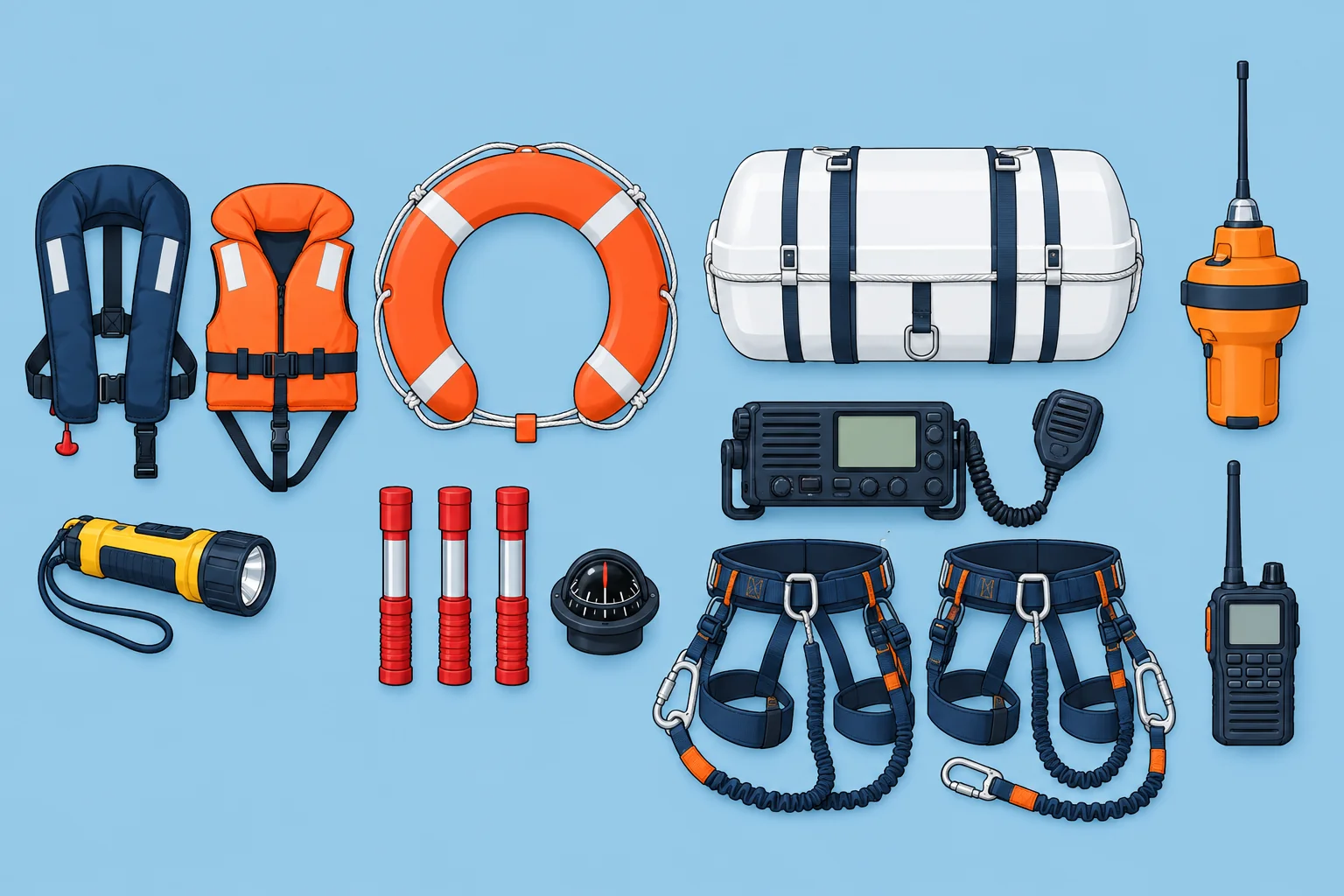
What each band adds to the kit
1The lesson in plain words
Basique starts the kit. Côtier adds flares; semi-hauturier adds a fixed marine VHF radio; hauturier an emergency position-indicating radio beacon (EPIRB).
Basique (under 2 NM)
For each person, carry an accessible level 50 (50 newtons) buoyancy aid or lifejacket (EIF), or wear a neoprene wetsuit or drysuit covering torso and abdomen, with positive buoyancy and thermal protection. Carry a waterproof 6-hour torch, or one waterproof 6-hour light per person, worn or fixed to their EIF. Add extinguishers specified by the owner's manual (annex 240-A.3 without a manual), a bucket or hand pump to remove water if the boat is not self-draining or has accommodation, a towing point and line, and ground tackle (anchor with chain/rope).
Anchoring and tides
Anchoring exemptions: sailing craft under 250 kg empty; motor craft under 250 kg and at most 4.5 kW. Carry today's local tide times and coefficients outside the Mediterranean.
Côtier (2 to less than 6 NM)
Levels rate buoyancy in newtons (N), not body weight. Add a compliant lifebuoy with its required light; at least level 100 EIFs each; three red hand flares; a waterproof magnetic steering compass, fixed in view of the helm with lighting; current official charts; RIPAM or summary; and a buoyage guide. Swimmers over 30 kg may instead wear level 50 EIFs or wetsuits/drysuits covering torso and abdomen, with thermal protection, at least 50 N intrinsic (built-in) buoyancy, and bright neck/shoulders or a permanently attached waterproof 6-hour light.
Semi-hauturier (6 to less than 60 NM)
Add level 150 EIFs for everyone, a fixed VHF marine radio, an inflatable liferaft for all on board, tools to find and mark your position on a chart, a light list (a directory of coastal navigation lights), a log book, a way to receive marine forecasts, a first-aid kit and a waterproof searchlight. A tether is a safety line connecting your harness to the boat. Sailing boats carry one harness and tether per person; motorboats carry at least one set.
Hauturier (60 NM and more)
Add a 406 MHz emergency position-indicating radio beacon (EPIRB) and waterproof handheld VHF. Your liferaft must seat everyone and meet ISO 9650 type I, be an eligible Division 333 class II raft, or be a Division 311-approved model. A compliant raft already aboard counts; you do not need a second. Satellite communication is recommended.
Rules for everyone
Children up to 30 kg need EIF 100 at any distance; from 6 NM the others need EIF 150. On outboards and jet skis, wear the fitted kill cord (engine-stop lanyard) whenever the engine runs; keep a spare accessible. Before leaving the helm, stop the engine or secure neutral so the propeller cannot engage. With wireless stops and others aboard, someone must remain at the helm. At sea, monitor VHF channel 16 whenever possible. Service gear on time. Keep portable gear accessible; install extinguishers as the owner's manual specifies.
2Step by step
Before you leave: check the kit against your route
- 1
Along your route, find the greatest distance to the nearest usable shelter.
That distance, not the distance from the coast, sets your band.
- 2
Count everyone aboard and check each child's weight.
You need an EIF of the right level each: level 100 for children up to 30 kg at any distance, and level 150 for the others from 6 NM.
- 3
Check expiry dates on flares, liferaft and EPIRB battery.
Gear must be in date and serviced to count.
- 4
If fitted, attach the kill cord and show the crew the spare.
It stops the propeller if you fall, and the spare lets them restart to pick you up.
- 5
Switch on the VHF and set channel 16.
At sea, keep watch on VHF channel 16 whenever possible.
3Key data
- EIF level by band
- Basique 50 · côtier 100 · semi-hauturier and hauturier 150
- Children ≤ 30 kg
- Level 100, at any distance from a shelter
- Hand flares
- 3 red hand flares from the côtier band
- Fixed VHF + liferaft
- From 6 NM (semi-hauturier)
- EPIRB + handheld VHF
- From 60 NM (hauturier)
- Light
- Waterproof, 6 h autonomy, in every band
4Key points
- 1
Basique: EIF 50 or qualifying suit, 6-hour waterproof light, extinguishers, bailing, towline, ground tackle; exemptions apply.
- 2
Côtier: lit lifebuoy, EIF ≥ 100 (worn alternatives apply), 3 flares, lit waterproof compass, charts, RIPAM, buoyage guide.
- 3
Semi-hauturier adds: EIF 150, fixed VHF, liferaft, log book, forecasts, first aid, harnesses.
- 4
Hauturier adds: 406 MHz EPIRB, handheld waterproof VHF, offshore-type liferaft.
- 5
Wear the kill cord while running. Before leaving, stop the engine or secure neutral against propeller engagement.
5Frequent mistakes
Wrong: Small children can wear the same level 50 aid as adults near the shore.
Right: Children up to 30 kg need a level 100 EIF at any distance, even close to shelter. From 6 NM, the others need level 150.
Wrong: A handheld VHF is enough for an offshore passage.
Right: From 6 NM you need a fixed VHF. From 60 NM you need a handheld waterproof VHF as well, plus an EPIRB.
Wrong: The kill cord can be lengthened so the driver can move around.
Right: Never lengthen or relocate the kill cord. Before leaving, stop the engine or secure neutral against propeller engagement.
6Practice case & exam keys
A family of four (two adults, children of 25 kg and 40 kg) takes a 7 m outboard boat 4 NM offshore from a shelter. On board: four level 50 buoyancy aids, a torch, an extinguisher, a bucket, an anchor and a towline. The kill cord lies on the dashboard. What must change?
Show the answer
At 4 NM, côtier applies. Carry level 100 EIFs; swimmers over 30 kg may instead wear level 50 aids. The 25 kg child needs level 100. Add a lit lifebuoy, 3 red hand flares, a lit waterproof steering compass fixed in view of the helm, charts, a RIPAM summary and a buoyage guide. Check that the torch is waterproof and lasts 6 hours. Outside the Mediterranean, add local tide times and coefficients. Wear the kill cord and keep a spare accessible.
Exam keys
- EIF minimums: 50 basique; 100 côtier (worn alternatives apply); 150 from 6 NM. Children ≤ 30 kg: level 100 at any distance.
- Côtier: compliant lit lifebuoy, 3 red hand flares, lit waterproof compass, official charts, RIPAM, buoyage guide.
- Semi-hauturier: fixed VHF, liferaft, log book, forecasts, first aid, harness per person on sailboats.
- Hauturier: 406 MHz EPIRB, waterproof handheld VHF; kill cord rule since the 2024 arrêté.
Finish this unit
When you've read it, answer three questions. Get all three right to finish the unit; opening the page alone doesn't count.
My notes for this unit
No notes