

Right of way under the BPR: starboard side first, then size, then type
1The lesson in plain words
First identify any snel schip, which gives way. For other boats, test starboard side first, then size, then type.
The rule book
Most Dutch inland waterways follow the BPR (Binnenvaartpolitiereglement, inland navigation regulations), based on CEVNI, the European inland navigation code. A klein schip (small craft) is normally under 20 m. Some shorter vessels also count as large. These include ships certified for more than 12 passengers, certain ferries and push barges. They also include fishing vessels whose gear restricts manoeuvring, and vessels towing, assisting, pushing or carrying a large ship alongside. A snel schip, a large motor vessel able to exceed 40 km/h, gives way to everyone.
Step 1: the starboard side
For ordinary head-on and crossing encounters, apart from a snel schip, the boat not following the starboard side of the fairway gives way to the one that is when collision is possible. Keep to starboard: it gives you priority over other ordinary boats and makes you predictable. Crossings involving ferries, turning, leaving a berth or joining a main fairway have separate rules.
Step 2: small gives way to large
A groot schip (large ship) is at least 20 m long or belongs to an exception above. If neither boat keeps to the starboard side, a small craft gives way to a large one. When a large ship shows a light-blue board with a white flashing light, it asks to pass starboard to starboard. A small craft must then give way, preferably by doing as asked.
Step 3: among small craft
If neither keeps to starboard, a small motorboat gives way to small sailing boats and human-powered craft, such as rowing boats and canoes, and a human-powered craft gives way to a sailing boat. Two small motorboats head-on both turn to starboard; crossing, the one coming from port gives way.
Sailing boats and Dutch words
Between two small sailing boats, apply the starboard-side test first. If neither follows that side and collision is possible, the boat with wind from port gives way when tacks differ. On the same tack, windward (nearer the wind) gives way to leeward (farther from the wind). Dutch names the tack by the boom: over bakboord means boom to port, wind from starboard; over stuurboord means the reverse. Remember: "stuurboord wijkt voor bakboord".
2Key data
- Small craft (klein schip)
- Normally under 20 m; certain vessel types count as large
- Order of priority
- Snel schip gives way; others: starboard side → size → type
- Among small craft
- Motor gives way to human-powered craft; both give way to sail
- Snel schip
- Large motor vessel able to exceed 40 km/h: gives way to all
- Light-blue board
- Large ship asks to pass starboard to starboard
3Key points
- 1
A snel schip gives way to all. For other boats, test starboard side first, then size, then type.
- 2
If neither keeps to starboard, small craft give way to large ones.
- 3
Among small craft, motor gives way to sail and human-powered craft, and human-powered craft gives way to sail.
- 4
A light-blue board from a large ship: give way, preferably passing starboard to starboard.
- 5
If neither small sailing boat follows the starboard side, over stuurboord gives way to over bakboord when collision is possible.
4Frequent mistakes
Wrong: Sail always has right of way over motor, so I can cut across a barge's bow under sail.
Right: A snel schip gives way to all. For other boats, starboard side comes first, then size. Sail over motor applies only between small craft when neither keeps to starboard.
Wrong: A Dutch sailor 'over stuurboord' has the wind from starboard, so she has priority.
Right: Dutch names the tack by the boom. Over stuurboord means boom to starboard, wind from port. Between small sailing boats on opposite tacks, it gives way if neither follows the starboard side and collision is possible.
5Practice case & exam keys
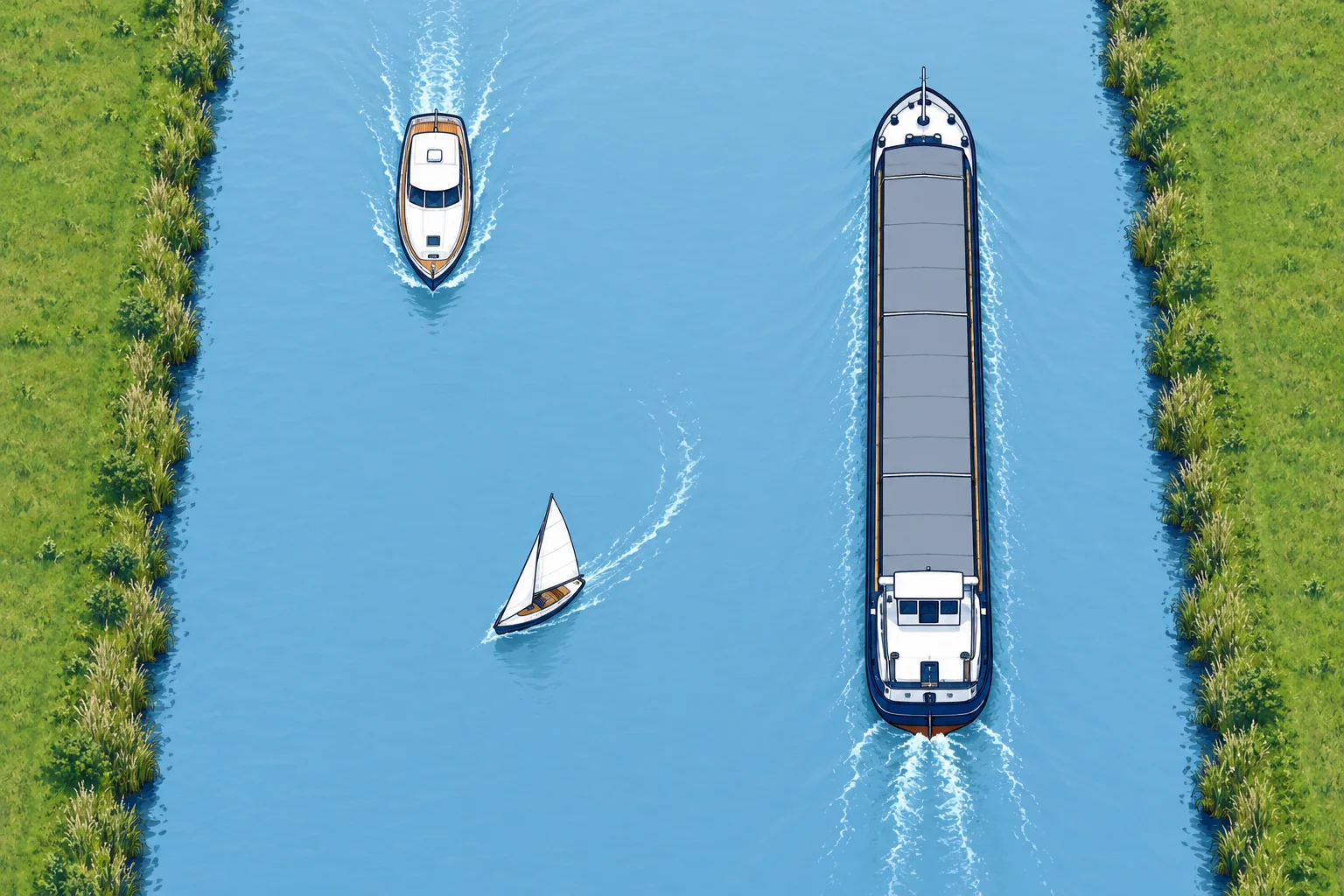
On a wide Frisian canal you sail a 7 m dinghy close-hauled near the middle. A 9 m motor cruiser comes the other way, keeping to its starboard side of the canal. Behind it, a 110 m barge shows a light-blue board on its starboard side. Who gives way?
Show the answer
Give way to the cruiser because it follows its starboard side. Also give way to the blue-board barge, preferably passing starboard to starboard. These passes may require different tracks. Slow or wait in a safe position until both ships’ intentions and passing room are clear. Do not turn automatically to starboard.
Exam keys
- BPR 6.04 and 6.17: except for a snel schip, the boat not following the starboard side gives way to the one that is.
- Then small gives way to large; among small craft motor gives way to sail and human-powered craft, human-powered craft to sail.
- BPR 6.02: a snel schip (large motor vessel > 40 km/h) gives way to all other vessels.
- BPR 6.04a: light-blue board plus white flashing light = request to pass starboard to starboard.
Finish this unit
When you've read it, answer three questions. Get all three right to finish the unit; opening the page alone doesn't count.
My notes for this unit
No notes