

Dutch waterway signs in five families, and the ones visitors miss
1The lesson in plain words
BPR signs come in five families, A to E. Learn the families by shape and colour, then the few that small boats meet every day.
Five families
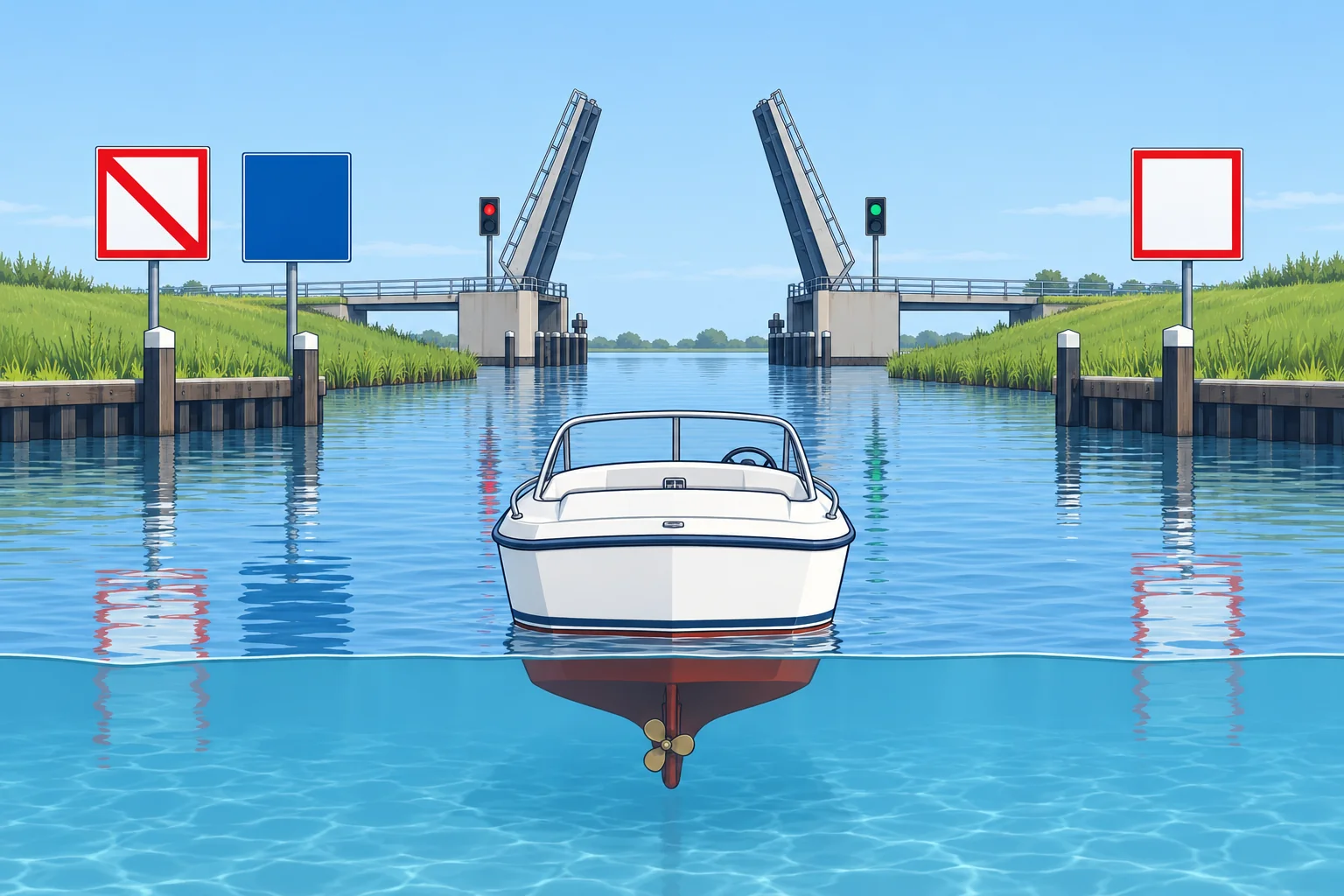
Annex 7 groups BPR signs by purpose. A prohibits: usually white boards with red borders or bars. B commands: usually red-bordered white boards without a slash. C restriction boards have red borders, white backgrounds and black symbols. D recommendations include yellow diamond marks at bridge openings. E informs or permits: usually blue boards, with E.1 using green and white. Learn each symbol as well as its colour.
Stop and go
A.1, a board with red–white–red bands or red lights, means no passage. E.1, a board with green–white–green bands or green lights, permits passage. Steady red and green together normally mean wait: permission will follow shortly. At bridges, yellow lights above the opening can permit boats low enough to pass beneath the closed span despite red signals. Read the complete display and pass safely.
Signs for small craft
A.13 bans small craft, A.15 bans sailing boats, A.14 bans water skiing and A.17 bans windsurf boards. Their E-sign twins allow them: E.16 small craft, E.17 water skiing, E.18 sailing and E.20 windsurfing. B.6 sets a speed limit in km/h, common in canals and towns.
Fast-boating signs
E.21 marks fast-boating water; A.18 marks its end. The normal maximum for fast motorboats is 20 km/h unless the competent authority permits faster boating on that stretch. Check the permitted times, any local speed limit and any lower limit shown by B.6. Times, such as daytime only, appear on boards below the sign.
Local rules on top
Provinces, water boards and towns add lower limits, mooring rules and closures. Check vaarweginformatie.nl for navigation notices and lokaleregelgeving.overheid.nl for local regulations. The Wateralmanak is a commercial guide, not an official publication.
2Key data
- A / B / C / D / E
- Ban / command / limit / recommendation / information
- A.1 / E.1
- No passage / passage allowed
- B.6
- Speed limit in km/h
- E.21 / A.18
- Fast boating allowed / end of fast-boating water
- E.17 / A.14
- Water skiing allowed / water skiing banned
3Key points
- 1
A bans, B commands, C limits, D recommends, E informs or permits.
- 2
A.1 prohibits passage; E.1 permits passage when it is safe.
- 3
A.13 bans small craft and E.16 allows them; A.15 and E.18 do the same for sail.
- 4
B.6 shows a speed limit in km/h; check the board below for times and exceptions.
- 5
E.21 opens fast-boating water; A.18 ends it.
4Frequent mistakes
Wrong: A red light at a lock only applies to commercial ships.
Right: A.1 red applies to everyone, small craft included. Wait well clear until the displayed signal permits passage.
Wrong: An E.21 sign means there is no speed limit at all.
Right: E.21 marks fast-boating permission, often only at set times. Check the designation and its conditions. Safe speed and local limits, including B.6, still apply.
5Practice case & exam keys
Leaving Loosdrecht in your 6 m speedboat, you see E.21 with a board 'Mon–Fri 09:00–19:00'. It is Sunday 11:00. Further on, B.6 shows 9. Assume no other designated exception or restriction applies. How fast may you go on the open lake and after B.6?
Show the answer
The E.21 permission is inactive on Sunday. With no other designated exception, the maximum is 20 km/h before the B.6 sign and 9 km/h after it. Go slower if conditions require.
Exam keys
- BPR annex 7: A ban, B command, C limit, D recommendation, E information/permission.
- A.1 no passage, E.1 passage allowed; B.6 speed limit in km/h.
- A.13 / E.16 small craft; A.15 / E.18 sail; A.14 / E.17 water skiing; A.17 / E.20 windsurfing.
- E.21 fast boating allowed for small motor craft; A.18 end of it.
Finish this unit
When you've read it, answer three questions. Get all three right to finish the unit; opening the page alone doesn't count.
My notes for this unit
No notes