

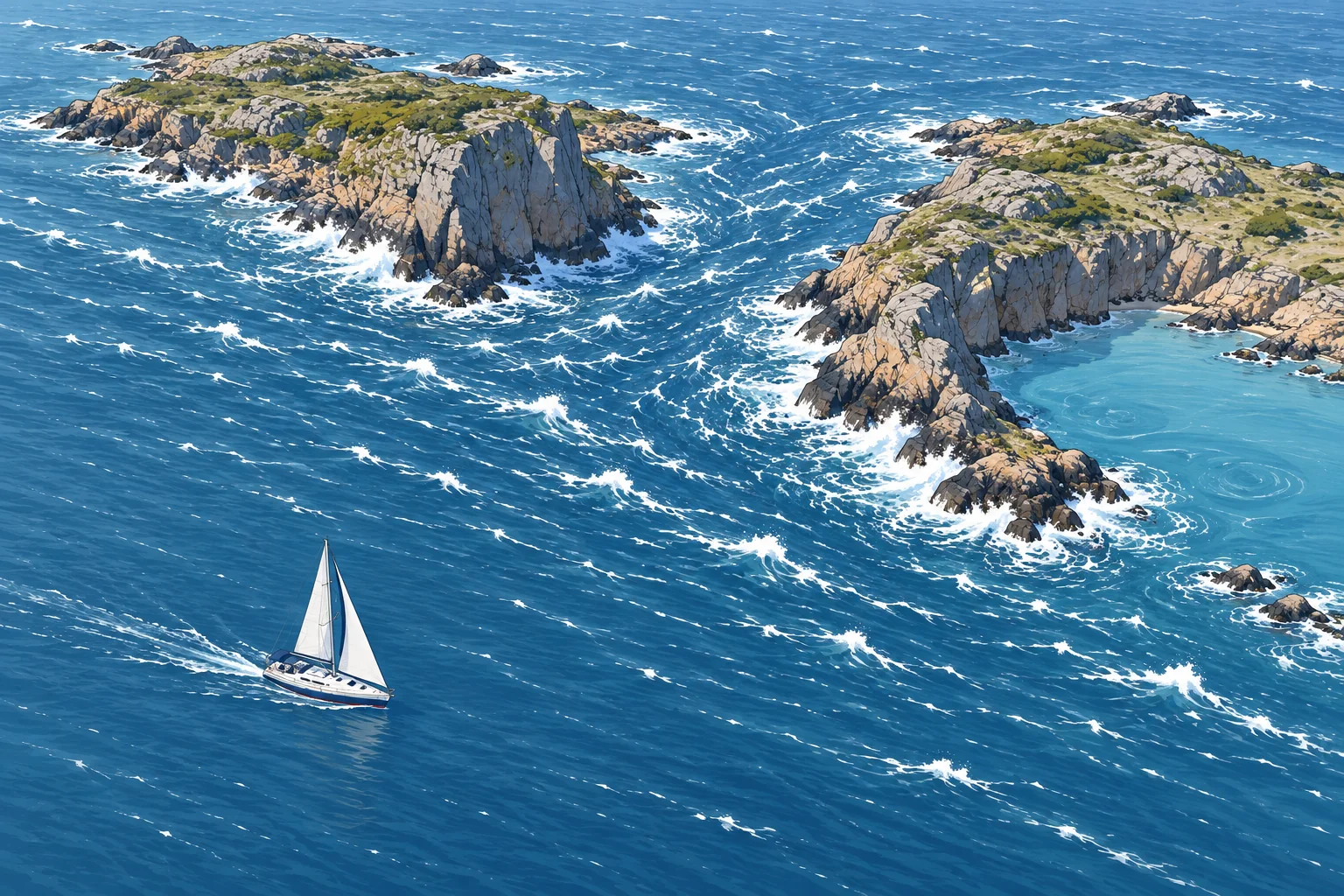
Funnelling, headlands and wind shadows
1The lesson in plain words
Land bends and squeezes the wind. Expect stronger wind in gaps and off headlands, shadows and eddies in the lee, or downwind side, of high land.
Funnelling
When wind is forced through a narrow gap, such as a strait, a channel between islands or a valley, it speeds up. This is funnelling. It also turns to follow the gap. Wind in a strait can be much stronger than offshore; a local forecast may already include this acceleration.
Headlands
Where wind is forced around an exposed headland or island corner, it can speed up and change direction. This is the corner effect. Allow room off exposed headlands in fresh wind.
Wind shadows
On the lee, or downwind side, of high land, cliffs or tall buildings, the wind may be light or calm, then turn gusty and swirling. Close under high cliffs, strong gusts can drop steeply onto the water. Shore height alone does not guarantee steady wind or suitable shelter.
Along the coast
In the Northern Hemisphere, friction turns the wind farther anticlockwise over land than over sea: it backs. With your back to a wind blowing along the coast, land on your right makes the flows converge, or come together: stronger wind and often more cloud near shore. Land on your left makes them diverge, or spread apart: lighter wind.
Reading the chart
Before a passage, mark gaps, headlands and high land on the chart. Ask where the forecast wind will be squeezed, where it will be blocked and where it will turn. Plan reefs before the headland, not off it.
2Key data
- Funnelling
- Faster wind in straits, channels and valleys
- Corner effect
- Exposed corners can bring stronger wind and shifts
- Lee of high land
- Calm patches, then gusty, swirling wind
- Coastal convergence (NH)
- Back to wind, land on right: stronger near shore
- Coastal divergence (NH)
- Back to wind, land on left: lighter near shore
3Key points
- 1
Funnelling speeds the wind up in gaps and straits.
- 2
Headlands can strengthen the wind and change its direction.
- 3
The lee of high land may contain calm patches and strong, swirling gusts.
- 4
NH, back to wind along the coast: land on right → stronger wind.
- 5
Plan reefs before the headland or gap.
4Frequent mistakes
Wrong: The open-sea forecast holds in a narrow strait.
Right: Check the strait-specific forecast and warnings. Do not automatically add one or two forces to a forecast already covering the strait.
Wrong: Sailing close under high cliffs gives the calmest water in a strong wind.
Right: Cliff lee can contain strong, swirling gusts. Keep clear of the turbulent zone and choose shelter for the expected wind direction, with room to manoeuvre.
5Practice case & exam keys
The open-sea forecast west of the Strait of Bonifacio gives a westerly force 5. You plan to motor-sail east through the strait, between Corsica and Sardinia. What should you check?
Show the answer
Westerly winds can strengthen through the strait and around headlands. Check the local strait forecast and warnings; force 5 offshore does not fix the strength inside. Reduce sail before entering if needed, keep clear of rocks and islets, and identify a sheltered alternative.
Exam keys
- Funnelling: wind accelerates and turns through gaps, straits and valleys.
- Wind forced around exposed corners can accelerate; high land creates gusty wind shadows.
- NH coastal convergence: back to the wind along the coast with land on the right gives stronger wind.
Finish this unit
When you've read it, match the terms, then answer three questions. Get them all right to finish the unit; opening the page alone doesn't count.
My notes for this unit
No notes