

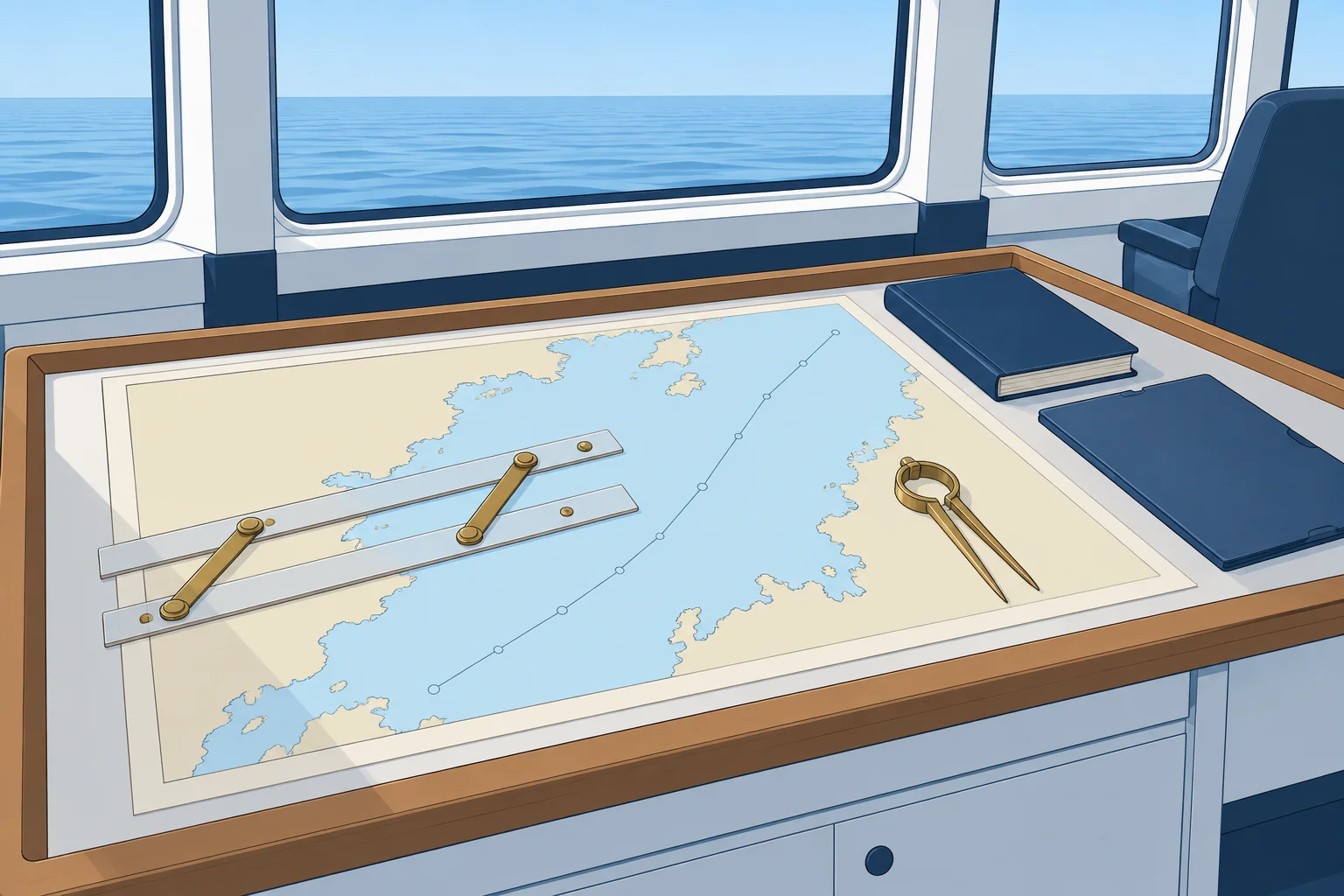
Taking over the watch and the master's orders
1The lesson in plain words
Arrive early, let your eyes adjust and check the position, plan and traffic yourself. Never take over in the middle of a manoeuvre.
Ready to relieve
Arrive early and fit for duty. Do not take over until your eyes are fully adjusted; at night, allow roughly 20–30 minutes after bright light, and longer if needed. Check that every member of your incoming watch is fit and has adjusted night vision. The outgoing OOW must not hand over to a relief who seems unable to keep the watch through tiredness, illness or drink, and must tell the master.
What you check
Read the master's standing orders, night orders and special instructions. Personally check position, intended track, course, speed and draught, the hull's depth below the waterline; present and forecast tides, currents, weather and visibility; traffic and expected hazards; bridge engine-control procedures and unattended machinery space (UMS) controls where fitted; operating condition of all navigation and safety equipment in use or likely to be used; and gyro and magnetic compass errors. Check under-keel clearance, the water between keel and seabed, including the effects described next.
Clearance checks
Heel is sideways lean; trim is the difference between forward and aft draughts. Squat is extra sinkage and change of trim when moving through water. Changes in water density also change draught. Before accepting the watch, check how these affect your under-keel clearance.
Not during a manoeuvre
If a manoeuvre or other action to avoid a hazard is under way at changeover time, the relief is deferred until that action is complete. The outgoing OOW keeps the watch; the relief can help as lookout. Then hand over at a quiet moment with clear words, for example 'You have the watch', and log the time. The rating's view of the same handover is in Watch ratings.
Standing and night orders
The master's standing orders set the rules for every watch: when to call the master, minimum passing distances, fixing intervals, use of engines and steering. Each OOW reads and signs them on joining. Night orders are written each evening for that night: expected landfall, traffic, weather and extra call points. Read and sign them before taking over. Night orders normally add instructions for that night. If they appear to conflict with standing orders, ask the master to clarify before taking over.
The master on the bridge
As OOW, you keep responsibility for the navigational watch even with the master on the bridge, until the master clearly takes over and both of you understand it. The master's overall responsibility continues throughout. On a small ship the master often comes up for a look. Ask rather than guess: 'Captain, are you taking over responsibility for the navigational watch?' Confirm the answer explicitly.
2Step by step
Taking over a navigational watch
- 1
Arrive early and let your eyes adjust to the light.
STCW forbids taking over before your vision is fully adjusted.
- 2
Read the standing orders, night orders and any special instructions.
They set the call points and limits for your watch.
- 3
Check the position, the plan ahead, course, speed and draught.
You must know where the ship is and where the dangers are.
- 4
Check present and forecast conditions, UMS controls where fitted, and equipment needed during the watch.
These change how the ship follows her track and what you can rely on.
- 5
Compare nearby ships' positions and movements and review collision risks with the outgoing OOW.
You need a shared traffic picture before taking responsibility.
- 6
Take over with clear words at a quiet moment, then log the time.
Responsibility must pass openly, never in the middle of a manoeuvre.
3Key points
- 1
Do not take over until your eyes have fully adjusted to the light.
- 2
Check position, plan, traffic, weather, compass errors and under-keel clearance yourself.
- 3
If a manoeuvre is under way, the relief waits until it is complete.
- 4
Night orders normally add to standing orders. Read and sign both; ask the master to clarify any apparent conflict.
- 5
With the master on the bridge, you keep the watch until the master clearly takes over.
4Frequent mistakes
Wrong: The outgoing OOW's summary is enough; you can check the details later.
Right: STCW says the relief shall personally satisfy themselves about position, plan, traffic and conditions before taking over.
Wrong: Once the master is on the bridge, the master is in charge.
Right: The OOW keeps responsibility for the navigational watch until the master clearly takes over and both understand it.
5Practice case & exam keys
At 2358 you arrive to relieve the watch. The OOW is altering course to starboard for a crossing ship 2 miles off on the starboard bow, and says 'Quick, you have it, I'm off.' What do you do?
Show the answer
Do not take over. A manoeuvre to avoid a hazard is in progress, so the relief is deferred until it is complete. Act as an extra lookout, let your eyes adjust, and read the orders. When the crossing ship is past and clearing, take the full handover: position, plan, traffic, weather and equipment. Then take over with clear words and log the time.
Exam keys
- Relief only with vision fully adjusted.
- Relief deferred while a manoeuvre or avoiding action is in progress.
- OOW keeps responsibility for the navigational watch until the master clearly takes over.
Finish this unit
When you've read it, match the terms, then answer three questions. Get them all right to finish the unit; opening the page alone doesn't count.
My notes for this unit
No notes