

Provisioning and self-sufficiency on an ocean passage
1The lesson in plain words
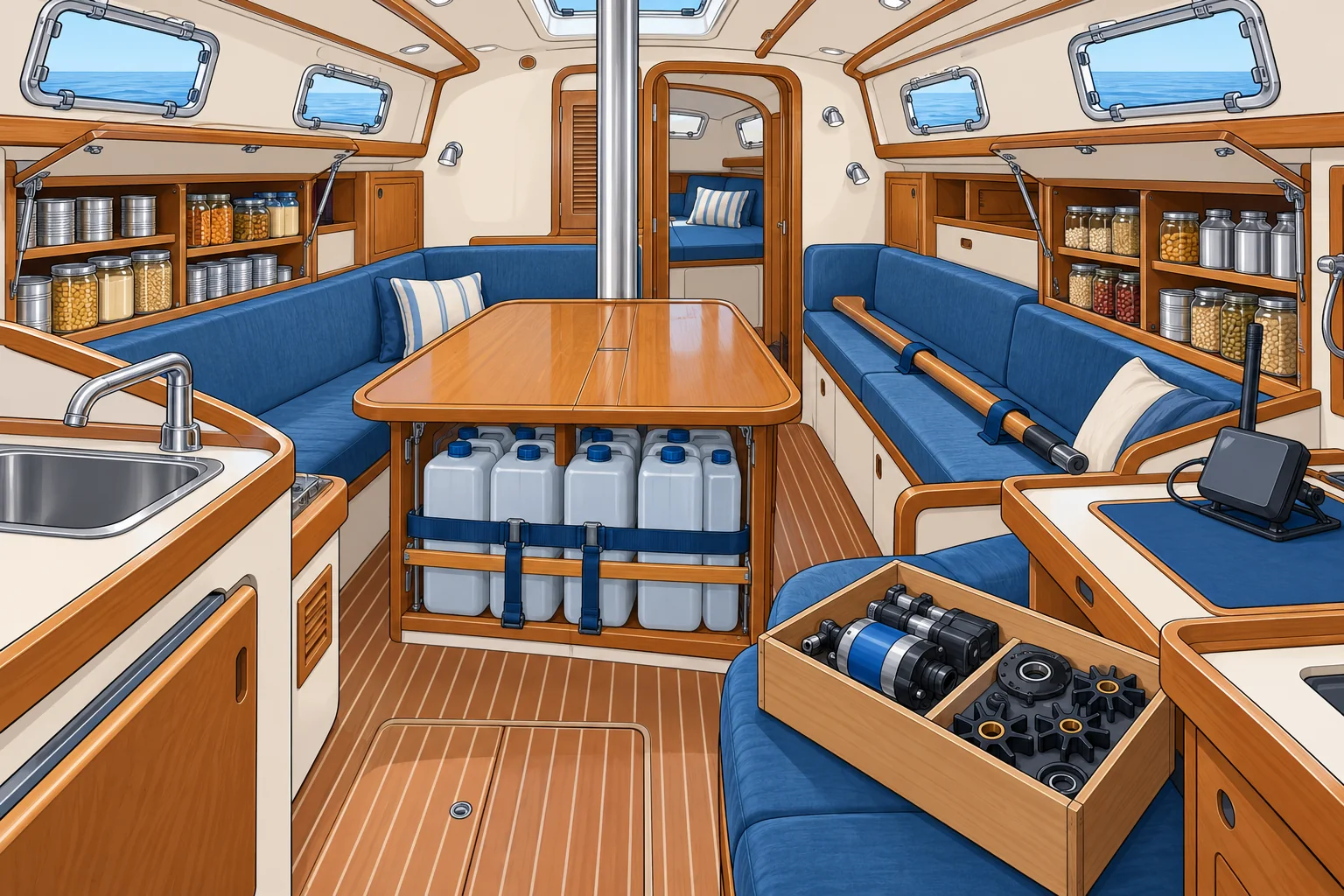
Far from help, you need supplies and repair options for weeks. Plan water, food, fuel, energy, spares, medical care and communications with a margin.
Plan the time
Start with the time at sea. Divide the distance by a realistic day's run, not the best one. Add a margin for calms, headwinds and repairs: 25 % or more is common. The Offshore planning unit covers watch systems and fatigue; World Sailing's Category 0 and 1 regulations set a benchmark for equipment.
Water
Water is the first item. World Cruising Club's planning guidance is at least 5 litres per person per day. Split it between tanks and separate sealed containers, so one leak or contamination cannot lose it all. A watermaker, which makes fresh water from seawater, is a bonus, not the only source. Keep emergency water in the grab bag.
Food, fuel and energy
Plan meals for the whole time plus the margin, with food that keeps without a fridge. Carry fuel for calms such as the doldrums, for charging and for the final approach. Make an energy budget: the daily use of every device, against what the engine, solar panels and generators can supply.
Spares and repairs
Far from repair services, you must handle essential repairs yourself. Carry spares and tools for the engine, steering, rig, sails, pumps, toilet and watermaker, plus a way to steer if the rudder fails. Inspect the rig and steering before leaving and at sea. A medical kit and a plan for radio medical advice belong here too; the Medical module covers them.
Communications
Plan how you will receive forecasts, call for help and send reports offshore. Agree report times with someone ashore and what they should do if a report is missed. The GMDSS ocean communications unit covers equipment choices.
2Key data
- Passage time
- Distance ÷ realistic day’s run, plus a suitable delay margin
- Water
- At least 5 L per person per day (WCC planning guidance)
- Storage
- Split between tanks and separate sealed containers
- Watermaker
- A bonus, never the only water source
- Energy budget
- Daily use of each device vs. charging sources
3Key points
- 1
Estimate passage time from a realistic day’s run, then add a margin for expected delays.
- 2
Water first: plan at least 5 litres per person per day, split between tanks and containers.
- 3
Carry fuel for calms, charging and the approach; balance an energy budget.
- 4
Carry spares and tools for every vital system, plus emergency steering.
- 5
Plan offshore communications and agree report times with a contact ashore.
4Frequent mistakes
Wrong: With a watermaker you only need a small water reserve.
Right: Watermakers fail. Carry enough water for the passage without it, split between tanks and containers.
Wrong: Plan provisions on your fastest day's run.
Right: Plan on a realistic average and add a margin for calms, headwinds and repairs.
5Practice case & exam keys
Four crew plan the 2,700-mile crossing from Las Palmas to Saint Lucia in a 12 m yacht that averages 5.6 knots. Only 400 litres are stored, but the watermaker works. Are you ready?
Show the answer
At 5.6 knots, your day’s run is 134.4 nautical miles. The crossing takes about 20.1 days; adding 25 % gives about 25.1 days. Round up to 26 days for provisioning. Four crew need at least 4 × 5 × 26 = 520 litres of stored water. The 400 litres falls short. Add water and split it between tanks and separate sealed containers; do not count on the watermaker.
Exam keys
- Passage time = distance ÷ realistic day’s run, plus a suitable margin; 25 % in the worked example.
- Water: at least 5 L per person per day, in tanks and separate containers; a watermaker is a bonus.
- Fuel for calms and charging; a daily energy budget.
- Spares and tools for vital systems, emergency steering and ocean communications.
Finish this unit
When you've read it, match the terms, then answer three questions. Get them all right to finish the unit; opening the page alone doesn't count.
My notes for this unit
No notes