

Position lines: the building blocks of a fix
1The lesson in plain words
A position line is any line you know you are on. Cross two or more taken at the same time and you have a fix.
What it is
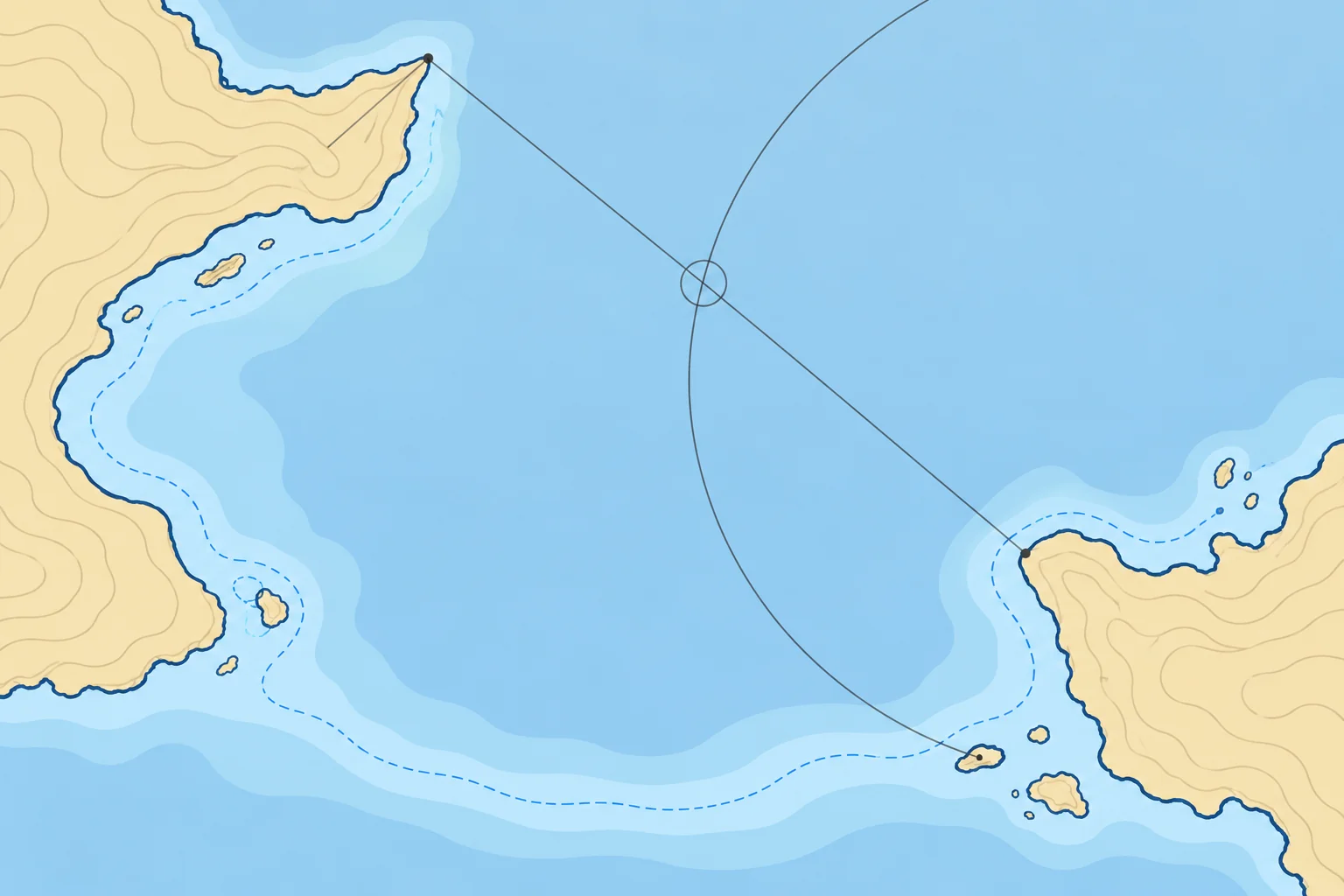
A position line (PL, also called a line of position) is a line on the chart somewhere along which you know you were at a given time. On its own it does not say where along the line. The point where two or more position lines taken at the same time cross is a fix: a position found from observations of the outside world, not from estimates.
Four common kinds
A compass bearing of a charted object gives a straight line through it. A transit, two charted objects seen in line, gives the most accurate straight line. A range (your distance from an object, usually by radar) gives a circle around it. A depth contour, a charted line joining points of equal depth, gives a line you can match with the echo sounder. Spanish courses call contours veriles or isobatas.
The angle of cut
Two lines crossing at a shallow angle leave a long, thin area of doubt: a small error in either line moves the crossing a long way. Aim for two lines crossing at about 90°, or three at about 60° to each other. Avoid lines that cross at less than about 30°.
Marking a fix
Draw a small circle round the crossing point and write the time beside it, for example ⊙ 14:20, and write the fix in the log. Schools differ on the other symbols: RYA courses mark an estimated position with a triangle, while Bowditch marks a DR position with a semicircle and an estimated position with a square. Use one set consistently on board.
2Key data
- Bearing
- Straight line through the object
- Transit
- Straight line through both objects; the most accurate
- Range
- Circle centred on the object
- Angle of cut
- Two lines about 90°; three about 60°
- Fix symbol
- Small circle round the crossing, with the time
3Key points
- 1
A position line says you are somewhere on it; crossing lines give a fix.
- 2
Bearings and transits give straight lines; a range gives a circle.
- 3
Cross lines near 90° (two) or 60° (three); avoid shallow cuts.
- 4
Mark a fix with a small circle and the time.
4Frequent mistakes
Wrong: Any two bearings make a good fix.
Right: Lines crossing at a shallow angle magnify every error. Choose objects so the lines cross near 90°.
Wrong: A depth sounding fixes your position.
Right: A depth gives a position line only where the contours are clear, and you still need a second line.
5Practice case & exam keys
You can see two charted objects: a headland 10° on the port bow and a beacon 15° on the starboard bow. Is a two-bearing fix from them reliable?
Show the answer
No. Both are nearly ahead, so the bearings differ by only about 25° and the lines cross at a shallow angle. A 2° error in either moves the fix a long way along your track. Look for an object nearer the beam (the boat’s side), or take a radar range of one of these objects, so the lines cross closer to 90°.
Exam keys
- Position line: you were somewhere on it at that time.
- Fix: two or more position lines, taken at the same time, crossing.
- A range gives a circle; a bearing or transit gives a straight line.
- Best cut: about 90° for two lines, about 60° for three.
Finish this unit
When you've read it, match the terms, then answer three questions. Get them all right to finish the unit; opening the page alone doesn't count.
My notes for this unit
No notes