

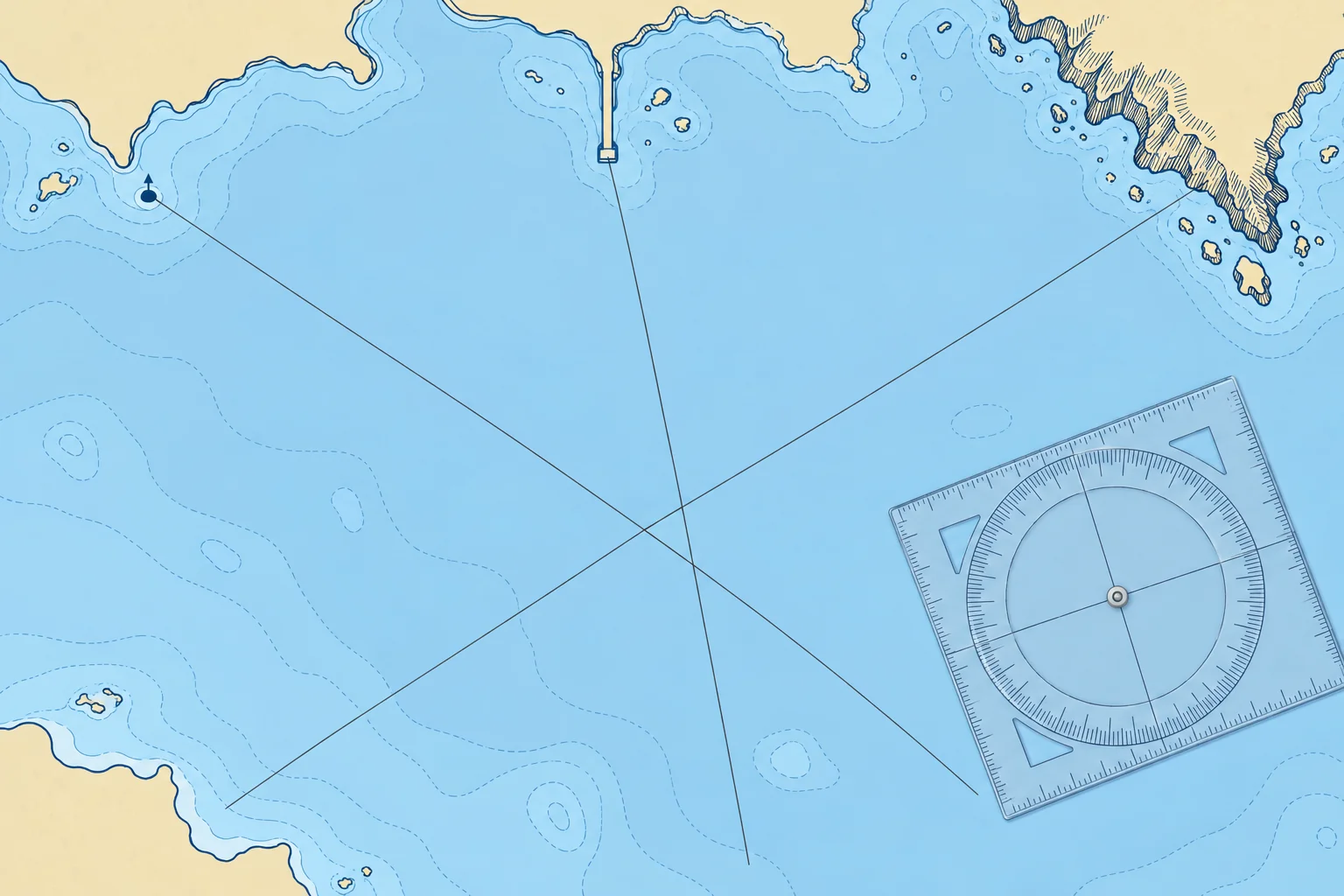
The three-point fix and the cocked hat
1The lesson in plain words
Three bearings provide a useful check. Their triangle can reveal inconsistency, but cannot prove accuracy.
Choosing objects
Pick three charted objects you can identify for certain: a steep headland edge, a beacon, a tower, a pier end. Avoid buoys, which can drag or be out of position, and gently sloping points whose edge is hard to judge. Nearer objects reduce angular errors: at 6 nautical miles (M), a 1° error shifts the line about 0.1 M, or one cable. Choose objects about 60° or 120° apart.
Taking them
Plan the order first. Take the bearings quickly, one after the other. Start with the objects nearest ahead or astern, whose bearings change slowly, and finish with the one nearest the beam, whose bearing changes fastest. Note each bearing and the time of the last. Then convert to true and plot.
The cocked hat
Three lines rarely meet at one point. They form a small triangle called a cocked hat. Its size shows disagreement between the plotted lines, not the full position error. A large one means a mistake: a wrongly identified object, a misread figure, variation applied the wrong way, or bearings taken too far apart in time.
Using it safely
Use the corner nearest danger as a cautious working position, not a boundary: you may be outside the triangle. Allow extra clearance. If the triangle is large, do not average it: check the objects and your arithmetic, then take a new set. A tiny cocked hat can still hide an error common to all three lines, such as unknown compass deviation, so check independently with the depth too.
Two bearings only
A two-bearing fix has no check: two lines always cross somewhere, even when one is wrong. Use it only at a good angle, and confirm it with a sounding or a third line as soon as you can.
2Key data
- Spread
- Three objects about 60° or 120° apart
- Order
- Ahead or astern first, nearest the beam last
- Error with distance
- 1° ≈ 1 cable at 6 M, 2 cables at 12 M
- Cocked hat
- Nearest-danger corner: working reference; you may lie outside
3Key points
- 1
Use three certain, charted, fixed objects about 60° or 120° apart.
- 2
Take bearings quickly: ahead or astern first, nearest the beam last.
- 3
Use the nearest-danger corner as a working assumption, not a boundary; you may be outside the cocked hat.
- 4
A large cocked hat means a mistake: check and re-take, never average.
- 5
A two-bearing fix has no built-in check.
4Frequent mistakes
Wrong: Take the beam bearing first, while the object is easy to see.
Right: Take it last: it changes fastest, so it should be the closest to the time you record.
Wrong: Put the fix in the middle of the cocked hat.
Right: Use the nearest-danger corner as a working assumption, not a boundary: you may be outside. Keep extra clearance and re-take the bearings if the triangle is large.
Wrong: Buoys make ideal fix objects.
Right: Buoys can drag or be out of position. Prefer fixed, charted marks.
5Practice case & exam keys
Crossing a bay, you take bearings of a pier end 30° off the bow, a beacon abeam and a headland 30° off the stern. Plotted, they form a triangle almost 1 M across, 2 M from a reef.
Show the answer
Too big to trust. Check each object’s identity, your figures and the variation sign, then take a new set quickly: pier and headland first, the beacon abeam last. The corner nearest the reef is a working assumption, not a boundary: you may lie outside the triangle. Keep extra clearance. Compare a sounding, corrected for sounder offset and tide, with the chart to help confirm the new fix.
Exam keys
- Three fixed, certain objects about 60° or 120° apart.
- Bearings ahead or astern first, beam last; note the time of the last.
- Cocked hat: nearest-danger corner is a working assumption, not a boundary; you may be outside.
- A large cocked hat: check and re-take; never average it.
Finish this unit
When you've read it, match the terms, then answer three questions. Get them all right to finish the unit; opening the page alone doesn't count.
My notes for this unit
No notes