

Headlands, races and timing a passage
1The lesson in plain words
Streams run hardest off headlands and through narrows. Time your passage so the stream carries you round, close to slack if the sea there can be rough.
Why headlands
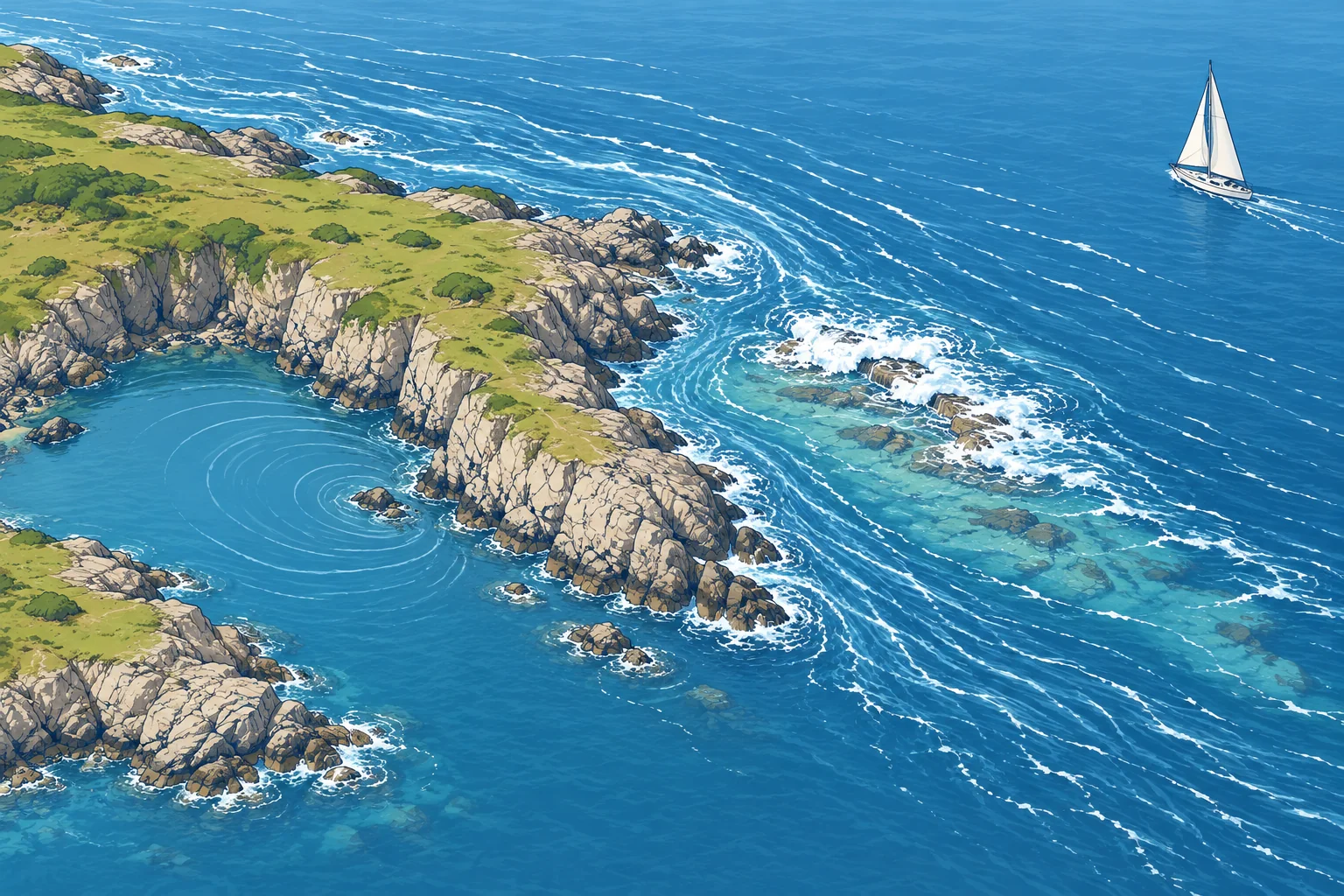
Water flowing along a coast speeds up as it squeezes round a headland or through a narrow channel. Rates off a headland can be much higher than a few miles away, and the stream often turns earlier close inshore than offshore. In bays and behind headlands you can find eddies, where the water runs the opposite way to the main stream.
Races and overfalls
Where a fast stream runs over an uneven seabed or an underwater ledge, the surface breaks into overfalls: steep, confused, breaking seas, even in light wind. A tidal race is a fast, concentrated tidal stream, often off a headland or in narrows; it may produce overfalls. Charts mark overfalls with a wavy-line symbol, and pilot books say how far they reach and when they are worst.
Timing
Work backwards from the headland. Find in the atlas when the stream there turns fair (running with you), then the time you need to get there at your expected speed over ground (SOG). Aim to arrive near slack or early in the fair stream, so it carries you round and on. Arriving after it has turned foul (against you) can stop a small boat almost dead.
Inshore or offshore
Pilot books often describe a passage close inshore that avoids a race in settled weather, or advise standing well out to sea. Follow that local advice, keep the engine ready and leave space to manoeuvre safely (sea room). Swell is waves travelling beyond the wind that formed them. Never cut through a race to save time, and never choose the inshore passage in an onshore swell.
2Key data
- Fair stream
- Running with your course
- Foul stream
- Running against your course
- Overfalls
- Breaking seas where a fast stream crosses a ledge or bank
- Tidal race
- Fast, concentrated tidal stream; may produce overfalls
- Plan backwards
- From the time the stream turns fair at the headland
3Key points
- 1
Streams are strongest off headlands and in narrows; they may turn earlier inshore.
- 2
A tidal race is a fast, concentrated stream; its overfalls can break even in light wind.
- 3
Plan backwards from when the stream turns fair at the headland.
- 4
Follow the pilot book's inshore or offshore advice; never cut through a race.
4Frequent mistakes
Wrong: Leave when you are ready and see what the stream does.
Right: Plan the departure time from the time the stream turns fair at the headland.
Wrong: The stream at the headland turns at HW at the standard port.
Right: Read the headland's own hours from the atlas or pilot book; they can differ by several hours.
Wrong: A race is safe in light wind.
Right: Overfalls can break in a calm. Swell, waves travelling beyond the wind that formed them, becomes steeper against the stream.
5Practice case & exam keys
The headland is 15 M away. Its stream turns fair at 1100. You planned 5 kn average SOG and an 0800 departure. The pilot advises passing near slack to avoid the race. You now expect 4 kn. Does the plan still work?
Show the answer
At 4 kn, allow 3 h 45 min: departure becomes about 0715. Leaving at 0800 gives an arrival around 1145, later than your near-slack target. A fair stream alone does not justify that arrival. Recheck the pilot’s timing and route advice before deciding whether to proceed.
Exam keys
- Streams are strongest off headlands; eddies form in bays.
- Overfalls are rough, often breaking seas; a race is a fast, concentrated tidal stream.
- Arrive near slack or early in the fair stream.
- Work the departure time backwards from the headland.
Finish this unit
When you've read it, match the terms, then answer three questions. Get them all right to finish the unit; opening the page alone doesn't count.
My notes for this unit
No notes