

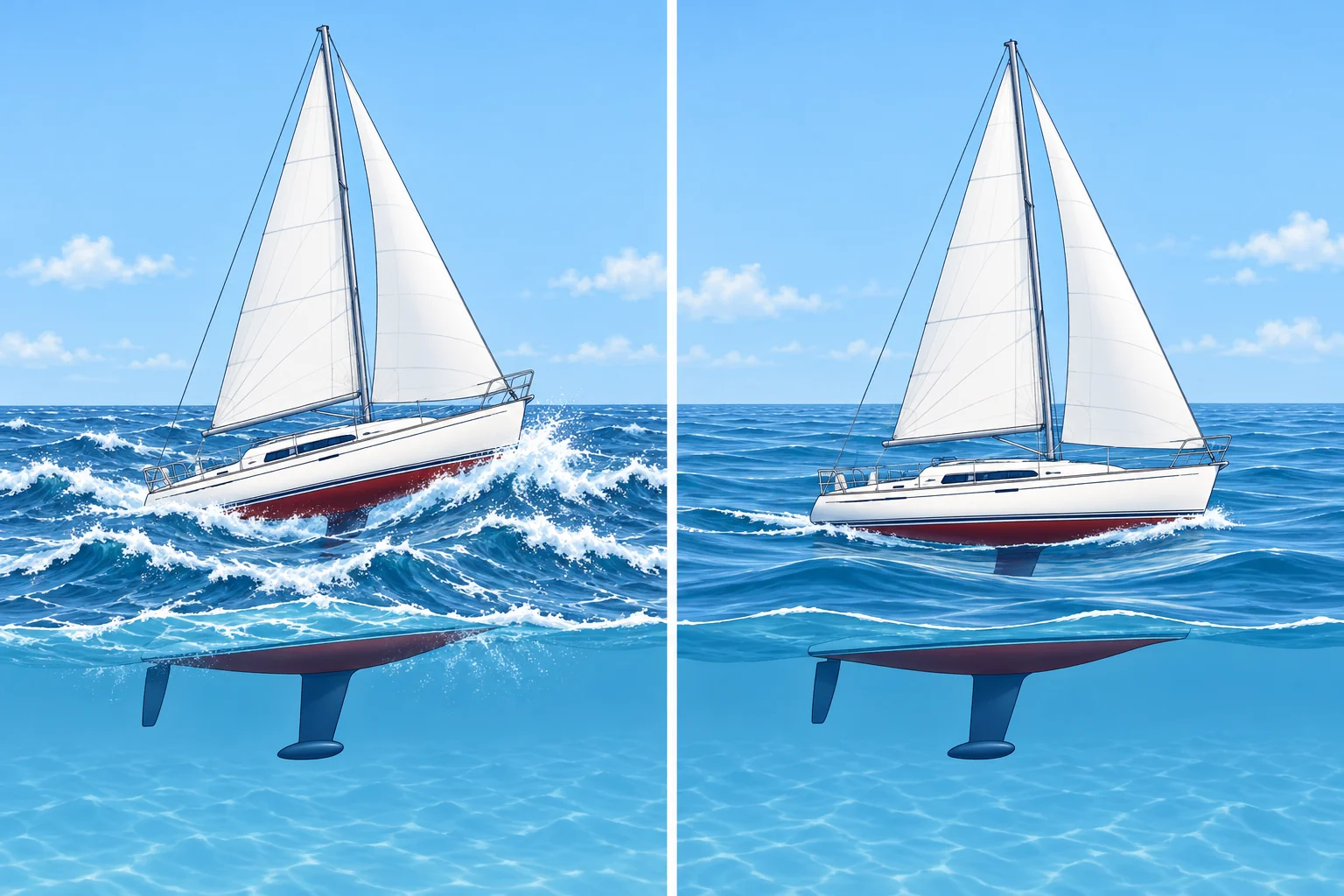
Wind against tide
1The lesson in plain words
When the wind blows against the stream, waves become shorter, steeper and break. Plan the hours when wind and stream run the same way.
What happens
Waves travel with the wind. When the stream runs against them, called wind against tide (or wind over tide), the waves shorten and steepen and more of them break. In a strong stream a moderate breeze can raise a sea that is dangerous for a small boat. When wind and stream run the same way, the waves are longer and lower.
Name them the right way
Wind is named for where it comes from; stream set for where it goes towards. A westerly wind blows towards the east, so a stream setting 090°T runs with it, while a stream setting 270°T runs against it.
Where it is worst
The effect grows with the rate of the stream. It is strongest when the local opposing stream runs fastest; check local rates. Springs, headlands, narrows and shoals (shallow patches) can worsen it. An estuary bar is a shallow ridge across its entrance. An opposing stream also steepens swell coming in from offshore, even with little wind. Avoid crossing a bar on the ebb when the wind or swell is onshore.
Planning
For each hour of the passage, set the forecast wind against the atlas. Mark the hours when they oppose at the danger spots. Shift your departure, pick a route away from races and bars, or wait for neaps or less wind. A fair stream against the wind gives speed but a rough sea; a foul stream with the wind gives a smoother sea but slow progress. Write the choice and the reason in your plan.
2Key data
- Wind against tide
- Shorter, steeper, breaking seas
- Worst
- Peak opposing stream; springs, headlands, narrows, shoals and bars
- Wind direction
- Where it blows FROM
- Stream set
- Where it flows TOWARDS
- Bar crossing
- Avoid the ebb with onshore wind or swell
3Key points
- 1
Wind against tide makes short, steep, breaking seas; with the wind the sea is easier.
- 2
Wind is named from, stream set towards: a westerly and a 090°T stream run together.
- 3
Worst near the peak opposing stream, especially at springs, off headlands, in narrows and over bars.
- 4
Plan departure times and routes so wind and stream do not oppose at danger spots.
4Frequent mistakes
Wrong: A westerly wind and a stream setting 090°T are opposed.
Right: Both run towards the east. A westerly opposes a stream setting 270°T.
Wrong: Wind against tide only matters in a gale.
Right: In a strong stream, a moderate breeze or an offshore swell can be enough to make dangerous seas.
Wrong: With a good engine you can cross a bar at any state of tide.
Right: Follow local bar guidance. You need adequate depth, a suitable stream and no breaking seas; HW does not guarantee slack.
5Practice case & exam keys
Forecast: west, force 5. You are heading east round a headland with a race. There the stream sets 270°T from HW−6 to HW, and 090°T from HW to HW+6 at the standard port. When is the race worst, and when do you round it?
Show the answer
The westerly opposes the 270°T stream from HW−6 to HW. Check the atlas rates to find the strongest hours. After HW, the 090°T stream runs with the wind and your course. Subject to local advice and suitable sea conditions, aim for early in that stream and keep clear of the race.
Exam keys
- Wind against tide: short, steep, breaking seas.
- Wind named from; stream set towards.
- Worst near peak opposing stream, especially at springs, headlands, narrows and bars.
- Opposing streams steepen swell; avoid bars on the ebb in onshore swell.
Finish this unit
When you've read it, match the terms, then answer three questions. Get them all right to finish the unit; opening the page alone doesn't count.
My notes for this unit
No notes