

Real tides: amphidromes, giant ranges and the Mediterranean
1The lesson in plain words
Oceans do not hold neat bulges. Each basin rocks in its own way, so ranges vary from over 14 m in the Bay of Fundy to a few centimetres in the Mediterranean.
Basins and amphidromes
Many basins have rotating tidal waves. An amphidromic point has almost no rise and fall for the particular tidal wave circling it; other tidal waves can still affect that location. The range generally increases away from the point. Rotation is usually anticlockwise in the northern hemisphere. The North Sea has three main amphidromic points for its dominant semi-diurnal tide.
Resonance and giant ranges
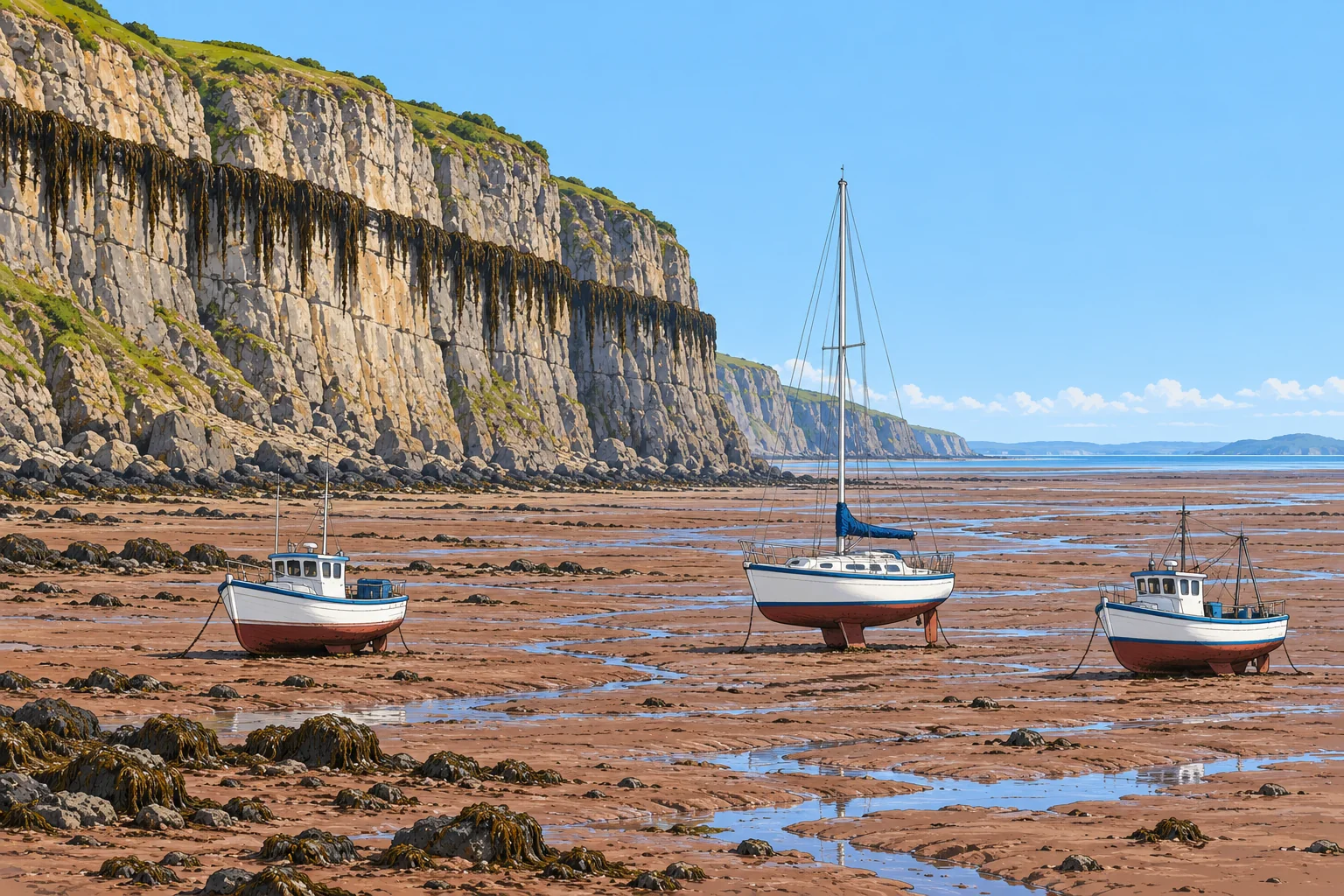
Where a bay rocks naturally at close to the tidal period, the tide is amplified, like a child pushed on a swing. The Bay of Fundy in Canada has the world’s largest tides: a mean spring range of about 14.5 m at Burntcoat Head, and over 16 m at the biggest. The Bristol Channel and Severn estuary also have very large spring ranges, over 12 m. Atlantic Spain and Portugal see about 3–4 m at springs.
The Mediterranean
The Mediterranean’s basin response keeps astronomical tides small on most coasts; local tide-raising forces and the Atlantic tide entering through Gibraltar both contribute. Most coasts have a range of a few tens of centimetres. There are exceptions: the Gulf of Gabès in Tunisia reaches about 2 m at springs, and the northern Adriatic around Venice and Trieste about 1 m. On such coasts, weather often changes the sea level more than the tide does.
Weather and sea level
Low pressure raises the sea about 1 cm per 1 hPa below normal: the inverse-barometer effect. Onshore wind piles water against the coast. These effects cause a storm surge. On 12 November 2019, Venice reached 187 cm above its local tidal zero, from astronomical high water plus a large storm surge. A seiche is a standing basin oscillation: water moves back and forth. Ciutadella’s rissaga is a weather-driven harbour oscillation, often triggered by rapid pressure changes; levels can change by over a metre in minutes.
Worked example
Mean sea-level pressure is about 1,013 hPa. A deep low gives 988 hPa: 25 hPa below average, so the sea can stand about 25 cm higher than predicted. A high of 1,038 hPa can leave it about 25 cm lower, which matters when you plan to cross a shallow bar at low water. Wind can add more. Check local surge warnings.
2Key data
- Bay of Fundy
- Mean spring range about 14.5 m; extreme over 16 m
- Bristol Channel / Severn
- Spring range over 12 m
- Most Mediterranean coasts
- A few tens of centimetres
- Mediterranean exceptions
- Gulf of Gabès about 2 m; northern Adriatic about 1 m (springs)
- Inverse barometer
- About 1 cm of sea level per 1 hPa
3Key points
- 1
An amphidromic point has almost no rise and fall for one rotating tidal wave; other tidal waves can still affect it.
- 2
Resonance gives the Bay of Fundy a mean spring range of about 14.5 m.
- 3
Most Mediterranean coasts have only a few tens of centimetres of tide.
- 4
Low pressure raises the sea about 1 cm per hPa; wind adds a surge.
- 5
Where tides are small, weather can matter more than the tide.
4Frequent mistakes
Wrong: The Mediterranean has no tide, so sea level never changes.
Right: Tides are small, but pressure, wind and seiches can change the level by tens of centimetres or more.
Wrong: A high barometer has no effect on depth.
Right: High pressure lowers the sea about 1 cm per hPa above average. Allow for it in shallow water.
5Practice case & exam keys
At a northern Adriatic harbour, pressure is 1,035 hPa instead of 1,013 hPa. A steady offshore wind is blowing. Why might observed sea level differ from the astronomical tide prediction?
Show the answer
The inverse-barometer estimate is about 22 cm below the prediction. Offshore wind may lower the level further, depending on local conditions. This is a rough estimate of weather effects, not a precise local water-level prediction.
Exam keys
- Amphidromic point: almost no rise and fall for a particular rotating tidal wave; others can still affect the location. Rotation is usually anticlockwise in the northern hemisphere.
- Fundy mean spring range about 14.5 m; Bristol Channel over 12 m; most of the Mediterranean a few tens of centimetres.
- Inverse barometer: about 1 cm per hPa; surges and seiches (rissaga) can exceed the tide in the Mediterranean.
Finish this unit
When you've read it, answer three questions. Get all three right to finish the unit; opening the page alone doesn't count.
My notes for this unit
No notes