

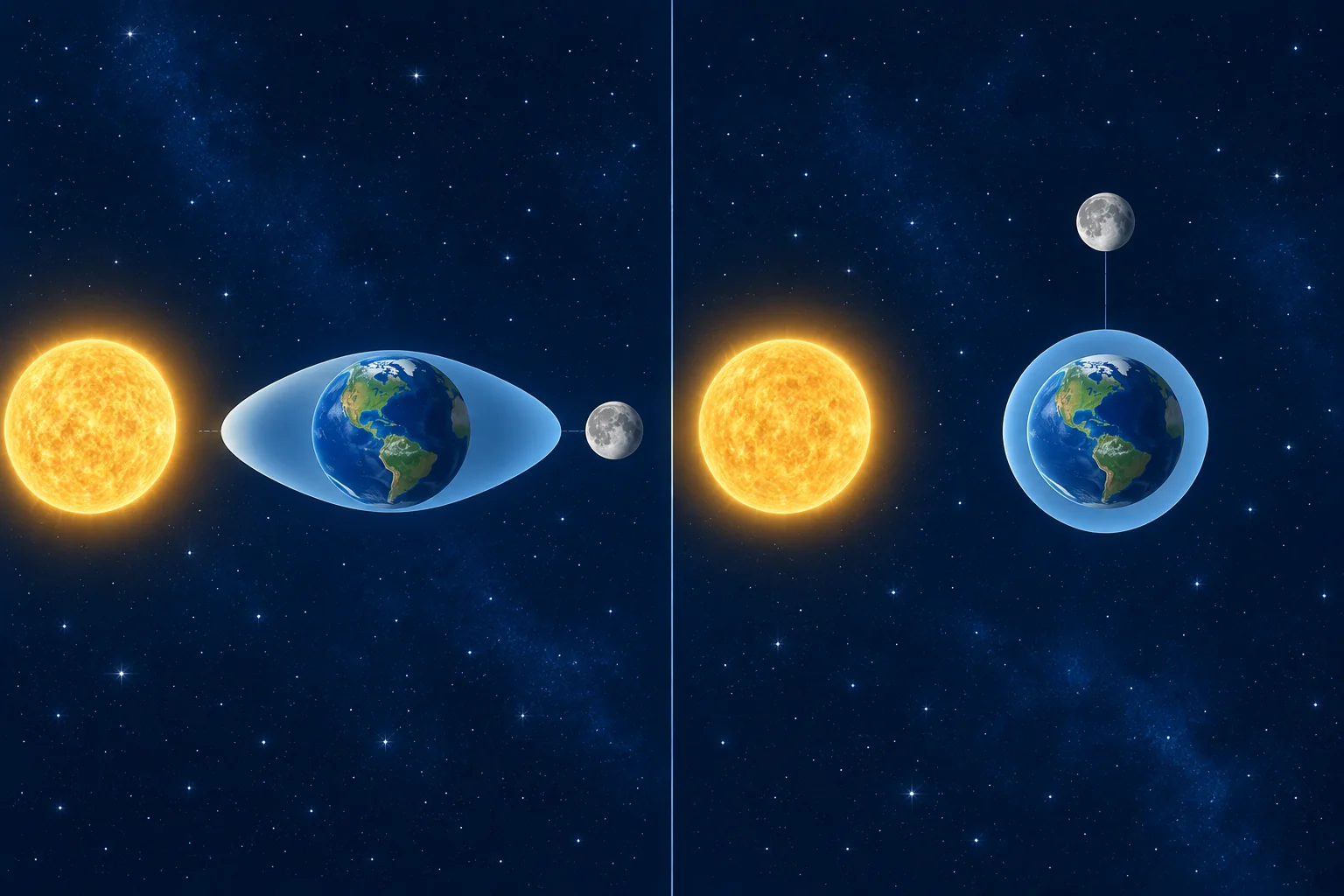
Springs and neaps: the Sun joins in
1The lesson in plain words
When Sun and Moon line up, their tides add up: springs. When they pull at right angles, they partly cancel: neaps. The cycle takes about two weeks.
Springs
At new moon and full moon the Sun, Earth and Moon are roughly in line. The Sun’s bulges lie on top of the Moon’s and add to them. High waters are higher and low waters lower. The tidal range, the height difference between high and low water, is large. These are spring tides. The name has nothing to do with the season: springs happen twice a month, all year.
Neaps
At the first and last quarter, when you see half a Moon, the Sun pulls at right angles to the Moon. The Sun’s bulges fill the Moon’s low areas and partly cancel them. High waters are lower, low waters higher, and the range is small. These are neap tides. In much of western Europe the neap range is roughly half the spring range.
The fortnightly cycle
From springs to neaps and back takes about 14.8 days, half the Moon’s cycle of phases. Ranges grow day by day from neaps to springs and shrink again after.
The lag
At many ports, the largest spring ranges come one to two days after new or full moon. The oceans need time to respond. This delay is called the age of the tide, and it varies locally. Use the port’s tide tables to confirm the timing and range.
Extra-big springs
The Moon’s orbit is an ellipse. Near perigee, when the Moon is closest, its tide-raising force is stronger. At many semi-diurnal ports, springs near the equinoxes in March and September are also large: low solar and lunar declinations strengthen the twice-daily tide. The largest local range depends on how these factors combine. Larger ranges generally bring stronger tidal streams, the horizontal flow of water; see the Tidal streams lesson.
2Key data
- Spring tides
- Near new and full moon; large range
- Neap tides
- Near first and last quarter; small range
- Spring to spring
- About 14.8 days
- Lag (age of the tide)
- Often 1–2 days after new or full moon; varies by port
- Larger springs
- Perigee and equinoxes can increase spring ranges
3Key points
- 1
Springs: Sun and Moon in line at new and full moon; big range.
- 2
Neaps: Sun and Moon at right angles at the quarters; small range.
- 3
The spring–neap cycle takes about 14.8 days.
- 4
Spring ranges often peak 1–2 days after new or full moon; the lag varies by port.
- 5
Perigee and equinoxes can increase spring ranges; local ranges vary.
4Frequent mistakes
Wrong: Spring tides happen in spring.
Right: Springs happen twice a month, all year, near new and full moon.
Wrong: Neaps mean low water is extra low.
Right: Neaps have a small range: low waters are higher and high waters lower than at springs.
Wrong: The biggest tide is always on the day of the full moon.
Right: At many ports, spring ranges peak one to two days later, but the lag varies locally. Check the tide table.
5Practice case & exam keys
Full moon falls on Saturday near the September equinox, with the Moon near perigee. At this semi-diurnal port, spring ranges usually peak one to two days after full moon. What pattern do you expect?
Show the answer
Expect a large spring range, probably peaking on Sunday or Monday at this port. Full-moon alignment and perigee favour a larger range, and equinoctial conditions can add to it. Confirm the actual timing and range in the port’s tide tables. Expect generally stronger streams too; check the local stream information before choosing the visit.
Exam keys
- Springs at new and full moon (Sun and Moon in line); neaps at the quarters (at right angles).
- Cycle about 14.8 days; spring ranges often peak 1–2 days after new or full moon (age of the tide); the lag varies by port.
- Perigee and equinoxes can increase spring ranges; local ranges vary.
Finish this unit
When you've read it, answer three questions. Get all three right to finish the unit; opening the page alone doesn't count.
My notes for this unit
No notes