

Coiling and flaking a rope so it runs free
1The lesson in plain words
A rope stowed well runs out without a tangle when you need it. Coil it, flake it or hang it, and always know where its ends are.
Words first
A rope with a job is a line. A sheet controls a sail; a halyard hoists it. A mooring line secures the boat. The working end is the end you handle; the standing part is the main length away from it. A bight is a U-shaped bend in the rope. Coiling makes loops; flaking lays a line back and forth so it runs freely.
Coiling
Hold the coil in one hand and make even loops with the other. A three-strand (twisted) rope is coiled clockwise, giving each loop a small twist so it lies flat. A braided rope fights twisting: coil it in figure-of-eight loops, or flake it. Start coiling from the end that is made fast (secured), so twists run out of the free end.
Flaking
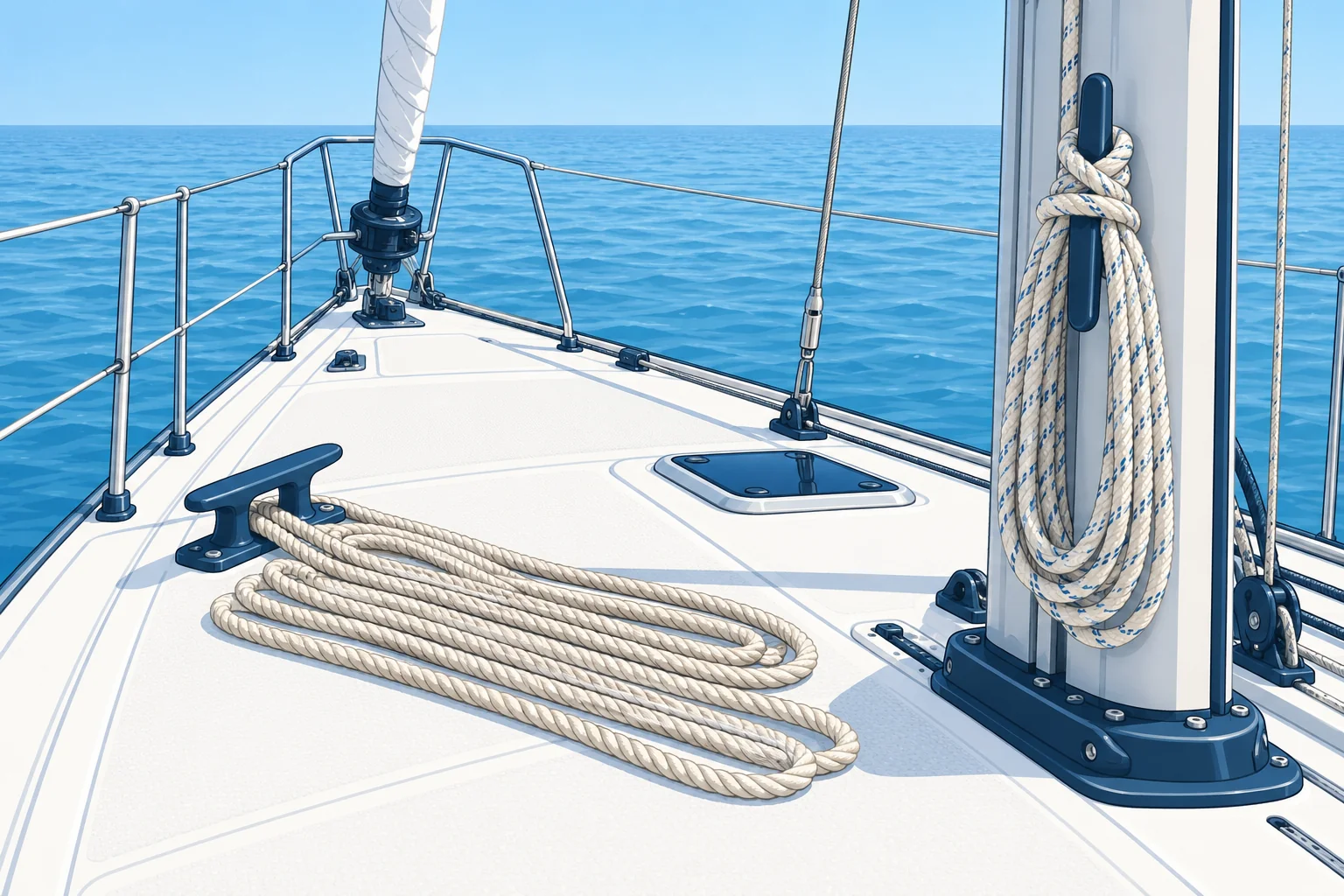
Flaking down a rope on deck, in loose layers with no twists, lets it run out fast. Flake a mooring line before coming alongside, and a halyard before raising or lowering a sail. Put the length that will feed out first on top. When lowering a sail, this is the length leading to the cleat, the fitting that holds the line.
Hanging a halyard
Hang the coil on the cleat to keep the deck clear. A cleat horn is one of its projecting arms. Follow the procedure below, then undo the securing bight and flake the line before use.
Ends and safety
Secure or knot the free end of a halyard or sheet so it cannot run away out of reach: a stopper knot, such as a figure-of-eight, in a sheet's end stops it pulling through a block (pulley). Never stand inside a coil or bight on deck: if the line runs, it can catch your foot.
2Step by step
Coiling and hanging a halyard
- 1
Make the halyard fast on its cleat first.
The load stays on the cleat, not on the coil.
- 2
Coil from the cleat towards the free end. Use clockwise loops for three-strand rope and figure-of-eights for braid.
Twists run out of the free end and the loops lie flat.
- 3
Leave a short length between cleat and coil.
You need it to hang the coil.
- 4
Reach through the coil, pull a bight of that length through and twist it two or three times.
The twisted bight holds the coil together.
- 5
Hook the twisted bight over a cleat horn.
The coil stays tidy and secure as the boat moves.
- 6
Lift the coil off, undo the securing bight and flake the line clear. To ease (let out) a halyard, put the length leading to the cleat on top.
The line feeds towards the cleat without pulling through the pile.
3Key data
- Three-strand
- Coil clockwise, a small twist in each loop
- Braided rope
- Figure-of-eight loops, or flake
- Stopper knot
- Figure-of-eight in a sheet's end
4Key points
- 1
Coil three-strand clockwise; coil braid in figure-of-eights or flake it.
- 2
Flake a line on deck before it has to run out fast.
- 3
Coil from the made-fast end, so twists run out of the free end.
- 4
Never stand inside a coil or bight on deck.
5Frequent mistakes
Wrong: Coil braided rope in round loops like three-strand.
Right: Braid kinks and tangles that way. Use figure-of-eights or flake it.
Wrong: Drop the mooring line in a heap ready to throw.
Right: Flake it so it runs free; a heap tangles at the worst moment.
6Practice case & exam keys
You are about to come alongside. The bow line lies in a twisted heap in the locker, still coiled from last week. What do you do?
Show the answer
Take it out early, make one end fast on the bow cleat, lead it outside the guardrails and their posts and flake it on deck with the free end on top. Then it runs out cleanly when you step ashore or throw it. Do the same with the stern line, and keep your feet out of the bights.
Exam keys
- Three-strand: coil clockwise; braid: figure-of-eight or flake.
- Flake lines before they must run.
- Stopper knot (figure-of-eight) in the end of a sheet.
- Never stand in a bight.
Finish this unit
When you've read it, match the terms, then answer three questions. Get them all right to finish the unit; opening the page alone doesn't count.
My notes for this unit
No notes