

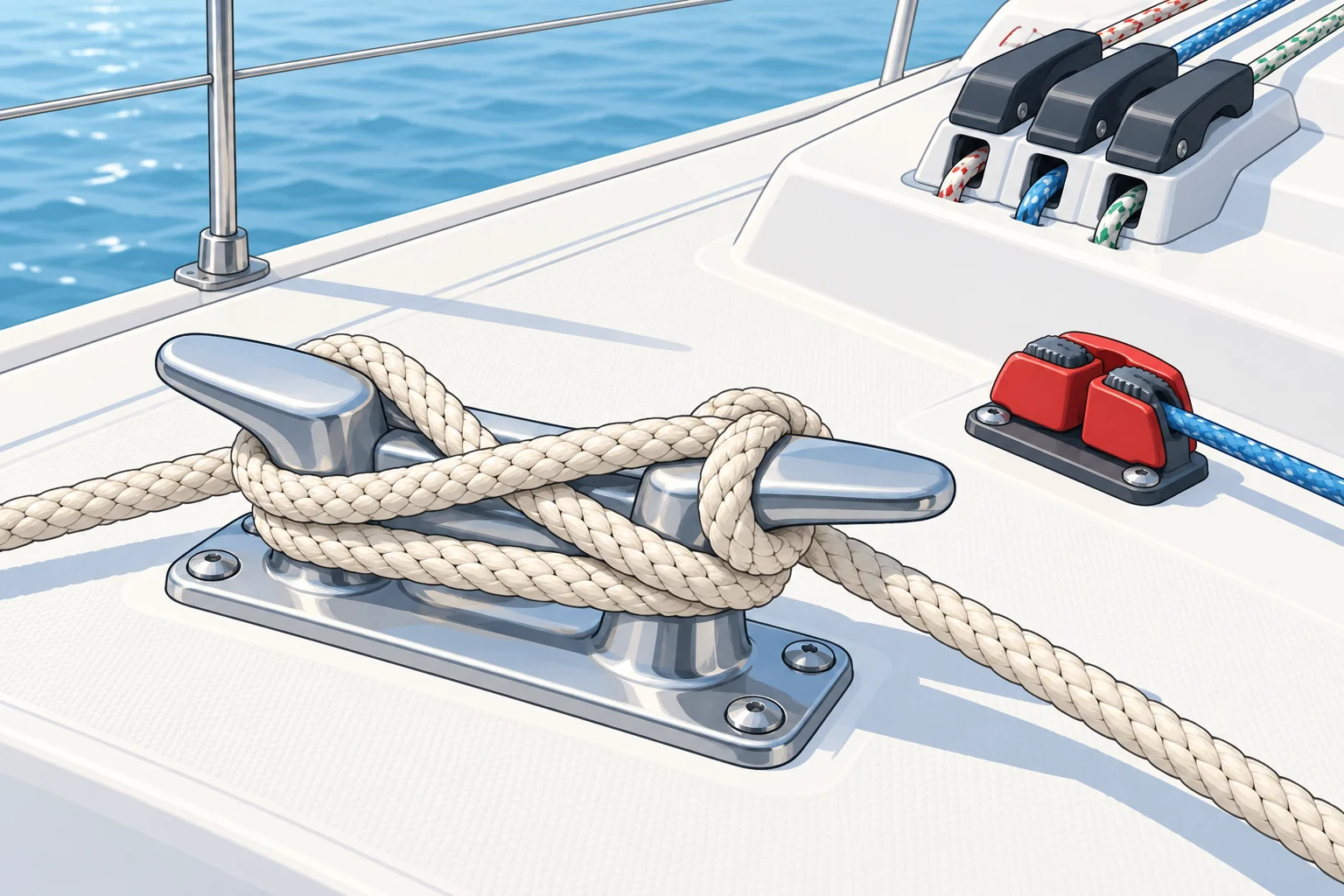
Cleats, clutches and making fast
1The lesson in plain words
Each fitting holds a rope in its own way. Know how to make fast and, just as important, how to let go safely under load.
Horn cleat
The horn cleat, with two horns, is the most common fitting for mooring lines and halyards. Make fast with a turn round the base, figure-of-eights over the horns and, if needed, one locking hitch, a final turn that locks the line. The step-by-step method is in the cleat hitch study in the Knots section. It can be let go under load.
Cam and clam cleats
A cam cleat has two spring-loaded toothed jaws; a clam cleat has fixed grooves. The rope is pulled in and jams. Pull it upward and out to release it. They are quick for small sheets and control lines, but a rope of the wrong size slips or will not come out.
Rope clutches
A rope clutch grips a halyard or control line with a lever, so one winch can serve several lines. Opening a loaded clutch can let the line run suddenly. First put the tail, the free end, around a winch drum, using enough turns to control the load. Wind the winch until it takes the load, then remove the handle. Open the clutch and ease under control. Follow the fitting's instructions.
Bollards and rings
A bollard is a strong mooring post; an eye is a fixed loop in a line. An eye can go over a bollard. When practical, pass a line around the bollard or through a mooring ring and bring its free end back aboard. Secure both ends aboard so you can adjust or release the line without going ashore.
Hands and loads
Never wrap a loaded line round your hand. Keep fingers away from where a line enters a cleat, clutch or fairlead (a fitting that guides the line). Use enough turns on the fitting to control the load; a winch may need several. Ease the tail slowly, keeping your hands clear.
2Key data
- Horn cleat
- Turn round base, figure-of-eights; locking hitch if needed
- Cam/clam cleat
- Quick jam; pull up and out to release
- Rope clutch
- Winch takes the load before you open it
3Key points
- 1
Horn cleat: turn round the base, figure-of-eights, one locking hitch if needed.
- 2
Clutch: put the line on a winch and take the load before opening.
- 3
Cam and clam cleats: quick, but only for the right rope size.
- 4
Never wrap a loaded line round your hand.
4Frequent mistakes
Wrong: Pile many locking hitches on a cleat to be safe.
Right: Use at most one locking hitch, only if needed. Extra locking hitches can jam and delay release.
Wrong: Flip open a clutch to drop the main quickly.
Right: Take the load on a winch first, or the halyard runs out and burns your hands.
5Practice case & exam keys
You need to ease the mainsail halyard a little to adjust tension along the sail's front edge. The halyard is in a rope clutch, under load, with the tail lying on the cabin roof.
Show the answer
Put enough clockwise turns on the winch to control the load. Wind until the winch takes the load, then remove the handle. Hold the tail securely before opening the clutch. Release the tail from any self-tailing jaws, which grip the free end, and ease it slowly, keeping turns on the drum and fingers clear. Close the clutch, ease the tail to check it holds, then remove the winch turns.
Exam keys
- Horn cleat: turn round the base, figure-of-eights, one locking hitch if needed.
- Do not open a loaded clutch: winch first.
- Cam/clam cleats release by pulling up and out.
- Keep hands clear; never wrap a loaded line round them.
Finish this unit
When you've read it, match the terms, then answer three questions. Get them all right to finish the unit; opening the page alone doesn't count.
My notes for this unit
No notes