

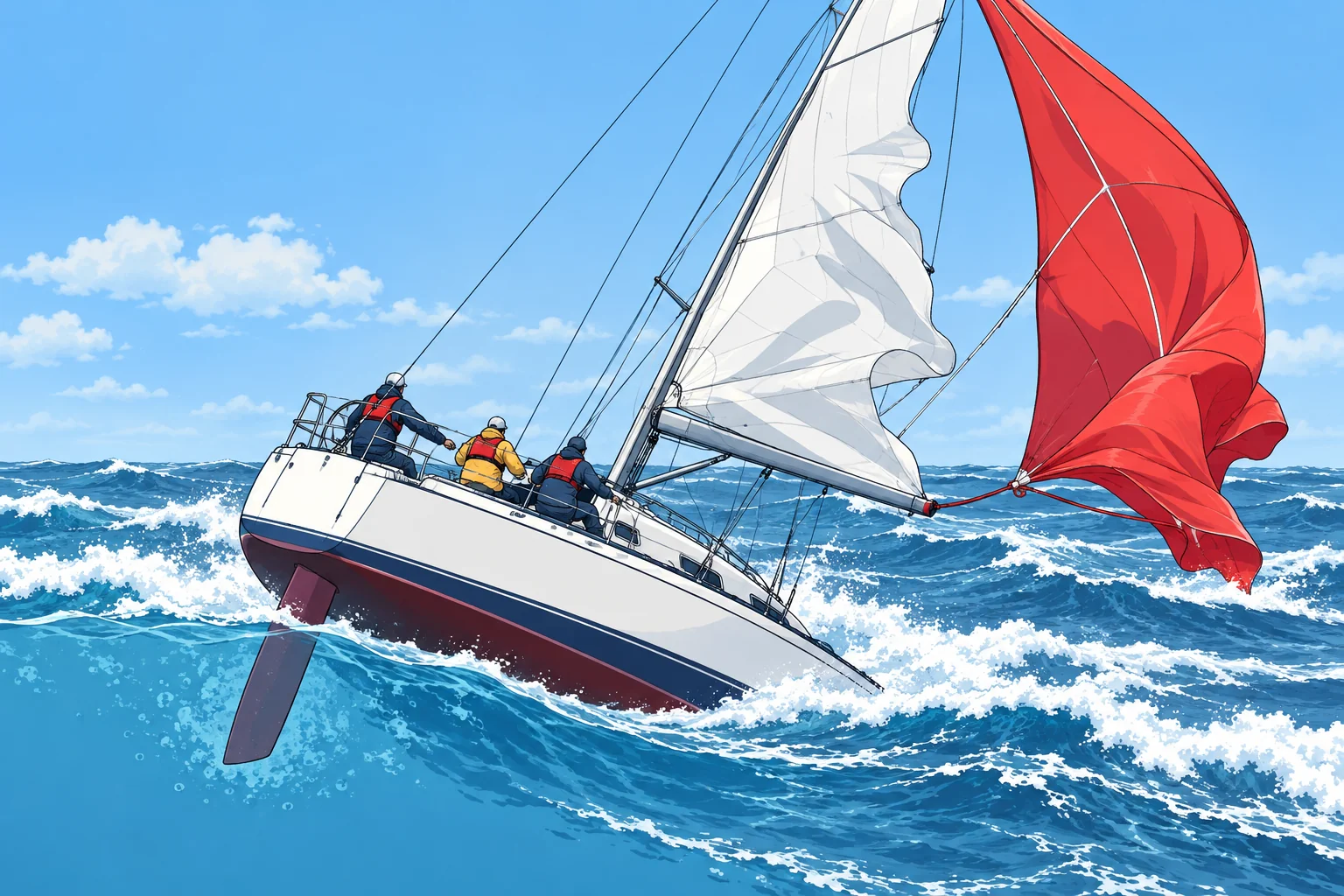
Broaching and the death roll
1The lesson in plain words
A broach is an uncontrolled round-up into the wind; a death roll is a violent roll to windward that can gybe the boat. Both have warning signs.
The broach
In a broach, the boat heels too far and turns sharply into the wind, out of control. The rudder stalls or comes out of the water and stops steering. The spinnaker pins the boat on her side until the load is released. Causes: too much sail, a gust, a wave pushing the stern sideways, a main sheeted too tight or a helm reacting too late.
Avoiding a broach
Steer down, bearing away, in gusts, before the heel builds. Ease the kicker (boom vang) first: it opens the main's leech and spills power from the top. Ease the mainsheet and spinnaker sheet as needed. Keep crew weight aft and to windward. Set a smaller or flatter sail in a rising wind; on a symmetric, lower the pole a little to stabilise the sail.
Recovering
If the boat broaches, release the kicker and mainsheet, and ease the spinnaker sheet until the sail flaps. As heel reduces, reduce excessive helm so the rudder can regain grip. Bear away gently as steering returns, then re-trim. Crew must hold on and stay clipped on: a broach can throw people across the boat or overboard.
Death roll
On a deep run, growing side-to-side rolls can develop into a violent roll to windward and an uncontrolled gybe or round-down (turn away from the wind). Warning signs include increasing rolling and an unstable spinnaker. Sailing by the lee, with wind coming over the same side as the boom, increases the danger. A pole too high and aft, or a sheet too loose, can let the sail swing.
Stopping rolling
Head up slightly, away from a dead run. On a symmetric, lower the pole and bring it forward a little, and trim the sheet in and down using a barber hauler, a control line that pulls the sheet down through a forward block. Keep the main not quite fully eased. Rolling is a warning: act before it builds.
2Key data
- Broach
- Round-up to windward: heel, stalled rudder
- Broach prevention
- Bear away early, ease kicker, smaller sail, crew aft
- Broach recovery
- Release kicker and main; ease spinnaker sheet
- Death roll
- Roll to windward and accidental gybe, running deep
- Stop rolling
- Head up, lower pole, sheet led forward and down
3Key points
- 1
A broach is a round-up to windward with a stalled rudder.
- 2
Prevent: bear away in gusts, ease the kicker, carry less sail.
- 3
Recover: release kicker and main, ease the spinnaker until it flaps.
- 4
A death roll is a roll to windward and accidental gybe when running too deep.
- 5
Rolling: head up, lower the pole, lead the sheet forward and down.
4Frequent mistakes
Wrong: When the boat starts to round up, pull the tiller hard to windward and hold the sheets.
Right: Ease sail loads promptly and avoid excessive helm. If the rudder stalls, reduce its angle so flow can reattach; steer down as control returns.
Wrong: Sailing deeper always steadies the spinnaker.
Right: Too deep, especially by the lee, starts rolling and can cause a death roll. Head up a little.
5Practice case & exam keys
Under spinnaker on a broad reach in 20 knots, gusting 26, the boat heels hard in each gust and needs full rudder. The kicker is very tight and the crew are sitting forward.
Show the answer
Repeated heavy heel and full rudder are already warnings to reduce sail. Ease the kicker, mainsheet and spinnaker sheet to unload the boat, and bear away early while steering still responds. Move crew aft and to windward. Arrange a controlled drop now; do not wait for stronger gusts. If she broaches, release kicker and main and ease the spinnaker; reduce excessive helm so the rudder can regain grip.
Exam keys
- Broach: uncontrolled round-up; rudder stalls.
- Prevent: bear away in gusts, ease kicker, smaller sail, crew aft.
- Recover: release kicker, main and spinnaker sheet.
- Death roll: rolling and accidental gybe when too deep; head up, lower pole, sheet forward.
Finish this unit
When you've read it, answer three questions. Get all three right to finish the unit; opening the page alone doesn't count.
My notes for this unit
No notes