
Decide
Four situations at sea. Decide first, then read why.
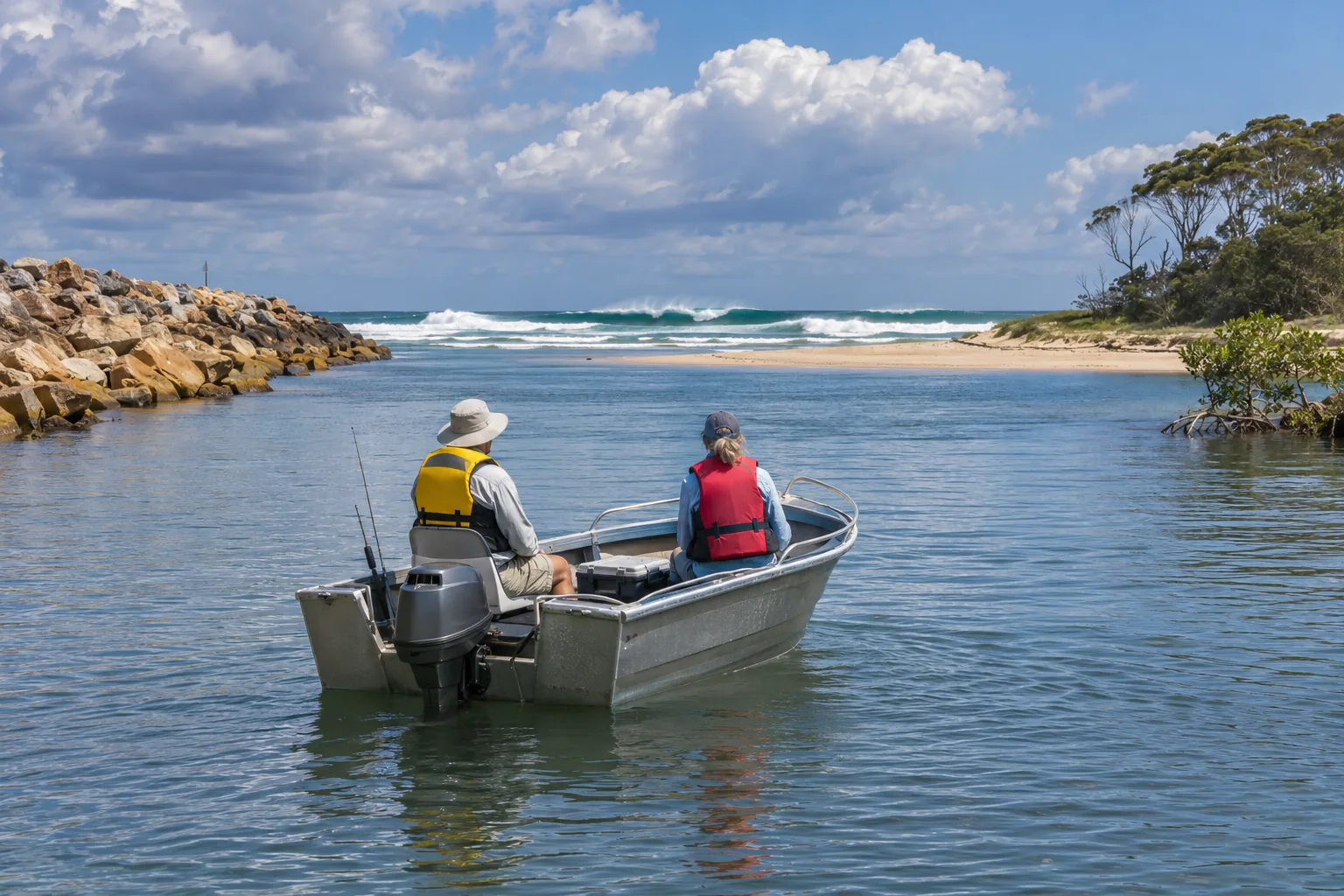
You are waiting safely inside Narooma bar. Breaking waves are building, and you are unsure whether your boat can handle them. What do you do?
Key points
- Check the waterway, not just its appearanceOpen-water boundaries may begin inside an entrance; enclosed water can still hide serious hazards.
- Check boating maps and carry equipment for the waters you will enter. Keep enough power for steerage in waves.
- Look for submerged hazards, currents, low bridges and powerlines. Avoid dam spillways and water-release areas.
- Alpine waters can be cold even in summer. Always wearing a lifejacket is recommended; wear is compulsory on small powerboats and sailing boats.
- For alpine powerboats and sailing boats, follow the stricter reading: everyone wears Level 50S or above up to and including 4.8 metres. The sources differ at exactly 4.8 metres; check the current TfNSW page.
- Decide before committingCheck both crossings and have a safe alternative if you cannot return over the bar.
- Use forecasts, tides, local advice and observations; a webcam alone is not enough.
- Prefer an incoming tide and avoid the ebb, without treating the tide as a guarantee.
- Everyone wears a lifejacket throughout the crossing: Level 100 or above on an ordinary powerboat.
- Log on and off with Marine Rescue NSW as recommended safety practice.
- Outwards and homewards are differentGoing out, control your approach to each wave; coming in, stay on the back of a swell.
- Outwards: near head-on, ease power before waves and accelerate between them; avoid becoming airborne.
- Inwards: do not run down the wave's face; keep ahead of the wave behind.
- If return entry is unsafe, wait safely or seek another safe harbour.
- Leave room on the HarbourKeep right, keep well clear of big ships in channels and know the local exclusions.
- Bridge Transit Zone: maximum 15 knots; no stopping, anchoring or drifting except in an emergency.
- A ferry's daytime orange diamond gives priority over sail, except when it is overtaking a sailing vessel.
- PWC and kiteboards are prohibited on Sydney Harbour; check other restrictions on maps and signs.
- Keep clear of naval vessel zones, restricted port facilities and seaplane take-off areas.
- An empty mooring is not automatic permissionKnow the buoy category and approach slowly with minimal wash.
- Pink: free public mooring for 24 hours; yellow: private; orange: commercial; red: club; blue: emergency.
- Private, commercial and emergency moorings require a licence or authorisation.
- At 6 knots or more in a powered boat, keep 30 metres from moored vessels where possible; otherwise keep a safe distance at a safe speed.
- Stop with the buoy ahead, put the engine in neutral and pick up the mooring.
- Anchor by the bow, then checkChoose shelter and swing room, avoid hazards and sensitive habitat, and confirm the anchor holds.
- Do not anchor in channels, obstruct access or anchor within 200 metres of underwater cables.
- Avoid seagrass, reefs, bomboras and historic wrecks.
- Use the handbook's 3:1 line-to-depth guidance, increasing to 5:1 or more in strong current or deteriorating weather.
- Allow for tides and wind changes; check position against landmarks and recheck in strong conditions.
Check what you have read
Your planned route stays just inside a river entrance. How do you decide whether open-water equipment is needed?
Worked case: Narooma: plan for the trip home before going out
You are taking a trailer boat offshore from Narooma with two friends. You have practised this bar with an experienced local skipper. The morning looks manageable, but the forecast suggests more swell and an ebb tide around your planned return.
Before you read the solution: what would you do?
True or false?
Decide each statement before you see the answer.
The bar webcam looked flat for a moment, so I can skip the other checks.
Choose shelter and swing room, avoid hazards and sensitive habitat, and confirm the anchor holds.
I am under sail, so a big ship in a Harbour channel must give way to me.
Open-water boundaries may begin inside an entrance; enclosed water can still hide serious hazards.
Anchoring by the stern keeps the cockpit conveniently near the beach.
Know the buoy category and approach slowly with minimal wash.
If the bar gets rough halfway across, I will turn side-on and head back.
It is inside the entrance, so enclosed-water equipment must be enough.
Keep right, keep well clear of big ships in channels and know the local exclusions.
Going out, control your approach to each wave; coming in, stay on the back of a swell.
Adults can leave their lifejackets beside them for a short bar crossing.
Check both crossings and have a safe alternative if you cannot return over the bar.
Exercise: Make the plan, then choose where to stop
Work through a coastal trip and a later anchoring stop. Practise the handbook's anchor-line ratios using the depths given here; you must still allow for tides, swing room and conditions on the water.
Step by step
In open water, you meet large waves coming directly towards you. How should you handle this head sea?
Show the solution
Control speed and direction in head seas. Too much power can launch the boat; too little can let waves break over it. Keep enough power for steerage. Handbook, pp. 130–132.
Three adults are crossing the bar in an ordinary powerboat. Who must wear a Level 100 or above lifejacket?
Show the solution
Everyone on board must wear a lifejacket throughout a coastal-bar crossing; the ordinary powerboat minimum is Level 100. Handbook, pp. 34, 136.
On return, large breaking waves make entry too dangerous. What is the safe response?
Show the solution
Reassess the return. The handbook says to wait for improvement or look for safe harbour elsewhere. Handbook, p. 137.
At a suitable sandy anchorage, water depth is 4 metres. Using the handbook's 3:1 ratio for this calculation, how much anchor line do you let out?
Show the solution
3 × 4 = 12 metres. Anchor from the bow, allow for tidal depth changes and swing room, and check that the anchor holds. Handbook, p. 147.
Now on your own
On another trip, you cross Sydney Harbour and later stop in a sheltered bay. Make each decision without help.
Can you drift in the Sydney Harbour Bridge Transit Zone while waiting for a friend, with no emergency?
You want a free public mooring for a short stop. Which buoy colour identifies that category in NSW?
Instead, you choose a suitable anchorage. Put these actions in order.
- 1Check shelter, depth, seabed, restrictions and swing room
- 2Check your position against landmarks to confirm the anchor holds
- 3Lower the anchor from the bow and pay out line as the boat moves backwards
- 4Slow down and prepare the anchor and line with the other end secured
The water is 6 metres deep and the current is strong. Using 5:1 for this calculation, how much line is needed?
Check: 10 questions
Questions from this subject, explained after each answer.
Free: lesson + 10 questions · Exam Pass: all 22 questions, unlimited practice tests, your mistakes retrained
The full explanation and the lessons for each programme item
Topic 1 of 6
Know which waters you are entering
Open waters include coastal and ocean waters.
Their official boundaries can start well inside a harbour or river entrance, so check the TfNSW boating map before choosing your safety equipment. A sheltered-looking stretch is not proof that you are still on enclosed waters. Check that your boat is suitable and watertight before heading out. Boating Handbook, pp. 129–130.
Enclosed waters include rivers, lakes, dams and enclosed bays and harbours. Calm water can hide snags, rocks and shifting shallows. Keep a proper lookout, slow down in unfamiliar areas and watch above you for powerlines and low bridges. Strong river currents after heavy rain can reduce your ability to manoeuvre. Boating Handbook, pp. 133–134.
On dams, avoid spillways and other water-release areas: fast, turbulent water is dangerous. Wind can produce short, steep waves even on a shallow dam. Tell someone your plans for remote waterways; phone reception may be unreliable, and the handbook recommends at least two means of communication, such as a marine radio and mobile phone. Boating Handbook, pp. 130, 134.
Alpine waters are a type of enclosed water. NSW examples include Lake Jindabyne, Lake Eucumbene and all navigable waters within Kosciuszko National Park. Cold water, fast weather changes and submerged hazards are risks even in summer. Avoid overloading, distribute weight evenly and stow heavy items low. In small boats, stay close to shore and shelter, and monitor the weather continuously. Boating Handbook, pp. 138–139.
The handbook recommends everyone always wear a lifejacket on alpine waters. Wearing one is compulsory for everyone on small powerboats and sailing boats: use Level 50S or above. At exactly 4.8 metres the sources disagree: the handbook says under 4.8 metres, while the webpage includes 4.8 metres. Follow the stricter reading and wear one on boats up to and including 4.8 metres; check the current TfNSW page. Other vessel, child and skipper-directed wear rules also apply. Boating Handbook, pp. 33–34, 138.
- Keep as far to starboard as practical in a narrow channel and do not obstruct it.
- On open waters, look out for bomboras: shallow rocks or reefs where waves may break only between long calm spells.
- In head seas, control speed and direction: take big waves bow-on or up to about 30 degrees off the bow. Keep enough power to steer, without leaping off crests. Altering your angle to a beam sea can reduce rolling.
- In following seas, the risk of broaching sideways increases. Control your speed and aim to stay on the back of a wave rather than running down its face.
- If rough weather arrives, seek shore or safe shelter if you can reach it. If you doubt you can, keep the bow into the wind and waves and have everyone hold on firmly. Watch for squalls, put lifejackets on and head for shore when safe.
Topic 2 of 6
A coastal-bar crossing starts with the decision to go
A coastal bar is a shallow, shifting sandbank at a river or estuary entrance.
The channel and breaking waves can change with the tide and weather. Seek local knowledge and advice from Marine Rescue NSW, and learn with an experienced skipper before trying a bar yourself. Check wind, swell, tide times and the actual entrance. If in doubt, delay or cancel. Boating Handbook, p. 135.
Official webcams help, but they are only one source. Watch the full camera tour, which can take up to 2 minutes, and combine it with forecasts, tides and local knowledge. Check again for your return. Plan an alternative port or safe anchorage in case you cannot get back over the bar. Logging on and off with Marine Rescue NSW, with your trip plan and expected return, is recommended safety practice.
Check steering, throttle controls, hatches and drains. Secure loose gear and brief everyone on emergency equipment. Everyone on board must wear a lifejacket throughout a coastal-bar crossing. For an ordinary powerboat, that means Level 100 or above. Put them on before entering the crossing. Boating Handbook, pp. 34, 136.
- Prefer an incoming tide and avoid an outgoing, or ebb, tide: ebb conditions are more likely to produce dangerous waves.
- An incoming tide does not guarantee a safe crossing. The conditions, your boat and your experience still decide whether you go.
- Make the go/no-go decision before committing. Turning around in the middle of the bar increases the risk of swamping.
Topic 3 of 6
Going out and coming back in
Going out, take waves as close to head-on as possible.
Approach at idle and watch for a lull. If it is safe, use a flat spot to move through. If you must meet waves, ease over broken water, accelerate between waves and reduce power just before meeting the next one. Aim for the lowest part of a wave where possible. Do not hit waves at high speed or launch the boat into the air. Boating Handbook, pp. 136–137.
Coming in, reassess the bar from outside. If it is safe, choose a suitable set and keep any lead marks in transit. Stay on the back of a swell: do not overtake it and run down its face, and stay ahead of the wave behind you. Once the wave ahead has broken, carefully accelerate through its white water. Watch for waves reflected from the entrance or shore and for outgoing current. Boating Handbook, p. 137.
- Conditions on the way home may be worse than when you left.
- If entry is too dangerous, wait for conditions or the tide to improve, or use a safe harbour elsewhere.
- These steps support practical training with an experienced skipper; reading them alone does not give you bar-crossing experience.
Topic 4 of 6
Sydney Harbour and areas you must keep clear of
Sydney Harbour mixes large ships, ferries, small boats, swimmers and seaplanes.
Keep right and maintain a proper lookout. In shipping channels, sailing boats, powerboats, paddlecraft and rowing boats must keep well clear of big ships, keep to starboard and give way. A ship cannot simply stop or turn out of your path. Boating Handbook, pp. 139–141.
The Sydney Harbour Bridge Transit Zone has a maximum speed of 15 knots. Travel through it to reach an area alongside or outside it. Do not stop, anchor or drift there except in an emergency. PWC are prohibited throughout Sydney Harbour, including its tidal bays, rivers and tributaries. Kiteboards are also prohibited; sailboards have local restrictions. Boating Handbook, pp. 140–142.
During the day, a ferry displaying an orange diamond has priority over sail: sailing vessels must keep at least 200 metres from its bow and 30 metres from its sides or stern. This special signal does not apply at night or when the ferry is overtaking a sailing vessel. High-speed ferries display an all-round flashing yellow light when travelling at speed. Boating Handbook, p. 141.
Marked shore swimming areas extend 60 metres into the water. Designated surf swimming areas extend 500 metres from shore between surf patrol flags or signs. Powered vessels, including sailing boats over 5.5 metres, must keep at least 60 metres from their boundaries; if that is not possible, keep a safe distance and travel at a safe speed. The Sydney basin PWC restriction zone lies between Port Hacking, Wamberal and the Blue Mountains, excluding open waters. Within it, irregular riding is prohibited within 200 metres of shore. Boating Handbook, pp. 89, 142–143.
Check maps, charts, Marine Notices and signs for restricted areas, swimming areas and organised events. Keep well clear of seaplane take-off areas such as Rose Bay and Station Beach, Pittwater. You must not go within 100 metres of wharves or installations used to ship or store oil, inflammable liquids, dangerous goods or explosives. Naval vessels have exclusion distances too: at least 200 metres from the bow and 60 metres from the side when underway, and at least 60 metres when at anchor. Boating Handbook, pp. 91, 142–143.
Seaplanes must give way to vessels when taking off and landing, but have limited manoeuvrability on the water. Where possible, keep at least 60 metres from their front and 30 metres from their back. Boating Handbook, p. 143.
- Do not assume a sailing boat always has priority on the Harbour.
- Keep a safe distance from organised aquatic events and obey any exclusion signs.
- A speed limit is a maximum; traffic and conditions may require a slower safe speed.
Topic 5 of 6
Pick a mooring or anchorage carefully
Mooring areas contain people, dinghies and trailing ropes.
Take extra care at night: moored boats may not be lit. In a powered vessel travelling at 6 knots or more, keep at least 30 metres from moored vessels. If that is not possible, keep a safe distance and travel at a safe speed. Approach a mooring slowly with minimal wash, usually towards the wind or current. Stop with the buoy ahead of the bow, put the engine in neutral, then pick up the mooring. Boating Handbook, pp. 144–145.
Pink buoys are free public moorings for a 24-hour period. Yellow identifies private moorings, orange commercial, red club and blue emergency moorings. Do not assume an empty buoy is yours to use: private, commercial and emergency moorings require a licence or authorisation. At a wharf, secure bow and stern lines and allow for the tide. Before leaving, start the engine at idle, check traffic and bring loose lines aboard so they cannot foul the propeller. Boating Handbook, pp. 145–146.
Choose shelter for the expected wind and swell, adequate depth through the tide and enough room to swing if the wind changes. Never anchor in a navigation channel, where you would obstruct access to wharves, ramps or moorings, or within 200 metres of underwater cables. Avoid reefs, bomboras, historic wrecks and sensitive habitat such as seagrass, even without a sign. If your anchor snags a cable, do not try to pull it free; cut the line as close as possible to the anchor. Boating Handbook, p. 146.
Prepare an anchor suited to the boat and seabed, with the line's other end secured. Lower it from the bow and let the boat move backwards as you pay out line. The handbook gives 3 times the water depth, increased to 5 times or more in deteriorating weather or strong currents. Keep feet clear of the line, allow swing room, check the anchor has held against nearby landmarks and recheck regularly in strong wind or current. Anchoring by the stern can swamp and flood the boat. Boating Handbook, pp. 146–147.
- Shelter that works in one wind direction may be unsafe after a wind change.
- A buoy's colour identifies its mooring category, not a promise that it suits your boat.
- Anchor from the bow and confirm you are holding before settling in.
Topic 6 of 6
Practise and go further
The best places to practise this subject. When you finish, one tap brings you back to the course.
- Read a chart before entering unfamiliar waterLesson
- Check marine weatherLesson
- Cold water and survivalLesson
- Tides and currentsLesson
- Forecast sourcesLesson
- Prepare safety equipmentLesson
All lessons by programme item
- H8a Open, enclosed and alpine waters (Handbook pp. 129–134, 138)
- H8b Coastal bars: planning, crossing out and back in, lifejackets (Handbook pp. 135–137)
- H8c Sydney Harbour rules and exclusion and restriction zones (Handbook pp. 139–143)
- H8d Mooring and anchoring (Handbook pp. 144–147)
Sources
- TfNSW Boating Handbook 2026: waterways, coastal bars, Sydney Harbour, mooring and anchoring, pp. 129–147; lifejackets, p. 34; naval vessel distances, p. 91 · checked
- TfNSW: When to wear a lifejacket — alpine waters and boat-length boundary · checked
- TfNSW: Crossing coastal bars — preparation and crossing out and in · checked
- TfNSW: Webcams for coastal bars and alpine waters — limitations and full camera cycle · checked
- TfNSW: Coastal bar safety resources — alternative harbour and Marine Rescue trip planning · checked
Checked against the official sources on .