
COLREG: rules of the road · Level P3 · 5 parts · about 18 min
Annexes I–III, exemptions and compliance (Rules 38–41)
5 short parts: Light positions · Light specs · Fishing & sound · Annex IV · Rules 38–41. Each part explains the idea, then gives the points to remember, the common mistakes, a worked case and a practice question; the Academy unit adds all 32 check questions.
1 · Light positions
Annex I: where the lights go on a ship
Annex I sets the heights and spacing of navigation lights. You use these limits to check a ship’s light arrangement.
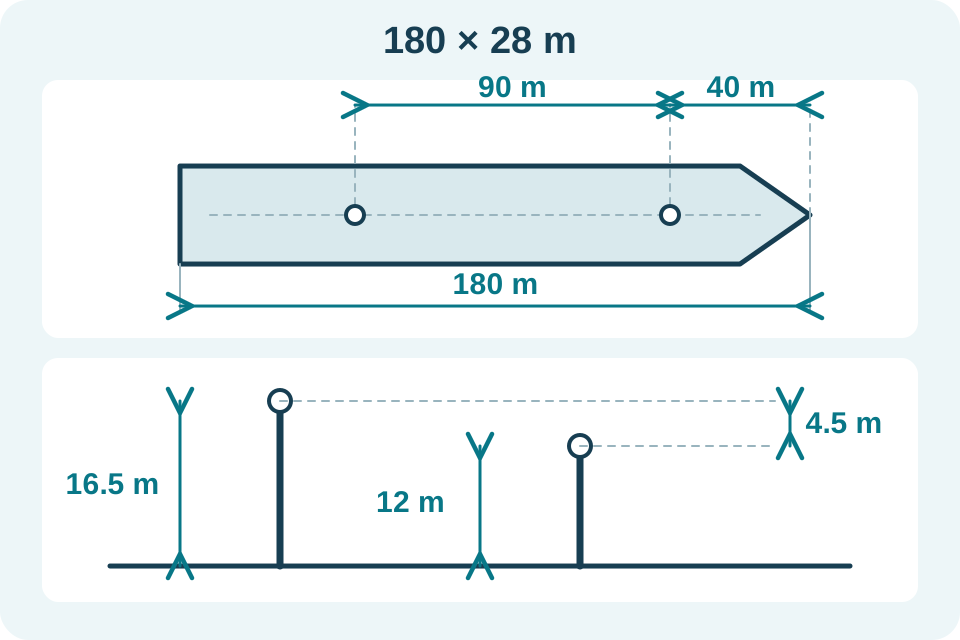
Height above the hull
Heights are measured from the uppermost continuous deck, directly below the light. Breadth is the ship’s width; the stem is the bow’s leading edge; the gunwale is the hull’s upper edge. Trim means how deeply the bow and stern sit relative to each other.
Masthead lights, vertical
On a power-driven vessel of 20 m or more, the forward masthead light, or the only one, is at least 6 m above the hull. If her breadth is more than 6 m, it is at least the breadth, but it need not be higher than 12 m. The after masthead light is at least 4.5 m higher than the forward one. In every normal trim the after light must be seen above and separate from the forward light at 1,000 m from the stem, viewed from sea level.
Masthead lights, horizontal
When two masthead lights are required, space them at least half the ship’s length, up to a required maximum of 100 m. The forward light is no more than a quarter of the length from the stem. Place a single masthead light ahead of the ship’s midpoint; below 20 m, as far forward as practicable. Example: 180 m long, 28 m breadth: forward light at least 12 m above the hull, after light 16.5 m, at least 90 m apart, forward one within 45 m of the stem.
Sidelights
On a power-driven vessel, sidelights are no higher than three quarters of the height of the forward masthead light, and not so low that deck lights interfere. On a vessel of 20 m or more they are not in front of the forward masthead light, they are at or near the ship's side, and they have matt black inboard screens.
Lights in a vertical line
When two or three lights are carried in a vertical line, as for a vessel not under command, a vessel of 20 m or more spaces them at least 2 m apart, with the lowest at least 4 m above the hull, except where a towing light is required. Three lights are equally spaced. At anchor, a ship of 50 m or more has her forward anchor light at least 6 m above the hull, and at least 4.5 m above the after one.
Smaller vessels
On a power-driven vessel from 12 m to under 20 m, the masthead light is at least 2.5 m above the gunwale. Under 20 m, vertical-line lights are at least 1 m apart, with the lowest at least 2 m above the gunwale, except where a towing light is required. On a power-driven vessel under 12 m, the uppermost light may be lower; a masthead or all-round white light carried with sidelights must be at least 1 m above them.
Key figures
- Forward masthead, ≥20 m
- ≥6 m above hull; ≥breadth if over 6 m; need not exceed 12 m
- After masthead, ≥20 m
- ≥4.5 m above the forward one
- When two masthead lights are required
- ≥½ length, need not exceed 100 m; forward light ≤¼ L from stem
- Sidelights
- ≤¾ height of forward masthead; not forward of it (≥20 m)
- Vertical line, ≥20 m
- ≥2 m apart; lowest ≥4 m above hull, except where towing light required
- Worked example, 180 m × 28 m
- 12 m and 16.5 m high; ≥90 m apart; forward ≤45 m from stem
Remember
- On power-driven vessels ≥20 m, forward masthead ≥6 m above hull, or breadth; need not exceed 12 m.
- On power-driven vessels ≥20 m, after masthead at least 4.5 m above the forward one.
- When two masthead lights are required: spacing ≥½ length, need not exceed 100 m; forward light ≤¼ length from stem.
- Sidelights no higher than ¾ of the forward masthead light.
- Vertical lines on ships ≥20 m: ≥2 m apart; lowest ≥4 m above hull, except where a towing light is required.
Common mistakes
Wrong: On a 300 m ship the masthead lights must be 150 m apart.
Right: At least half the length, but the requirement need not exceed 100 m.
Wrong: The forward masthead light must be at least as high as the breadth, however wide the ship.
Right: It need not be higher than 12 m above the hull, even if the breadth is more.
Worked case
You survey a 180 m power-driven ship, 28 m in breadth. Her forward masthead light is 12 m above the hull and 50 m from the stem. The after light is 16.5 m high and 80 m aft of it. What must change?
Show the answer
Moving the forward light 10 m towards the stem puts it 40 m from the stem and makes the spacing 90 m. The heights meet the basic minima. Also check that the after light appears above and separate from the forward light at 1,000 m from the stem, viewed from sea level, in all normal conditions of trim.
Practice question
A power-driven vessel is 150 m long with a breadth of 22 m. What is the minimum height above the hull of her forward masthead light?
- 6 m
- 12 m
- 22 m
- 4.5 m
Show the answer
Answer: B. At least the breadth (22 m), but it need not be higher than 12 m. So 12 m.
2 · Light specs
Annex I: colours, intensity, sectors, shapes and high-speed craft
Annex I sets light colours, intensity and sectors, shape sizes, and special provisions for high-speed craft.
Colours
Each light's colour must fall inside a defined area of the CIE chromaticity diagram, a standard chart of colours from the International Commission on Illumination. White, green, red and yellow each have their own area. You do not measure this at sea: buy type-approved lanterns, keep the right coloured lens or LED unit, and replace faded lenses. A faded or wrong lens can put the colour outside its area.
Intensity and range
Use I = 3.43 × 10⁶ × T × D² × K⁻ᴰ. I is intensity in candelas (cd); D is range in nautical miles (NM). T = 2 × 10⁻⁷ lux is the visibility threshold. K = 0.8 is atmospheric transmissivity, the fraction of light remaining after each mile, for the standard calculation. Minimum intensities for 1–6 NM are 0.9, 4.3, 12, 27, 52 and 94 cd. Avoid glare; do not use a dimmer.
Horizontal sectors
Sidelights keep full minimum intensity ahead and reach cut-off, where the light ceases to be visible, 1–3° outside their sectors. At the other limits of masthead lights, sternlights and sidelights, full minimum intensity continues to 5° inside. It may fall to 50 % at the limit, then fades to cut-off within 5° outside. All-round lights must not be obscured over sectors greater than 6°. Anchor lights need not be raised to an impracticable height.
Vertical sectors
Electric lights on vessels other than sailing vessels under way keep full minimum intensity from 5° above to 5° below the horizontal, and at least 60 % throughout ±7.5°. On sailing vessels under way, they keep full minimum intensity throughout ±5° and at least 50 % throughout ±25°. This wider spread allows for heel: the boat leaning sideways.
Shapes
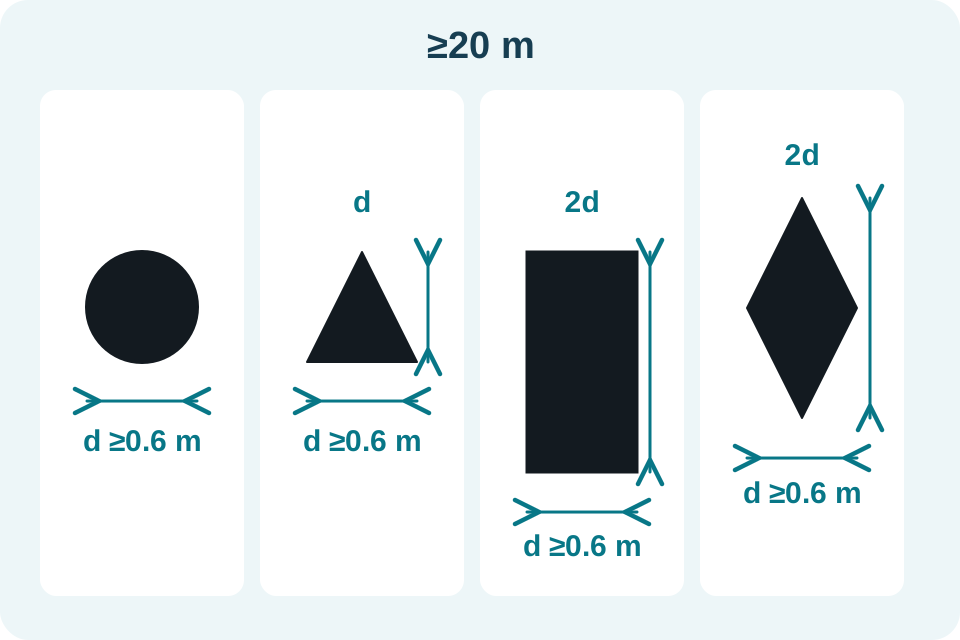
Shapes are black. On vessels of 20 m or more, a ball is at least 0.6 m across. A cone has a base diameter of at least 0.6 m and a height equal to that diameter. A cylinder is at least 0.6 m across and twice as high. A diamond is two such cones base to base. Vertical spacing is at least 1.5 m. Below 20 m, shapes may be proportionately smaller and spacing correspondingly reduced.
High-speed craft
A high-speed craft may carry its masthead light below the breadth-related height if the triangle seen end-on, with sidelights at its base, has both base angles at least 27°. For craft of 50 m or more, the 4.5 m vertical separation may be reduced only using Annex I 13(b), never below 2 m. Check the approved arrangement. The flag state approves the construction and fitting of lights and shapes.
Key figures
- Intensity formula
- I = 3.43 × 10⁶ × T × D² × K⁻ᴰ; T = 2 × 10⁻⁷ lux, K = 0.8
- Minimum intensity
- 1–6 NM respectively: 0.9, 4.3, 12, 27, 52, 94 cd
- Sidelight cut-off ahead
- Between 1° and 3° outside the sector
- Vertical sector
- Full minimum ±5°; ≥60 % ±7.5°; sail under way instead: ≥50 % ±25°
- Shapes, ≥20 m
- Ball, cone, cylinder ≥0.6 m across; spacing ≥1.5 m; black
- High-speed craft
- Lower masthead light allowed if base angle ≥27°
Remember
- Colours are fixed on the CIE chart; use type-approved lanterns.
- A 6 NM masthead light needs at least 94 cd.
- Sidelights cut off 1–3° outside their sector ahead.
- Full minimum intensity ±5° vertically, so lights stay visible as the ship rolls.
- On vessels ≥20 m, shapes are black, at least 0.6 m across and at least 1.5 m apart.
Common mistakes
Wrong: Fit a dimmer on the navigation lights to avoid glare on the bridge.
Right: Annex I says glare must not be limited by variable control of intensity. Use correctly rated, type-approved lights.
Wrong: Any LED of the right colour can replace a navigation lantern.
Right: Navigation lights must be approved by the flag and meet Annex I colour, intensity and sector rules.
Worked case
In port, a technician replaces your 6 NM masthead lantern with a cheaper LED fitting rated at 40 cd. He says it is bright enough. Is it acceptable?
Show the answer
No. A 6 NM light needs at least 94 cd under Annex I; 40 cd corresponds to between 4 and 5 NM. Intensity alone is insufficient: the lantern must also be approved and meet the colour and sector requirements. Fit an approved 6 NM lantern.
Practice question
A 3 NM lantern meets the 12 cd minimum, but has an unapproved replacement lens. Does intensity alone establish compliance?
- Yes: meeting the intensity table is sufficient
- Yes: any lens is acceptable at this intensity
- No: approval, colour and sectors also matter
- No: a 3 NM lantern must produce at least 52 cd
Show the answer
Answer: C. 12 cd meets the 3 NM intensity minimum. You must also use an approved arrangement that meets the colour and sector requirements; an unapproved replacement lens does not establish compliance.
3 · Fishing & sound
Annex II fishing signals and Annex III sound signal appliances
Annex II adds lights for fishing vessels working close together. Annex III sets whistle pitch, loudness and range by length, and the bell and gong.
Annex II: general
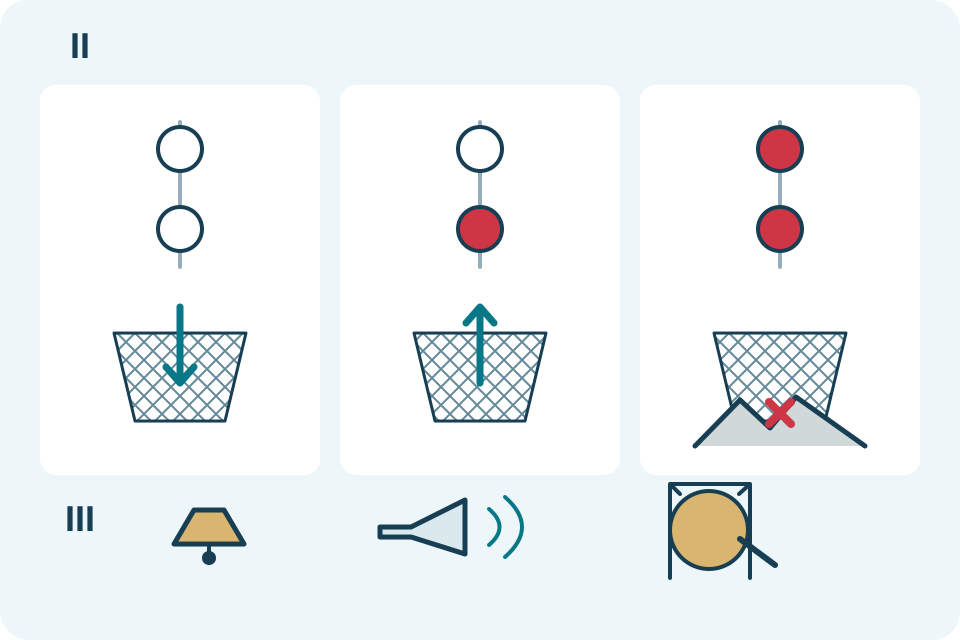
When fishing close to other fishing vessels, trawlers of 20 m or more must show the applicable Annex II signals. Smaller trawlers may show them; the purse-seine signal is optional. These extra lights are all-round, at least 0.9 m apart, below the main fishing lights, and visible for at least 1 NM (nautical mile), but less far than the main lights. They identify the gear operation, not the vessel’s speed or the exact position of all her gear.
Trawlers
A trawler of 20 m or more shows: two white in a vertical line when shooting, or paying out, the nets; white over red when hauling, or bringing them in; two red when the net is fast on an obstruction, meaning caught. In pair trawling, two vessels tow one net. By night, each vessel of 20 m or more shows a searchlight directed forward and towards the other vessel. Trawlers under 20 m may show these lights.
Purse seiners
A vessel fishing with purse seine gear may show two yellow lights in a vertical line, flashing alternately every second, with equal light and dark periods. She may show them only when hampered by her gear. A purse seine is a net used to encircle fish.
Whistles
Fundamental whistle pitch, measured in hertz (Hz), depends on length: 70–200 Hz at ≥200 m; 130–350 Hz at 75–<200 m; 250–700 Hz below 75 m. Minimum output at 1 m: 143/138/130 decibels (dB) for ≥200/75–<200/20–<75 m. For vessels ≥20 m, assess output in one-third-octave bands: narrow frequency bands within 180–700 Hz, distinct from fundamental pitch. Smaller-vessel bands and levels are in the facts. Typical still-air audibility: 2/1.5/1/0.5 NM for ≥200/75–<200/20–<75/<20 m. Wind and noise reduce it.
Placing whistles
Fit the whistle as high as practicable. At the ship's own listening posts, its sound must not exceed 110 dB(A), and so far as practicable 100 dB(A). Whistles more than 100 m apart must not sound together. A combined system, within 100 m and sounded together, counts as one whistle; each must differ in frequency by at least 10 Hz.
Bell and gong
A bell or gong gives at least 110 dB at 1 m. On vessels of 20 m or more the bell's mouth is at least 300 mm across, and the striker's mass is at least 3 % of the bell's. A power-driven striker is recommended, but manual use must stay possible. The bell and gong must have distinct tones.
Key figures
- Annex II lights
- All-round, ≥0.9 m apart, visible ≥1 NM, below main lights
- Whistle ≥200 m
- 143 dB at 1 m; typical audibility 2 NM
- Whistle 75–<200 m
- 138 dB at 1 m; typical audibility 1.5 NM
- Whistle 20–<75 m
- 130 dB at 1 m; typical audibility 1 NM
- Whistle <20 m: dB at 1 m by band
- 120/115/111 dB: 180–450/450–800/800–2,100 Hz; 0.5 NM
- Bell
- ≥110 dB at 1 m; mouth ≥300 mm for vessels ≥20 m
Remember
- Annex II lights are extra, 0.9 m apart, for fishing in close proximity.
- Trawler: 2 white shooting, white over red hauling, 2 red net fast.
- Purse seiner: 2 yellow, flashing alternately each second.
- Whistle 70–200 Hz and 2 NM for ships of 200 m or more.
- Bell mouth at least 300 mm for vessels of 20 m or more.
Common mistakes
Wrong: Two red lights under a trawler's lights mean she is not under command.
Right: On a trawler fishing close to others, two red lights in Annex II mean her net is fast on an obstruction.
Wrong: A 2 NM audibility range means your whistle will be heard at 2 NM.
Right: It is a typical figure in still air. Wind and background noise can reduce it greatly; never rely on being heard.
Worked case
A trawler fishing close to others shows additional white-over-red lights 0.5 m apart. They are visible for 3 NM, the same range as her main fishing lights. A colleague says the display complies because it correctly means hauling. Do you agree?
Show the answer
No. White over red correctly indicates hauling, but the additional all-round lights must be at least 0.9 m apart. They must be visible for at least 1 NM, but less far than the main fishing lights. Correct meaning alone does not make the installation compliant.
Practice question
A trawler fishing close to others shows two white lights in a vertical line below her trawling lights. What does it mean?
- She is hauling her nets
- Her net is fast on an obstruction
- She is pair trawling at night
- She is shooting her nets
Show the answer
Answer: D. Two white lights: shooting nets. White over red: hauling. Two red: net fast on an obstruction.
4 · Annex IV
Annex IV: the distress signals
Annex IV lists the signals that mean distress and need of help, from red flares to DSC and EPIRB alerts. Using them for anything else is forbidden.
What Annex IV is
Rule 37 says a vessel in distress and needing help uses or shows the signals in Annex IV. The list was last replaced by resolution A.1004(25), in force on 1 December 2009. No later amendment to Annex IV is in force as of 2026.
Sound and visual signals
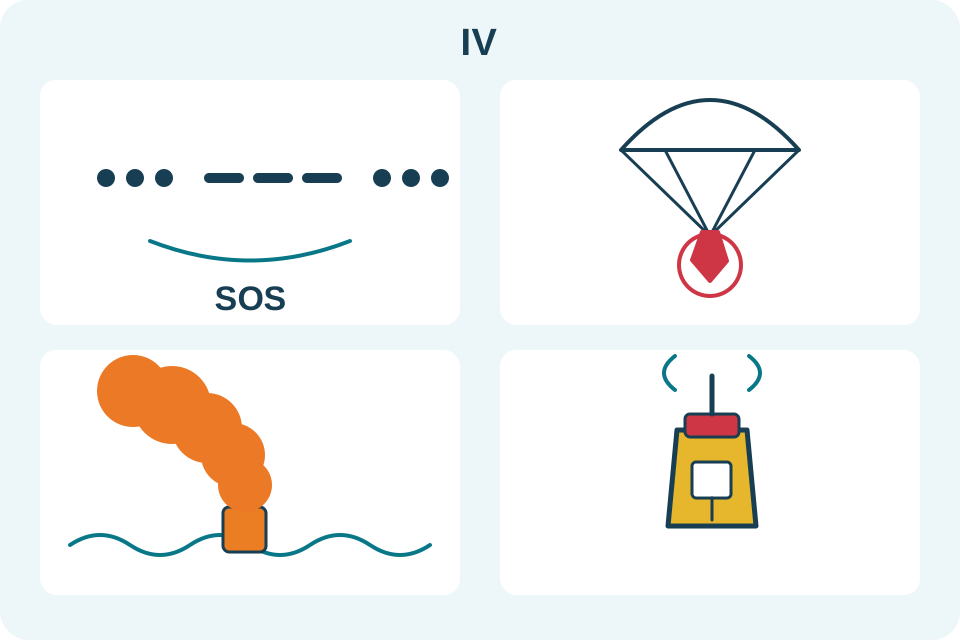
A gun or other explosive signal fired at intervals of about a minute. A continuous sounding of any fog-signal apparatus. Rockets or shells throwing red stars, fired one at a time at short intervals. A rocket parachute flare or a hand flare showing red. Orange smoke. Flames on the vessel. Slowly and repeatedly raising and lowering arms outstretched to each side.
Code and flag signals
SOS in Morse code by any signalling method. The spoken word MAYDAY by radiotelephony. The International Code signal NC: flags N (November) and C (Charlie). A square flag with a ball, or anything like a ball, above or below it.
Radio signals
A DSC (digital selective calling) distress alert on VHF channel 70, or on MF/HF 2187.5, 4207.5, 6312, 8414.5, 12577 or 16804.5 kHz. A ship-to-shore distress alert through Inmarsat or another mobile satellite service ship earth station. Signals from an EPIRB, an emergency position-indicating radio beacon. Approved signals from radiocommunication systems, including survival craft radar transponders.
Misuse and extras
Using any of these signals except for distress, or any signal that could be confused with them, is prohibited. Annex IV also points to the International Code of Signals, the International Aeronautical and Maritime Search and Rescue (IAMSAR) Manual, Volume III, an orange canvas with a black square and circle for aircraft, and a dye marker. How to use flares safely is in Helicopters and flares.
Key figures
- Current text
- Resolution A.1004(25), in force 1 December 2009
- DSC distress
- VHF ch 70; MF/HF 2187.5, 4207.5, 6312, 8414.5, 12577, 16804.5 kHz
- Explosive signal
- Fired at intervals of about a minute
- Code signal
- NC; or a square flag with a ball above or below
- Also referred to
- IAMSAR Vol. III; orange canvas; dye marker
Remember
- Rule 37 points to the distress signals in Annex IV.
- Annex IV text is A.1004(25), in force since 1 December 2009.
- Radio distress: DSC, satellite alerts, EPIRB, survival craft radar transponders.
- Visual: red flares, red stars, orange smoke, flames, arms raised and lowered.
- Using distress signals for any other purpose is prohibited.
Common mistakes
Wrong: A single white flare means distress.
Right: A white flare is used to attract attention or warn. Distress flares show red; smoke for distress is orange.
Wrong: A distress signal only counts if you also hear MAYDAY.
Right: Recognised distress signals may be used together or separately. Each can indicate distress on its own; radio confirmation is not required.
Worked case
You see a square flag with a ball below it. A colleague says distress requires the ball above the flag. Is the signal valid, and must you wait for another signal?
Show the answer
It is an Annex IV distress signal with the ball either above or below the square flag. These signals may be used together or separately. This signal alone indicates distress and need of assistance; you do not need a flare or radio call to confirm its meaning.
Practice question
Why does a casualty display orange canvas with a black square and circle?
- To show that dangerous cargo is on board
- To help aircraft identify the casualty
- To mark the safe side for passing ships
- To show that divers are working nearby
Show the answer
Answer: B. Annex IV draws attention to orange canvas with a black square and circle, or another appropriate symbol, for identification from the air.
5 · Rules 38–41
Rule 38 exemptions and Part F: verifying compliance
Rule 38 gave old ships time to adapt to the 1972 rules, and a few exemptions are permanent. Part F has IMO audit the states that apply the COLREG.
Who Rule 38 covers
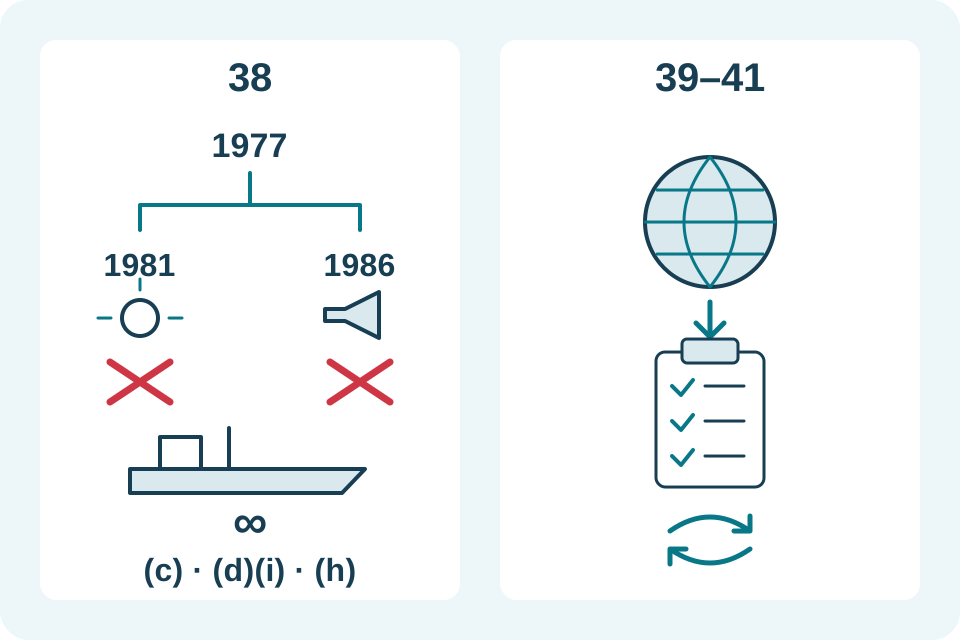
Rule 38 applies to a vessel that complies with the 1960 Collision Regulations and whose keel was laid, or which had reached a similar stage of construction, before the COLREG entered into force on 15 July 1977. Such a vessel may be exempted from certain technical requirements. Only the listed light and sound-appliance requirements may be exempted; steering and sailing rules still apply.
The 4- and 9-year exemptions
Light ranges under Rule 22 and the colour specifications of Annex I: until 4 years after entry into force, that is 15 July 1981. Repositioning of masthead lights on ships of 150 m or more under Annex I 3(a), of masthead lights under 2(b), and of sidelights under 2(g) and 3(b), plus Annex III sound appliances: until 9 years after, 15 July 1986. All of these have expired.
Permanent exemptions
Three stay permanent: repositioning of lights caused by converting from imperial to metric units and rounding off figures; repositioning of masthead lights on vessels of less than 150 m under Annex I 3(a), the horizontal spacing; and repositioning of all-round lights under Annex I 9(b). Today you meet them only on very old ships, still with their 1960-rule light layout.
Special construction
Separately, Rule 1(e) lets a government decide that a vessel of special construction or purpose, such as a warship or a cable ship, cannot fully comply with the rules on lights, shapes or sound appliances. She then complies as closely as possible, as her government decides. So an unusual light layout is not always a fault.
Part F: Rules 39–41
Part F, added by resolution A.1085(28) and in force since 1 January 2016, links the COLREG to the IMO Member State Audit Scheme (IMSAS). Rule 39 defines audit and the audit standard, the III Code, the IMO Instruments Implementation Code. Rule 40 says governments use the III Code to carry out their duties. Rule 41 makes each government subject to periodic IMO audits. Part F audits states, not ships.
Key figures
- Rule 38 covers
- 1960-compliant; keel laid/equivalent stage before 15 July 1977
- 4-year exemptions
- Light ranges, colours: expired 15 July 1981
- 9-year exemptions
- Masthead ≥150 m, sidelights, Annex III: expired 15 July 1986
- Permanent exemptions
- Metric rounding; masthead spacing <150 m; all-round lights 9(b)
- Part F
- A.1085(28), in force 1 January 2016; IMSAS and the III Code
Remember
- Only 1960-compliant ships keel-laid or at an equivalent stage before 15 July 1977 may qualify.
- The 4- and 9-year exemptions ended in 1981 and 1986.
- Three exemptions are permanent, all about repositioning lights.
- Rule 1(e) allows closest possible compliance for special vessels.
- Part F (Rules 39–41) audits states through IMSAS since 2016.
Common mistakes
Wrong: Rule 38 exempts old ships from the steering and sailing rules.
Right: It covers only listed technical items: light ranges, colours, positions and sound appliances.
Wrong: Part F lets IMO auditors inspect your ship's lights.
Right: Part F audits governments against the III Code; it does not establish a ship-inspection regime.
Worked case
You review a 120 m ship keel-laid in 1975 and compliant with the 1960 Regulations. Her masthead lights are 40 m apart. Her owner also claims an Annex III whistle exemption. Which exemptions could still apply?
Show the answer
Rule 38 allows a permanent exemption from masthead-light repositioning under Annex I 3(a) for eligible ships under 150 m. Check that the exemption applies to this ship; age and 1960 compliance alone do not establish it. The Annex III exemption expired on 15 July 1986, so it cannot excuse a non-compliant whistle today.
Practice question
A 1960-compliant vessel reached a construction stage equivalent to keel laying on 1 July 1977, but her keel was laid in August. Which construction cutoff applies under Rule 38?
- Keel laid or equivalent stage before 15 July 1981
- Keel laid or equivalent stage before 15 July 1986
- Keel laid or equivalent stage before 15 July 1977
- Keel laid or equivalent stage before 1 January 2016
Show the answer
Answer: C. Rule 38 requires compliance with the 1960 Regulations and either keel laying or a corresponding construction stage before 15 July 1977. Her equivalent stage on 1 July meets that cutoff despite the later keel laying. A particular listed exemption still needs to be established.