
COLREG: rules of the road · Level R4 · 5 parts · about 17 min
Radar and collision avoidance: Rules 7, 8 and 19 in depth
5 short parts: Look-out, speed · Risk of collision · CPA and TCPA · Rule 19 · Effective action. Each part explains the idea, then gives the points to remember, the common mistakes, a worked case and a practice question; the Academy unit adds all 31 check questions.
1 · Look-out, speed
Look-out and safe speed with radar: Rules 5 and 6
Radar is part of a proper look-out, not a replacement for eyes and ears. It adds to what you must weigh when you choose a safe speed.
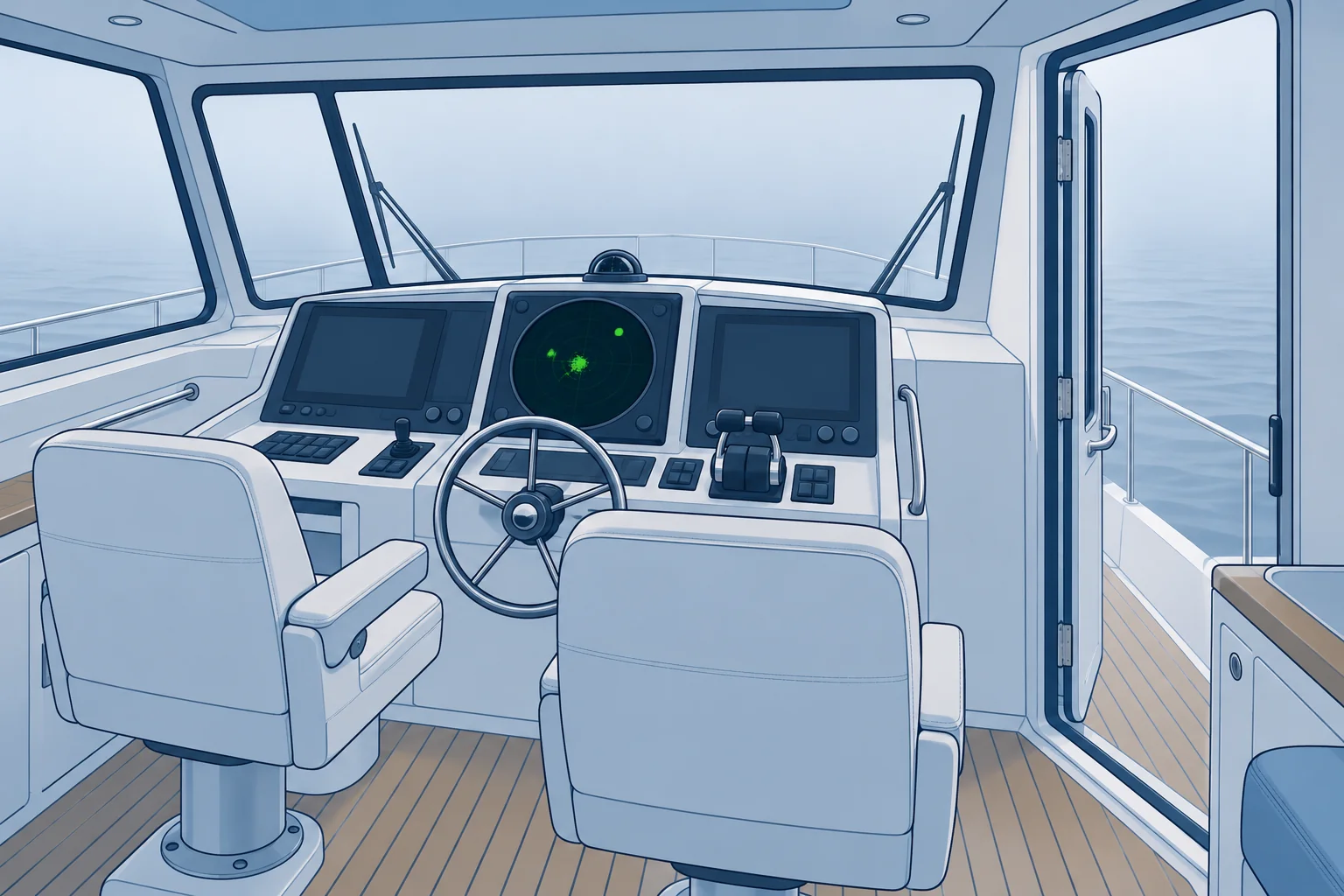
All available means
Rule 5 requires a proper look-out at all times, by sight and hearing and by all available means. Radar and the Automatic Identification System (AIS) support it when available and appropriate. In fog, assign a dedicated look-out when crew are available, and share helm, navigation and radar duties so none is neglected.
Radar adds factors
Rule 6(a) lists the factors for all vessels. With operational radar, Rule 6(b) adds six: equipment characteristics, efficiency and limits; range-scale constraints; sea state, weather and interference; small craft, ice and floating objects possibly missed at adequate range; detected vessels’ number, location and movement; and a better visibility estimate by comparing radar ranges with what you can see. Radar measures range, not fog thickness.
What radar misses
A wooden or glass-reinforced plastic (GRP) yacht, a kayak or a small fishing boat can return a weak echo, lost among waves near you in sea clutter or behind heavy rain in rain clutter. A mast or a funnel can hide a sector, called a blind sector. Too much anti-clutter wipes out real echoes along with the noise. Radar does not show everything; its presence alone does not justify a higher speed.
Long-range scanning
Rule 7(b) asks for long-range scanning to get early warning. Look at a longer range, say 12 nautical miles (M) on a yacht radar, to see ships coming early. Then work on a shorter range, 3 to 6 M, to plot them and to see small echoes. Changing scale now and then is part of the look-out. The Radar on a small vessel unit teaches the controls.
AIS helps, but
AIS supports your look-out. Many small craft carry no AIS, and reports can be late or wrong. Its predicted closest passing distance assumes unchanged motion. Cross-check with radar, sight and hearing; never base avoiding action on AIS alone. Full text: /colreg/rule-5 and /colreg/rule-6.
Key figures
- Rule 5
- Look-out by sight, hearing and all available means
- Rule 6(a)
- Six factors for all vessels
- Rule 6(b)
- Six more for vessels with operational radar
- Rule 7(b)
- Long-range scanning and systematic observation
- Typical yacht radar ranges
- Scan at about 12 M; plot at 3–6 M
Remember
- Radar and AIS are part of a proper look-out when the conditions call for them.
- Operational radar adds factors; choose speed from all prevailing conditions.
- Small craft can hide in sea and rain clutter or in a blind sector.
- Scan at long range for early warning, then plot on a shorter range.
Common mistakes
Wrong: With radar on, we can keep our normal speed in fog.
Right: Radar adds factors to Rule 6. It may miss small craft, so speed must still suit the visibility.
Wrong: AIS shows every vessel near you.
Right: Many small craft carry no AIS, and reports may be late or wrong. Radar and eyes remain essential.
Worked case
Fog closes in during a crossing. Your crew wants to keep 7 knots because the radar is on and the 3 M range looks empty.
Show the answer
An empty screen does not prove an empty sea: small boats can hide in clutter, and 3 M gives little warning of a fast ship. Reduce to a speed at which you can avoid collision and stop in time, have the engine ready, and post a look-out. Scan at 12 M for early warning, then plot targets on a shorter range.
Practice question
Which of these is one of the Rule 6(b) factors for a vessel with operational radar?
- The schedule the vessel has to keep
- The radar range scale in use
- The number of crew on watch
- The brand of radar fitted
Show the answer
Answer: B. Rule 6(b)(ii): any constraints imposed by the radar range scale in use. Schedules are never a safe-speed factor.
2 · Risk of collision
Is there a risk of collision? Rule 7 with radar
Use every means you have, plot, not guess, and if in doubt, treat the risk as real. A steady bearing is the classic warning sign.
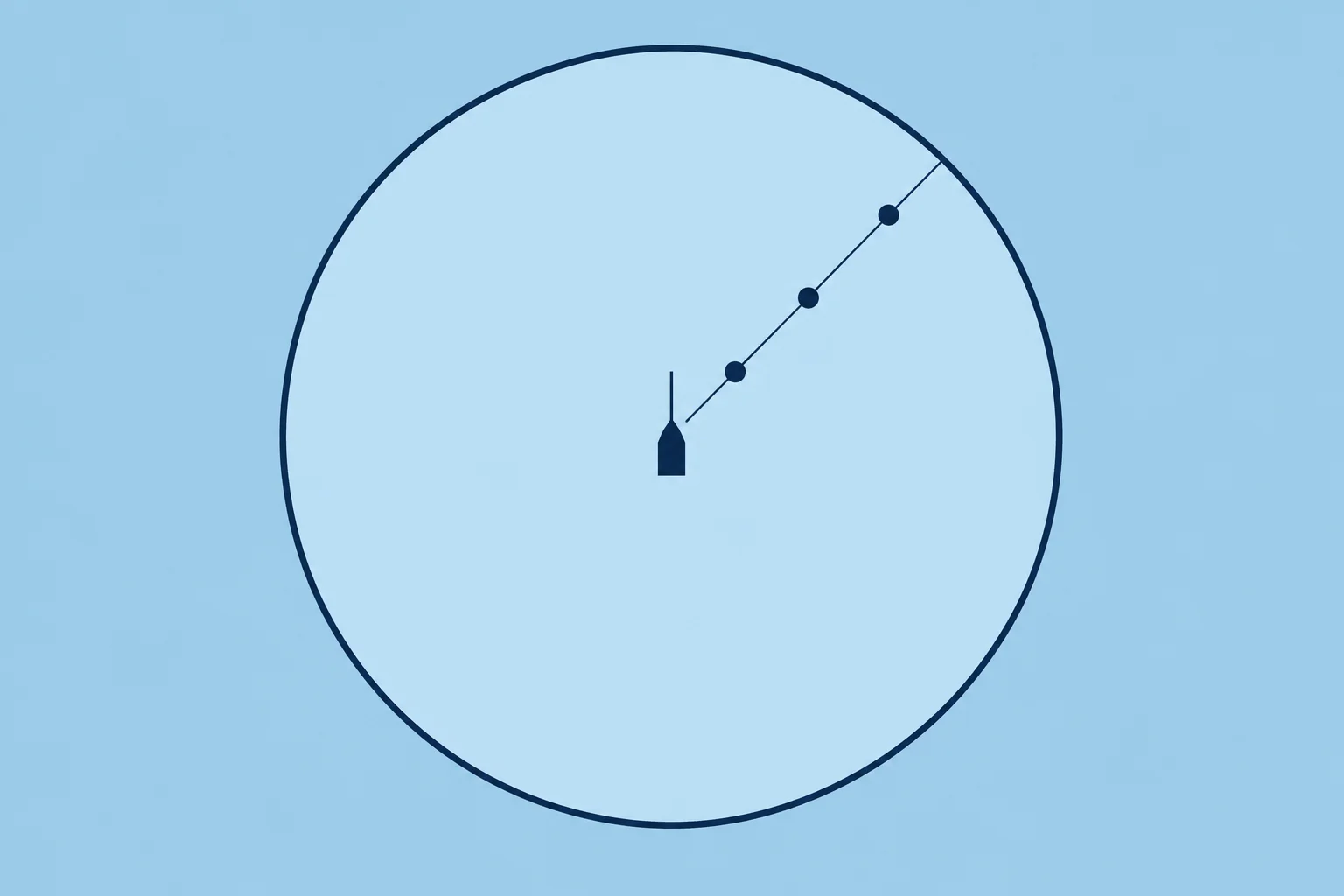
All available means
Rule 7(a): every vessel uses all available means appropriate to the circumstances to decide whether risk of collision exists. If there is any doubt, such risk shall be deemed to exist. You never need proof of danger before you act; you need proof of safety before you relax.
The steady bearing
Risk of collision is deemed to exist if the compass bearing of an approaching vessel does not appreciably change (Rule 7(d)(i)). Use compass bearings rather than bearings relative to your bow when your own heading changes. A small bearing change alone does not establish safety.
When a changing bearing lies
Risk may exist even with an appreciable bearing change (Rule 7(d)(ii)), especially with a very large vessel, a tow or a vessel at close range. A changing bearing to the bow or tug does not prove that you will clear the whole vessel or tow. At close range, an appreciable bearing change can still leave too little passing distance, even if neither vessel alters course. Watch the range too.
Scanty information
Assumptions shall not be made on the basis of scanty information, especially scanty radar information (Rule 7(c)). A single observation, a quick look at a trail, or an AIS number alone cannot establish safety. Several observations improve confidence; never delay necessary action for a fixed plot count. Reassess a target first seen at close range or one that may have altered.
Systematic observation
Rule 7(b) requires radar plotting or equivalent systematic observation. Repeat at intervals suited to the closing speed. Keep course and speed steady only while safe. An automatic radar plotting aid (ARPA), mini automatic radar plotting aid (MARPA) or AIS supports assessment. Check predictions against observations. CPA means closest point of approach; TCPA means time to CPA. Continue checking after either vessel manoeuvres. Full text: /colreg/rule-7.
Systematic observation of a radar target
- Assess risk immediately; if in doubt, deem risk to exist. — Do not wait for a fixed plot count before taking necessary avoiding action.
- Repeat observations at intervals suited to the closing speed. — Build a reliable trend. Keep course and speed steady only while safe; shorten intervals as needed.
- Cross-check automatic predictions against current observations. — A displayed CPA or TCPA assumes unchanged motion. If observations disagree, reassess immediately.
- Continue assessment after either vessel manoeuvres, until past and clear. — Changes can invalidate earlier predictions. Check that avoiding action remains effective.
Remember
- If in doubt, risk of collision is deemed to exist (Rule 7(a)).
- A compass bearing that does not appreciably change, on a closing target, means risk.
- Large ships, tows and close range can be dangerous even with a changing bearing.
- Use repeated observations to check the trend; never delay necessary action to complete a plot.
Common mistakes
Wrong: The bearing has moved 2°, so she will pass clear.
Right: A small change does not establish safety, especially at close range or with a large ship. If in doubt, deem risk to exist now.
Wrong: We must complete three plots before taking action.
Right: Rule 7 sets no minimum plot count. Several observations improve confidence; never delay necessary action to finish a plot.
Wrong: ARPA shows CPA, so plotting is unnecessary.
Right: ARPA is equivalent systematic observation only if you check its data and watch for changes.
Worked case
In fog, a vessel detected by radar alone at 7 M on your starboard bow moves from 040° to 038° in 6 minutes while closing. Your crew says the bearing change means no risk.
Show the answer
The small bearing change does not establish safety. If in doubt, deem risk to exist now. Continue systematic observation at intervals suited to the closing speed, but do not hold course and speed just to finish three plots. Take avoiding action in ample time under Rule 19 and check its effect until past and clear.
Practice question
You are not sure whether risk of collision exists. What does Rule 7 say?
- Wait until the bearing becomes steady
- Assume the other vessel will keep clear
- Such risk shall be deemed to exist
- Call the vessel and ask her intentions
Show the answer
Answer: C. Rule 7(a): if there is any doubt, such risk shall be deemed to exist.
3 · CPA and TCPA
CPA and TCPA: a worked radar plot
Plot the echo, draw its line of relative movement and read how close it will come and when. Then work out her true course and speed.
Relative motion
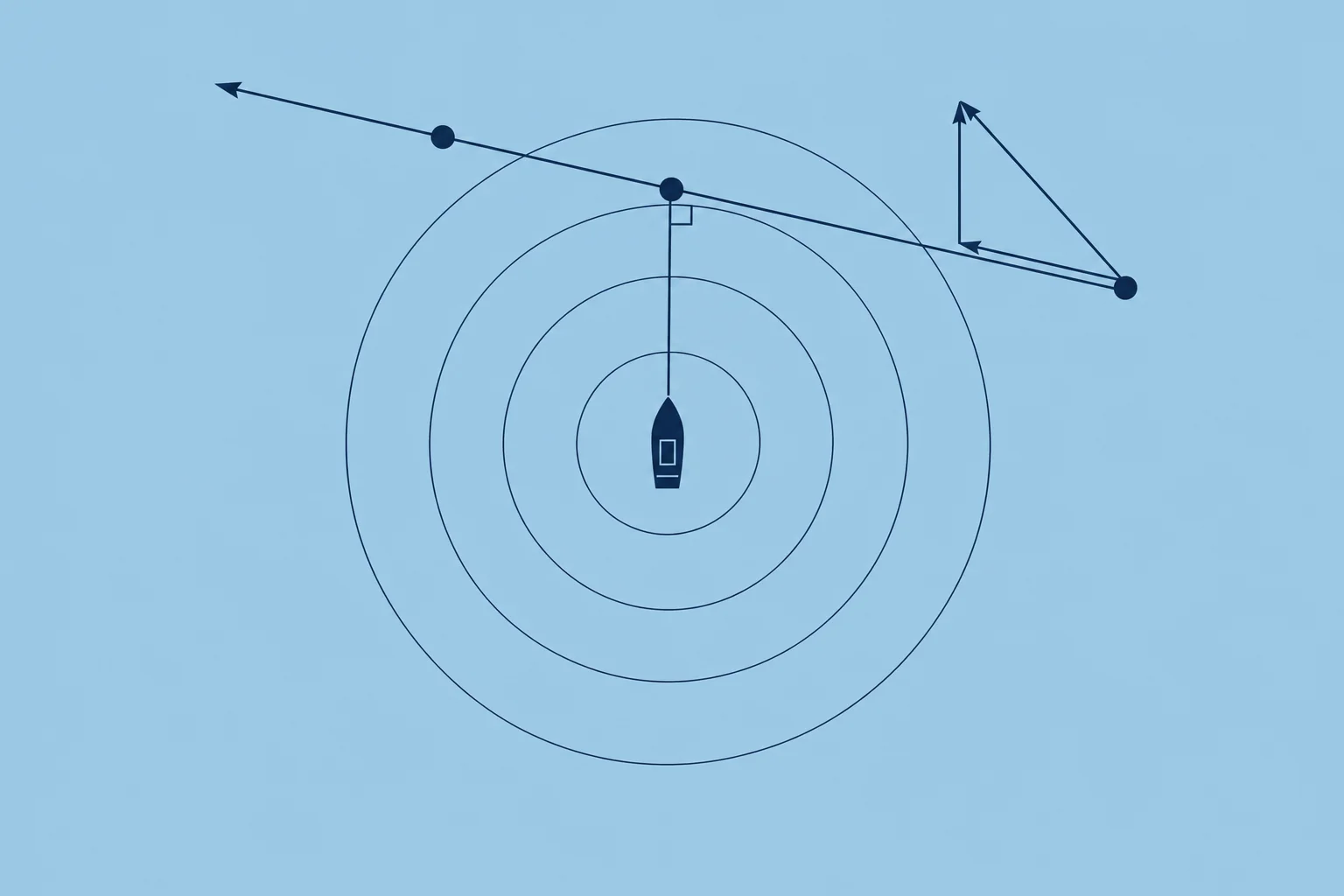
A relative-motion display fixes your screen position; echoes move relative to you. A fixed buoy appears to move as you pass it. With both vessels steady, successive target plots form a relative-motion line. Extend it ahead. Drop a perpendicular from your position to it: its length is the CPA, closest point of approach. TCPA, time to closest point of approach, is the time until then. Relative trails also show relative movement.
The worked example
Use true bearings (from true north) and nautical miles (M), with no current or leeway. You steer 000° at 6 knots in fog. A target is at 050°/8.0 M at 10:00, 049°/6.8 M at 10:06 and 048°/5.6 M at 10:12. Its relative track is about 2.4 M in 12 minutes. CPA is about 0.7 M on your port bow, below this exercise’s chosen 1 M minimum. That minimum is a planning choice, not a rule.
Relative speed and TCPA
Relative speed = relative distance ÷ time: 2.4 M in 12 minutes = 12 knots. The six-minute rule helps: distance in 6 minutes × 10 = speed in knots. From the 10:12 plot to the CPA is about 5.6 M along the line. TCPA = 5.6 ÷ 12 hours, about 28 minutes, so CPA comes at about 10:40.
Her true course and speed
In 12 minutes you ran 1.2 M north. From the 10:00 plot, draw your own run backwards, 1.2 M towards 180°, to point W. The line from W to the 10:12 plot is her true movement: about 1.98 M towards 264°. Her plotted true course is about 264° at about 10 knots, crossing from your starboard side.
True or relative display
Relative motion keeps your vessel at a fixed screen position; true motion moves it across the display. Trail settings are separate: relative trails show relative movement for CPA assessment; true trails show target tracks. Ground stabilisation measures movement over the ground. In ground-stabilised true motion, fixed objects stay still between display resets. Check both the motion mode and trail setting. Practise at /navigation/radar-simulator.
Key figures
- CPA
- Closest point of approach: nearest distance on the relative line
- TCPA
- Distance along the line to CPA ÷ relative speed
- Six-minute rule
- Distance in 6 minutes × 10 = speed in knots
- Worked example, CPA
- CPA about 0.7 M on your port bow, at about 10:40
- Worked example, target
- About 264°, 10 knots
Remember
- On a relative display, echoes move along the relative-motion line.
- CPA is the shortest distance from you to that line; TCPA is the time to reach it.
- Six-minute rule: distance in 6 minutes × 10 = speed in knots.
- Lay your own run back from the first plot to W; W to the last plot gives her true movement over the interval.
Common mistakes
Wrong: The echo moves along her true course on the screen.
Right: On a relative display it moves along the relative line, which combines her motion with yours.
Wrong: A target crossing ahead is safe because she is faster.
Right: Read the CPA. In this exercise it is about 0.7 M, below the chosen passing margin.
Wrong: TCPA is the range divided by her speed.
Right: Use the relative speed, from the plots, and the distance along the line to the CPA.
Worked case
In fog, with the target not visually in sight, you steer 180° at 5 knots. It plots at 200°, 6 M at 14:00 and 200°, 5 M at 14:06. Your crew says the 30-minute TCPA means action can wait.
Show the answer
Assuming steady motion, CPA is near zero. The echo moves 1 M in six minutes: 10 knots relative speed. At 14:06, TCPA is 5 ÷ 10 hours = 30 minutes, giving CPA at 14:36. That is assessment time, not permission to wait. Treat the steady closing bearing as risk now, continue observations and choose early effective action under Rule 19.
Practice question
On a relative-motion display, what does the line through a target’s plots show?
- Her true course and speed over the ground
- Her movement relative to your own vessel
- The course she will steer after altering
- The direction of the tidal stream there
Show the answer
Answer: B. The plots show her motion relative to you. Her true motion needs your own run added.
4 · Rule 19
Rule 19: action when vessels are not in sight
When vessels are not in sight in or near restricted visibility, neither is stand-on. Assess risk and act in ample time.
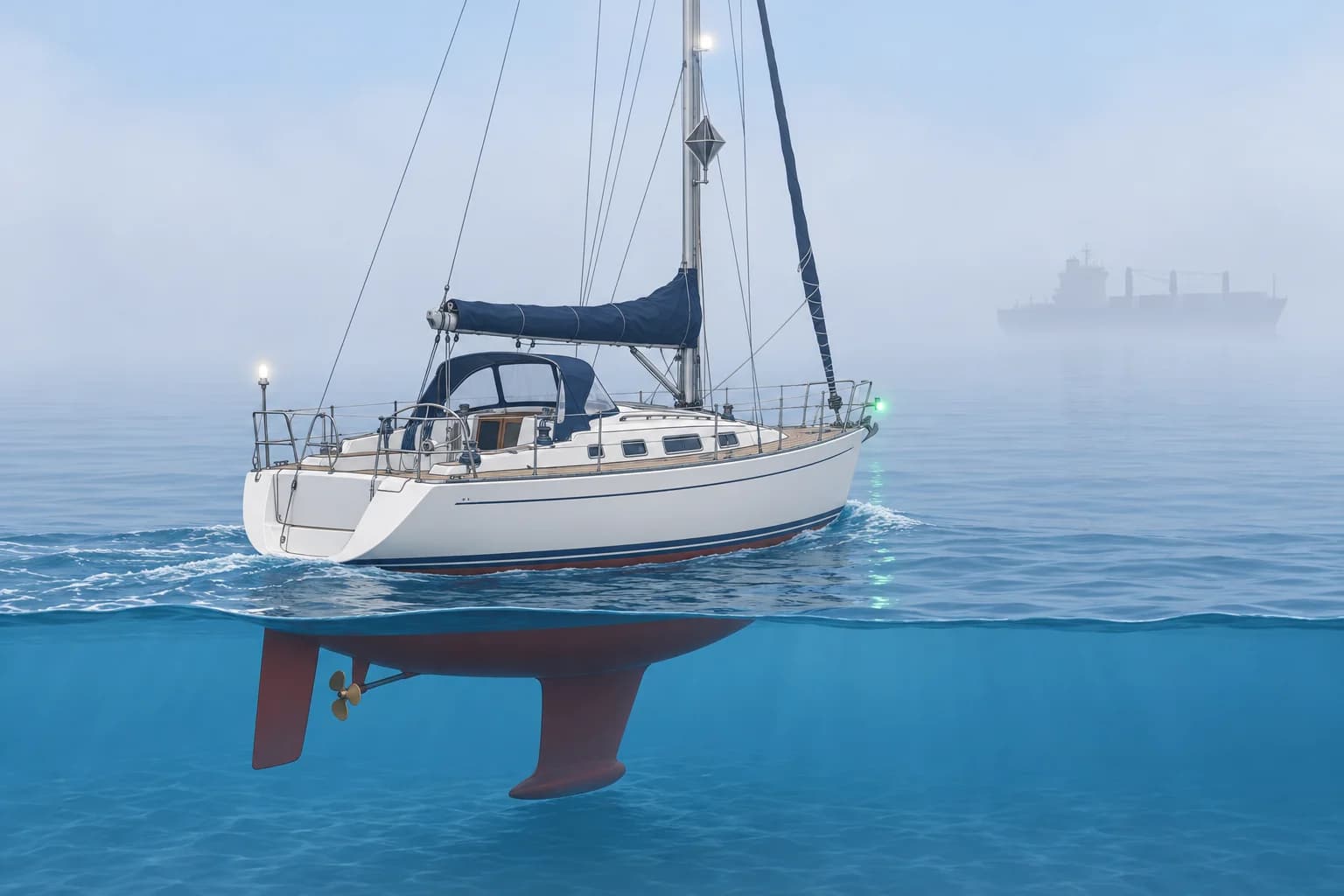
When Rule 19 applies
Rule 19 covers vessels not in sight of one another in or near an area of restricted visibility. You may be in clear air near a fog bank and still be under it. Once either vessel can be observed visually from the other, Rules 11 to 18 apply instead. Under Rule 19 there is no stand-on and no give-way vessel: whoever detects risk acts.
Speed and engines
Every vessel proceeds at a safe speed for the conditions, and a power-driven vessel keeps her engines ready for immediate manoeuvre (Rule 19(b)). For a sailing yacht, having auxiliary propulsion ready is prudent seamanship; Rule 19(b) does not require every sailing yacht to keep its engine running. An engine running without propelling you does not make you power-driven. Every vessel applies Rules 4 to 10 with poor visibility in mind (Rule 19(c)).
Detected by radar alone
A vessel that detects another by radar alone decides whether a close-quarters situation is developing or risk of collision exists. If so, she acts in ample time. The Rules set no distance for close quarters. Choose a passing margin suited to the conditions; no fixed CPA guarantees safety.
The two turns to avoid
The beam runs across your boat: abeam means alongside; abaft means behind the beam. When altering course, so far as possible avoid: (i) a port alteration for a vessel forward of the beam, except one you are overtaking; (ii) an alteration towards a vessel abeam or abaft the beam. These restrictions do not make the remaining choices safe. Check that your action gives a safe passing distance, with room for other traffic.
A fog signal ahead
Unless you have found that no risk exists, slow down when you hear a fog signal apparently forward of the beam, or cannot avoid close quarters with a vessel forward of the beam. Go to the minimum speed at which you can keep your course (Rule 19(e)). If necessary, take all way off (remove your forward movement), and navigate with extreme caution until danger of collision is over. Full text: /colreg/rule-19.
A radar contact in fog
- Assess risk and close quarters now; continue systematic observation. — Treat doubt as risk. Do not wait for more plots before necessary action.
- Decide early whether the CPA is acceptable. — Action must be taken in ample time.
- Note where she is: forward of the beam, abeam or abaft. — That decides which turns Rule 19(d) tells you to avoid.
- Choose and verify an early action that respects Rule 19(d), safe speed, sea room and other traffic. — A permitted turn or speed change can still worsen CPA. Check for a safe passing distance without creating another close-quarters situation.
- Unless you have established that no risk exists, a fog signal or unavoidable close quarters forward of the beam requires minimum course-keeping speed. — Take all way off if necessary; navigate with extreme caution until danger is over.
- Keep plotting until she is past and clear. — She may act too; Rule 8(d) requires you to check.
Remember
- Rule 19 applies to vessels not in sight in or near restricted visibility; no one stands on.
- Keep a safe speed; power-driven vessels need engines ready for immediate manoeuvre.
- So far as possible, avoid a port turn for a vessel forward of the beam (unless overtaking her).
- So far as possible, avoid turning towards a vessel abeam or abaft the beam.
- Unless risk is ruled out: fog signal or unavoidable close quarters ahead; minimum course-keeping speed; all way off if needed.
Common mistakes
Wrong: A radar target on your port bow in fog must give way to you, as in Rule 15.
Right: Rules 11 to 18 apply only in sight. Under Rule 19 every vessel acts when she detects risk.
Wrong: Turn to port to pass astern of a radar contact crossing from port.
Right: So far as possible, avoid a port alteration for a vessel forward of the beam unless overtaking her. Check any alternative against safe speed, sea room, other traffic and predicted CPA.
Wrong: After hearing a fog signal ahead, keep your speed so you clear the area fast.
Right: Unless you have established that no risk exists, a fog signal or unavoidable close quarters forward of the beam requires minimum course-keeping speed. Take all way off if necessary; use extreme caution until danger is over.
Worked case
In fog, a vessel detected by radar alone is 30° abaft your starboard beam at 3 M, closing with a steady bearing. You are motoring at 5 knots.
Show the answer
So far as possible, avoid a starboard alteration towards her. A port alteration may be suitable, but bearing alone cannot establish its effect. Choose early action giving a safe passing distance, with sea room and other traffic checked. Increase speed only if it remains safe for the visibility. Keep plotting until she is past and clear, and keep engines ready.
Practice question
In fog, you detect a closing vessel by radar alone on your port bow. Risk exists and you are not overtaking. Which alteration should you avoid so far as possible?
- An alteration of course to starboard
- An alteration of course to port
- A reduction in your speed
- Taking all way off your boat
Show the answer
Answer: B. Rule 19(d)(i): avoid an alteration to port for a vessel forward of the beam, other than one being overtaken.
5 · Effective action
Effective action: Rule 8 and checking that it works
Act early, make a change big enough to see on radar, and keep plotting. Compare course and speed changes to find a safe passing distance.
Early and positive
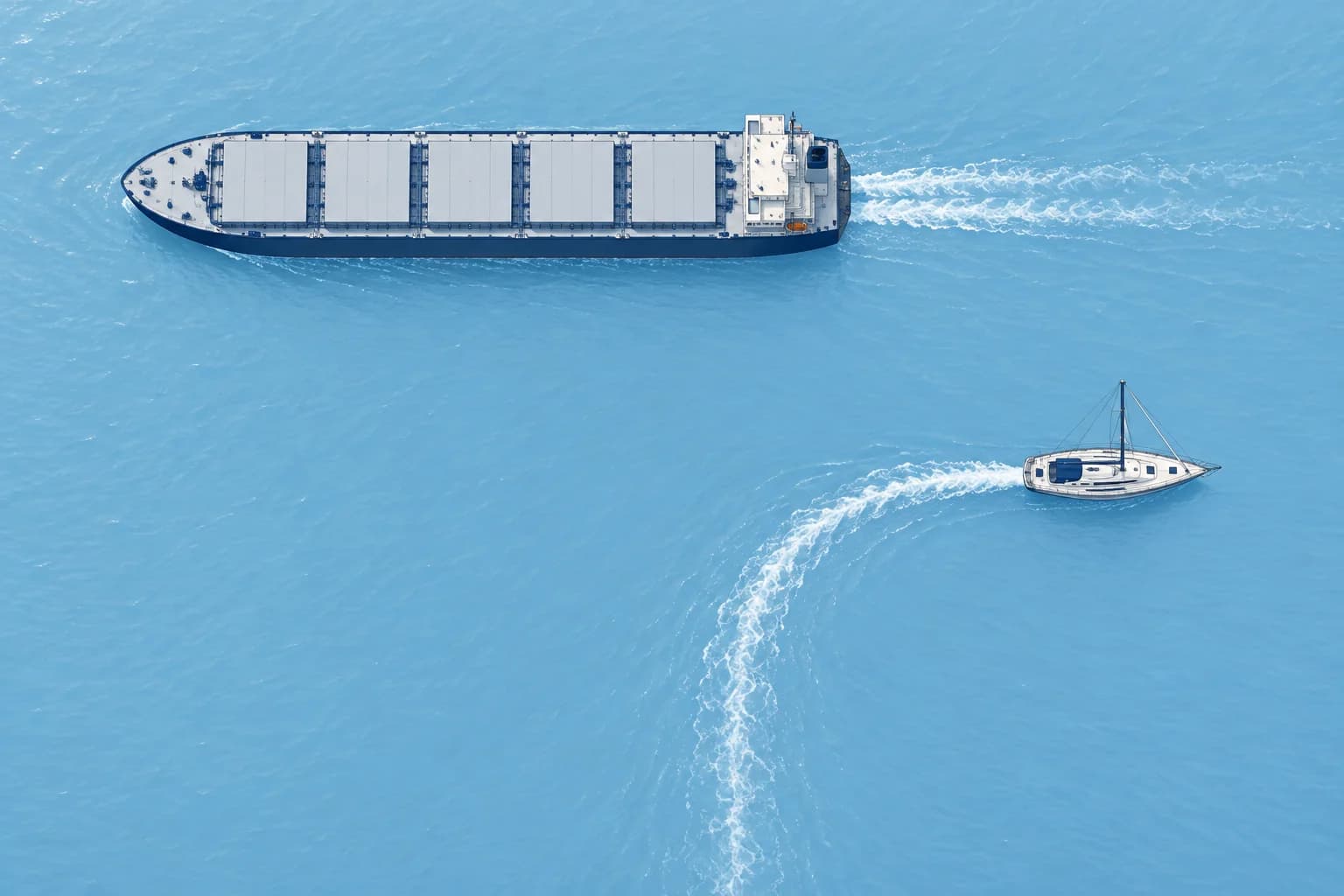
Rule 8(a): if the circumstances admit, action to avoid collision is positive, made in ample time, and follows good seamanship. Rule 8(b): if the circumstances admit, any change of course or speed is large enough to be readily apparent to a vessel watching by eye or radar. Avoid a succession of small alterations: another vessel may not notice them.
How big is big?
The Rules set no minimum angle. Choose a substantial alteration that is readily apparent and produces a safe passing distance. With sea room, a course alteration alone may be the most effective action, if it is in good time, substantial, and does not create another close-quarters situation (Rule 8(c)).
Slow down or stop
Rule 8(e) requires you to slacken speed or take all way off when necessary to avoid collision or gain assessment time. For this comparison, assume an immediate manoeuvre and unchanged target course and speed. At 10:12, stopping predicts a CPA of about 3.3 M instead of 0.7 M; reducing to 3 knots predicts about 1.9 M. Real boats take time and distance to slow or turn. Check the actual result.
Compare the turns
With an immediate course change and unchanged target motion, turning to 030°, 30° to starboard, predicts a CPA of about 1.6 M. Turning to 090° predicts about 3.5 M, with her passing down your port side. Turning to port to 300° predicts about 0.1 M: almost a collision course. No predicted distance is guaranteed. Allow for the boat’s response time. Check sea room and other traffic before choosing an action.
Check until clear
Action must result in passing at a safe distance. Check its effectiveness until the other vessel is finally past and clear (Rule 8(d)). After you act, use new observations to reassess CPA and TCPA. Confirm a safe passing distance. If the margin remains unsafe, take further effective action. Either vessel’s manoeuvre can change the prediction. Resume your intended course only when safe. Full text: /colreg/rule-8.
Key figures
- Rule 8(a)
- Positive, in ample time, good seamanship
- Rule 8(b)
- Readily apparent if circumstances admit; avoid small steps
- Rule 8(e)
- Slacken speed, stop or go astern if necessary
- Idealised example: stop at 10:12
- Predicted CPA about 3.3 M, assuming an immediate stop
- Idealised example: turn to 090°
- Predicted CPA about 3.5 M, her passing down your port side
- Idealised example: turn to port, 300°
- Predicted CPA about 0.1 M: much worse
Remember
- Act early, and make one large change rather than several small ones.
- No fixed angle guarantees safety; make the alteration readily apparent and check the resulting CPA.
- Slowing or stopping can avoid collision or give you assessment time; check the resulting passing distance.
- Keep plotting until she is past and clear.
Common mistakes
Wrong: Alter 5° now and another 5° later if needed.
Right: Small steps are hard to see on radar. Make one large, early alteration.
Wrong: Once you have altered, the job is done.
Right: Rule 8(d): check the result until the other vessel is past and clear.
Wrong: Stopping is a sign of poor seamanship; always alter course instead.
Right: Rule 8(e) requires slowing or taking all way off when necessary. Compare the predicted passing distances; stopping is not always safest.
Worked case
At 10:12 in the worked example, your crew suggests a 10° turn to starboard now and another later if needed. Sea room is clear and no other traffic constrains you.
Show the answer
A 10° starboard turn predicts a CPA of about 0.9 M, below this exercise’s 1 M minimum. With clear sea room and other traffic checked, a substantial turn to 090° predicts about 3.5 M, or stopping predicts about 3.3 M. These assume immediate manoeuvres and unchanged target motion. Allow for the boat’s response time. Keep plotting until she is past and clear; resume your intended course only when safe.
Practice question
Why does Rule 8(b) say to avoid a succession of small alterations?
- Because small turns waste fuel and time
- Because the other vessel may not notice them
- Because Rule 19 forbids any course change
- Because only speed changes count as action
Show the answer
Answer: B. Rule 8(b): changes should be large enough to be readily apparent to a vessel observing visually or by radar.