
Maritime English and signals · Level P3 · 4 parts · about 12 min
Morse code and light signals
4 short parts: Morse code · Signalling lamp · Light procedure · Letters by light. Each part explains the idea, then gives the points to remember, the common mistakes, a worked case and a practice question; the Academy unit adds all 25 check questions.
1 · Morse code
Morse code: letters, numbers and timing
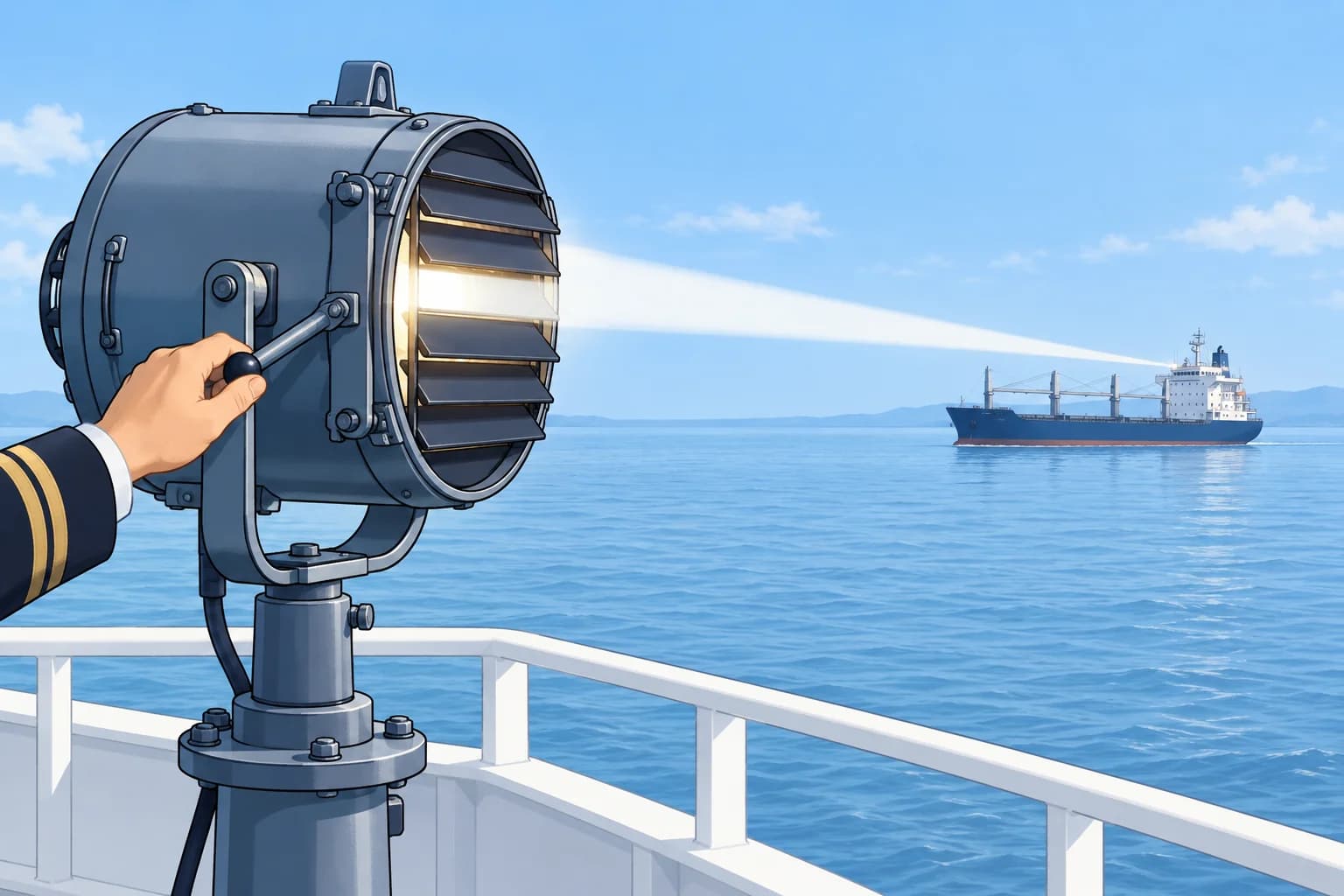
Morse code turns letters into short and long signals. The rhythm matters as much as the symbols: dot 1, dash 3, gaps of 1, 3 and 7.
Dots and dashes
Morse code writes each letter and figure as a pattern of short signals, dots (·), and long signals, dashes (–). You can send it by flashing light, by sound, by radio, or by hand flags and arms. The International Code of Signals sets the symbols and the timing for ships.
Letters
A ·–; B –···; C –·–·; D –··; E ·; F ··–·; G ––·; H ····; I ··; J ·–––; K –·–; L ·–··; M ––; N –·; O –––; P ·––·; Q ––·–; R ·–·; S ···; T –; U ··–; V ···–; W ·––; X –··–; Y –·––; Z ––··
Figures
Figures have five elements. 1 to 5 start with dots: 1 ·––––, 2 ··–––, 3 ···––, 4 ····–, 5 ·····. 6 to 0 start with dashes: 6 –····, 7 ––···, 8 –––··, 9 ––––·, 0 –––––. For 1–5, count the leading dots. For 6–9, add 5 to the leading dash count. Five dashes means 0.
Timing
The dot is the unit. A dash lasts 3 units. The gap between elements of one symbol is 1 unit, between letters 3 units, and between words or groups 7 units. The Code advises making dots slightly short, to keep them clearly different from dashes. Its standard rate for flashing light is 40 letters a minute; send slower and clearly rather than fast and wrong.
SOS
SOS, ···–––···, is a distress signal under COLREG Annex IV when made by any signalling method. Keep one-unit gaps between elements, but no letter gaps. Pause before repeating. Practise in pairs indoors, with the light hidden from outside view. Send five mixed letters or figures, write down what you receive, compare results, then repeat errors slowly. Swap roles and increase speed only when you both read accurately.
Key figures
- Dot
- 1 unit
- Dash
- 3 units
- Gaps
- Within a symbol 1; between letters 3; between words 7
- ICS standard rate (light)
- 40 letters per minute
- SOS
- ···–––··· with element gaps, no letter gaps
- Figures
- Five elements: 1 ·––––, 5 ·····, 6 –····, 0 –––––
Remember
- Dot 1 unit, dash 3; gaps of 1 within a symbol, 3 between letters, 7 between words.
- Numerals use five elements. For 1–5, count leading dots; for 6–9, add 5 to leading dashes. Zero is five dashes.
- Make dots slightly short so dots and dashes stay distinct.
- Send SOS as one symbol: ···–––···. Keep element gaps; omit letter gaps.
Common mistakes
Wrong: Decode a live signal by counting marks on a printed chart.
Right: Use the chart to check patterns during practice. Learn each letter’s rhythm so you can recognise it directly.
Wrong: Send SOS as three separate letters, S O S.
Right: Keep one-unit gaps between elements, but no letter gaps. Pause before repeating SOS.
Wrong: Speed proves skill, so send as fast as you can.
Right: Even rhythm and clear gaps matter more. A message sent slowly and read correctly is the only one that counts.
Worked case
Practising with a torch, your cadet sends ‘K’ as dash, short pause, dot, short pause, dash, but the pauses are as long as the dashes. You read ‘T E T’. What went wrong?
Show the answer
The gaps inside a symbol must be 1 unit, as long as a dot. Her gaps were 3 units, which is the gap between letters, so you read three letters instead of one. Ask her to keep the elements of K tight, –·–, and to leave 3 units only after the whole letter.
Practice question
How long is a dash compared with a dot?
- Twice as long
- Three times as long
- Five times as long
- Seven times as long
Show the answer
Answer: B. The dot is the unit and a dash is three units.
2 · Signalling lamp
The daylight signalling lamp and when to use light
SOLAS requires a daylight signalling lamp or equivalent means on ships ≥150 GT and all passenger ships. Use light when VHF or a shared language fails.
The requirement
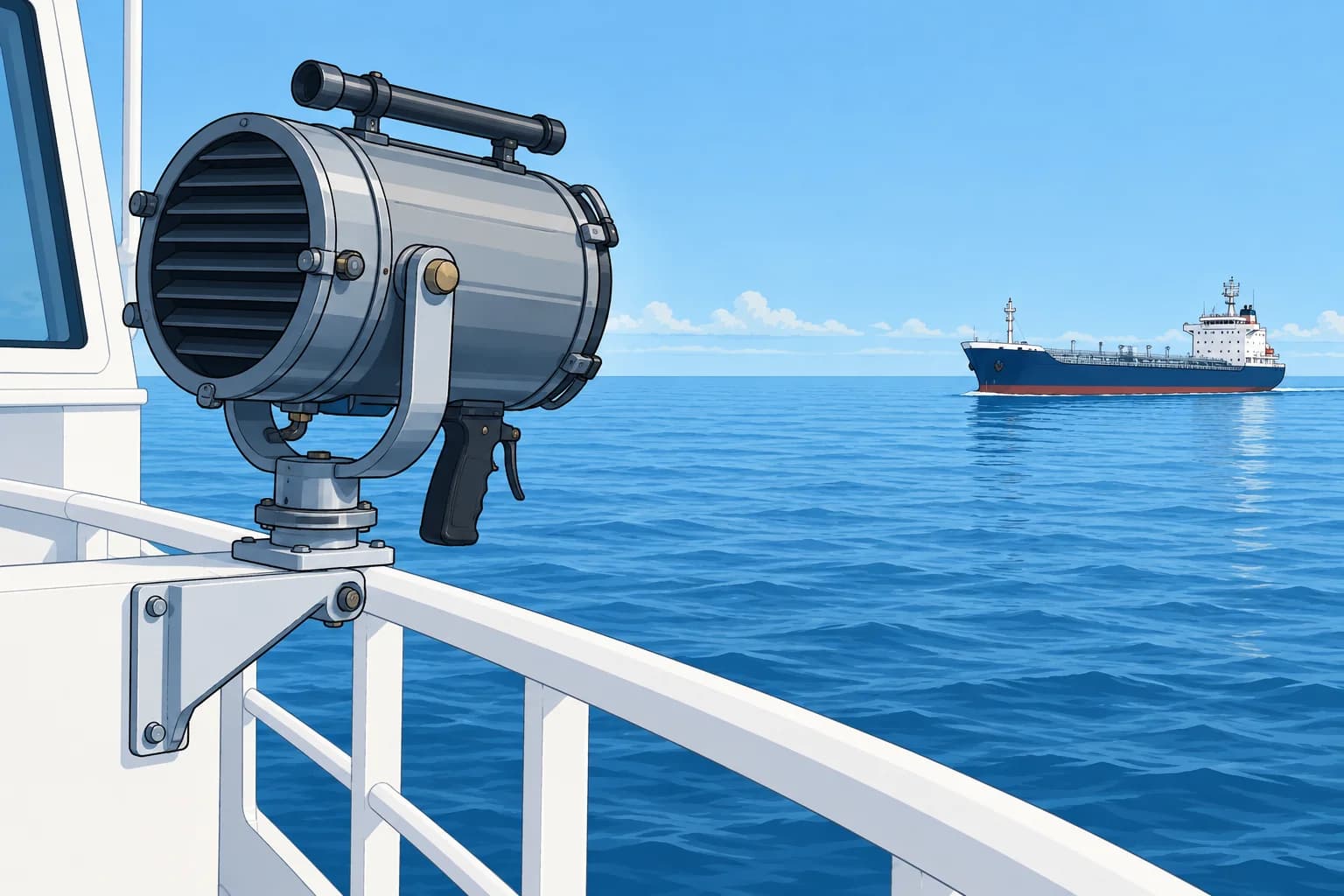
SOLAS V/19 requires every ship of 150 gross tonnage and upwards, and every passenger ship, to carry a daylight signalling lamp, or other means to communicate by light by day and night. Its power must not depend solely on the ship’s supply. The IMO performance standard, MSC.95(72), adds a portable battery weighing no more than 7.5 kg that runs the lamp for at least 2 hours.
The lamp
Many officers call it an Aldis lamp. A trigger opens a shutter or tilts a mirror, so the beam flashes without switching the lamp on and off. A sight on top lets you aim the narrow beam at the other ship’s bridge. Brace your arms, keep the beam steady on target and test the lamp and battery at each equipment check.
Your STCW competence
STCW table A-II/1 asks an officer of the watch to transmit and receive information by visual signalling. That means using the International Code of Signals, and sending and receiving SOS and single-letter signals by Morse light. Full messages by lamp are now rare and are not the core of the standard.
When light helps
Use VHF first: it is faster and you can talk. Light still helps when a ship does not answer the radio, when a radio has failed, when you share no language, or to reach one ship in a crowd. A single-letter Code signal is quick to send if the receiver knows its meaning. Keep light messages short.
Key figures
- Carriage (SOLAS V/19)
- Ships ≥150 GT and all passenger ships; lamp or equivalent means
- Power
- Not solely dependent on the ship’s supply
- Portable battery (MSC.95(72))
- ≤7.5 kg, at least 2 hours’ operation
- STCW A-II/1 by light
- SOS and single-letter signals in Morse
Remember
- Ships ≥150 GT and all passenger ships carry a daylight signalling lamp or equivalent means.
- Its power must not depend only on the ship’s supply; check the battery regularly.
- STCW asks for SOS and single-letter signals by Morse light, and use of the Code.
- Use VHF first; light helps when radio or a shared language fails.
Common mistakes
Wrong: Flash the lamp in the general direction of the other ship.
Right: Aim the narrow beam with the sight at the other ship’s bridge and hold it steady.
Wrong: The lamp runs from the ship’s mains, so a blackout is not a problem.
Right: That is why it needs power not solely dependent on the ship’s supply. Keep the portable battery charged.
Worked case
At night, VHF calls go unanswered. You can see the other ship’s bridge. Your lamp works from the mains, but its portable battery is flat. Can you rely on it as an independently powered back-up?
Show the answer
No. With its battery flat, the lamp depends entirely on the ship’s supply. Restore independent power or use a suitable independently powered light-signalling alternative. Light can help after unanswered VHF calls. Use the sight to aim steadily at the other bridge and keep the message short. Keep trying VHF and report the lack of response to the master.
Practice question
Which option gives the complete SOLAS V/19 carriage categories for a lamp or equivalent means?
- Ships ≥500 GT and all passenger ships
- Ships ≥150 GT and all passenger ships
- Ships ≥150 GT, except passenger ships
- Ships ≥500 GT, except passenger ships
Show the answer
Answer: B. Ships ≥150 GT and passenger ships of any size must carry a lamp or other means of communicating by light by day and night.
3 · Light procedure
Flashing light procedure: call, identity, text and ending
A flashing light signal has four parts: the call, the identity, the text and the ending. Short procedure signals keep both stations in step.

The call
To call a station whose identity you do not know, or all stations in sight, send the general call AA AA AA … until it answers. Otherwise call with its identity signal. The station called answers with the answering signal TTTT … and keeps it going until you stop calling.
The identity
You send DE, meaning ‘from’, then your identity signal or name. The receiver repeats it back, then sends her own identity, which you repeat back. Once two stations are already working, they may leave out the call and identity.
The text
The text is plain language or Code groups. Send YU before Code groups. The receiver acknowledges each word or group with T. AAA is a full stop or decimal point. AS asks the other station to wait, or separates groups. If you make an error, send the erase signal EEEEEE …; the receiver answers with the erase signal, and you repeat the last correct word and continue.
Repeats
RPT means “I repeat” when followed immediately by your repetition. Otherwise, as sender, it requests a readback: “Repeat what you have received”. As receiver, use RPT to request “Repeat what you have sent”. Add AA (all after), AB (all before), WA (word after), WB (word before) or BN (all between). For example, RPT AB KL means “Repeat all before KL”. Acknowledge a correct repetition with OK. For a received but unintelligible message, send ZL instead.
The ending
Send AR to end the signal or the transmission. The receiver answers R, ‘Received’. In the general call, join each AA pair without a letter gap. After RPT, AA means “all after”: send two separate A letters. Join AR, AS and AAA without letter gaps; keep normal gaps between their elements.
Key figures
- General call
- AA AA AA …; send each AA pair as one symbol
- Answering signal
- TTTT … until the caller stops
- Word or group received
- T
- Erase
- EEEEEE …, answered with the erase signal
- Ending / received
- AR answered by R
- Wait / group separator
- AS = wait or separate groups; AAA = full stop or decimal point
Exchanging a short message by lamp
- Send AA AA AA … (or the station’s identity) until you see TTTT. — Nothing is read until the other station is watching.
- Send DE and your identity; check it is repeated back, then repeat hers. — Both stations know exactly who is talking.
- Send each word or group, waiting for T after each one. — T confirms receipt before you go on.
- If you send a word or group incorrectly, send EEEEEE and wait for the receiver’s erase signal. Repeat the last correct word or group, then continue. — The receiver strikes out only the wrong part.
- Finish with AR and wait for R. — R confirms the whole signal was received.
Remember
- Four parts: call (AA AA AA or identity), identity (DE …), text, ending (AR).
- TTTT answers a call; T acknowledges each word or group; R acknowledges AR.
- EEEEEE erases the last word; RPT with AA, AB, WA, WB or BN asks for a part again.
- AS means wait; AAA is a full stop or decimal point; YU comes before Code groups.
Common mistakes
Wrong: Start sending the text as soon as you think the other ship is looking.
Right: Wait for the answering signal TTTT. Until then nobody is reading.
Wrong: Answer the ending signal AR with T.
Right: T acknowledges a word or group. AR is answered with R, ‘Received’.
Wrong: Send RPT when a decoded group makes no sense.
Right: Use RPT to request repetition or a readback. If you received the signal but cannot understand its meaning, send ZL.
Worked case
You are sending ‘PILOT BOARDING DELAYED’ by lamp. After you send ‘BOARDING’ you realise you flashed ‘BORDING’. The receiver has already sent T. What do you do?
Show the answer
Send the erase signal, EEEEEE, and wait for her to answer with the erase signal. Then repeat the last word that was correct, ‘PILOT’, and continue: ‘BOARDING’, ‘DELAYED’, waiting for T after each word. Finish with AR and wait for R.
Practice question
Which signal calls an unknown station by flashing light?
- TTTT
- AA AA AA
- DE DE DE
- CQ CQ CQ
Show the answer
Answer: B. AA AA AA is the general call or call for an unknown station by flashing light. CQ is for flags and radio.
4 · Letters by light
Single-letter signals by light and sound, and SOS
A few single letters by lamp say a lot, fast. Ten of them must not be sounded except as the COLREGs require, because they are COLREG sound signals.

Letters worth knowing
U ··– ‘You are running into danger’. L ·–·· ‘You should stop your vessel instantly’. K –·– ‘I wish to communicate with you’. X –··– ‘Stop carrying out your intentions and watch for my signals’. V ···– ‘I require assistance’. W ·–– ‘I require medical assistance’. O ––– ‘Man overboard’. D –·· ‘Keep clear of me; I am manoeuvring with difficulty’.
Letters and the COLREGs
The Code marks B, C, D, E, G, H, I, S, T and Z with an asterisk. By sound, they may be made only in compliance with the COLREGs, because they match COLREG whistle signals.
SOS and landing signals
SOS, ···–––···, by light or any other method is a distress signal in COLREG Annex IV. The life-saving signals referred to in SOLAS use letters to guide small boats landing persons in distress. K by light or sound means ‘This is the best place to land’. S means ‘Landing here highly dangerous’; S followed by R or L adds that a better place lies to the right or left in the boat’s direction of approach.
How to practise
Practise in pairs indoors, with the light hidden from outside view. Use a torch for ten minutes. Start with SOS and the letters above, then mix them. Your partner reads each symbol aloud and gives its meaning. Swap roles. Keep the timing clear before increasing speed.
Key figures
- U ··–
- You are running into danger
- L ·–··
- You should stop your vessel instantly
- K –·–
- I wish to communicate with you
- V ···– / W ·––
- I require assistance / I require medical assistance
- By sound only per COLREG
- B, C, D, E, G, H, I, S, T, Z
- Landing signals: right/left in the boat’s direction of approach
- K best place to land; S dangerous; S+R / S+L better place right / left
Remember
- U, L, K, X, V, W, O and D are the single letters you are most likely to need by lamp.
- Never sound the asterisked letters except as the COLREGs allow.
- SOS by light is a COLREG Annex IV distress signal.
- K and S are also landing signals for small boats with persons in distress.
Common mistakes
Wrong: Sound D, –··, on the whistle to ask a nearby ship to keep clear while you manoeuvre.
Right: Send D’s Code meaning by lamp. Sound an asterisked letter only when the COLREGs authorise that sound signal.
Wrong: K always means “I wish to communicate with you”.
Right: Context matters. In the life-saving landing signals, K means “This is the best place to land”.
Wrong: D by lamp means ‘I am in distress’.
Right: D means ‘Keep clear of me; I am manoeuvring with difficulty’. Distress by light is SOS.
Worked case
From the shore, you guide a lifeboat that wants to land survivors on a beach. The surf where she is heading is heavy, but a sheltered cove lies 300 m to the right as she approaches. What can you signal by lamp?
Show the answer
Send S, ···, followed by R, ·–·: ‘Landing here highly dangerous; a better place lies to the right in your direction of approach.’ When she reaches the cove, signal K, –·–, ‘This is the best place to land’, from the landing point. Use VHF too if she has a radio.
Practice question
A ship flashes ··– at you. What does it mean?
- I require assistance
- You are running into danger
- I wish to communicate
- Stop your vessel instantly
Show the answer
Answer: B. ··– is U, ‘You are running into danger’.