
Maritime English and signals · Level R5 · 5 parts · about 15 min
Nautical English: key phrases, pilot books and forecasts in English
5 short parts: Radio English · SMCP intro · Port and marina · Pilot books · Forecasts. Each part explains the idea, then gives the points to remember, the common mistakes, a worked case and a practice question; the Academy unit adds all 29 check questions.
1 · Radio English
Radio English: letters, numbers, positions and times
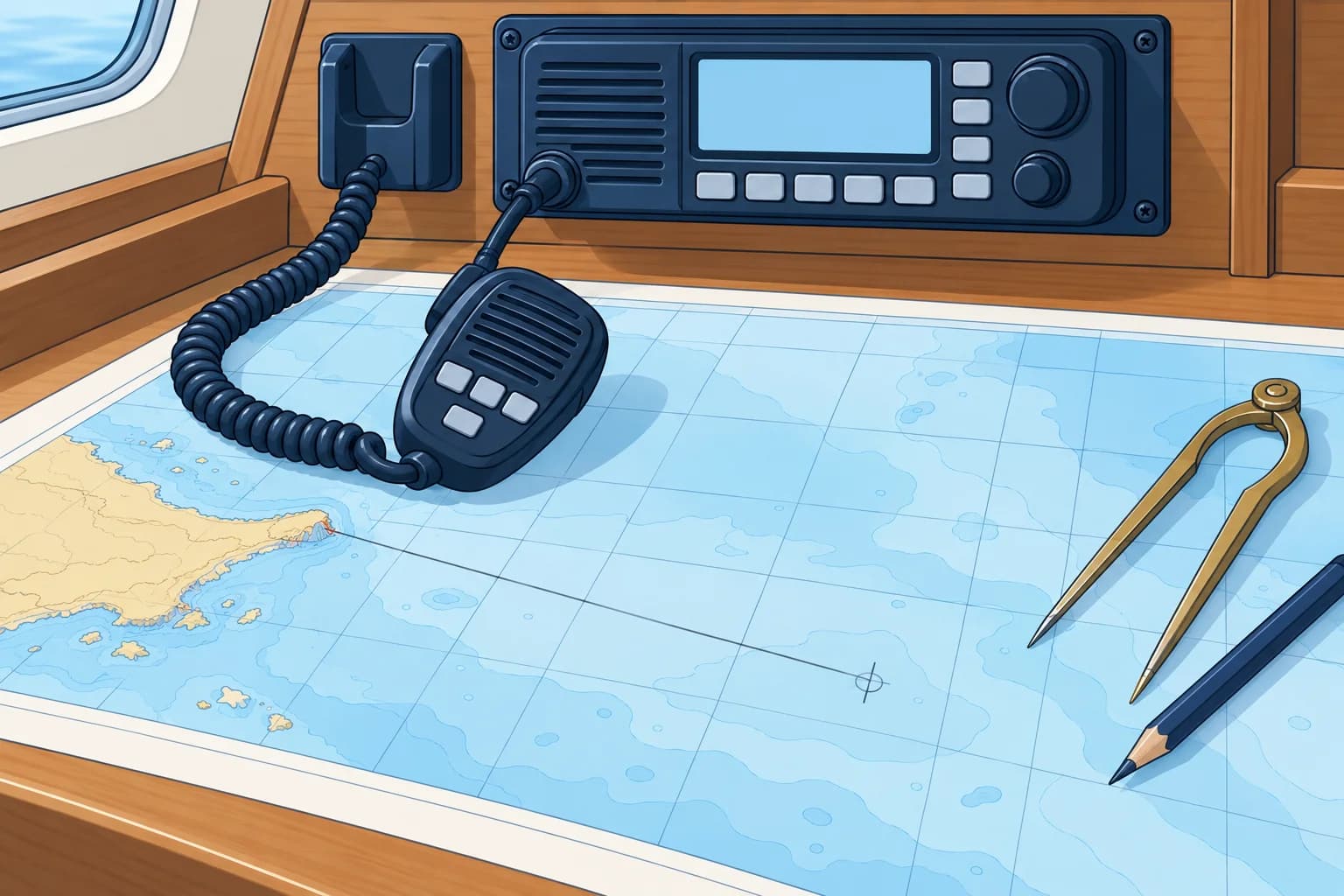
On the radio, small slips with numbers cause big mistakes. Say letters, numbers, positions, bearings and times the standard way, every time.
Why a standard
English is the common language at sea, but most people using it are not native speakers. Radio adds noise and distortion. The IMO Standard Marine Communication Phrases (SMCP), adopted in 2001 as resolution A.918(22), set out simple, fixed ways to say things so that they cannot be misunderstood. This part covers the basics every skipper needs; the full SMCP has its own unit.
Letters
Use the international spelling alphabet for names and call signs. See the GMDSS module for the alphabet and practice.
Numbers
Speak numbers digit by digit: 150 is ‘one-five-zero’. Some digits are pronounced differently from everyday English, to stay clear on the radio: ZEERO, WUN, TOO, TREE, FOWER, FIFE, SIX, SEVEN, AIT, NINER, and TOUSAND for 1,000. Say decimals as ‘decimal’ or ‘point’: 2.5 is ‘two decimal five’. The exception is rudder angle in a wheel order: say ‘fifteen’, not ‘one-five’.
Positions and bearings
Give latitude and longitude in degrees and minutes, with North or South and East or West. Or give a position from a charted mark: a true bearing in 360° notation from the mark, and the distance. Example: ‘My position two-two-five degrees from Punta Anaga lighthouse, three decimal two miles.’ Courses are also in 360° notation, true unless you say otherwise.
Units and times
Give distances in nautical miles or cables (tenths of a mile), always naming the unit. Speed is in knots: plain ‘knots’ means speed through the water; say ‘ground speed’ for speed over the ground. Times are in the 24-hour clock and UTC; if you use local time, say so. Use place names as they appear on the chart or in the sailing directions.
Key figures
- Numbers
- Digit by digit: 150 = one-five-zero
- Special pronunciation
- TREE, FOWER, FIFE, AIT, NINER, TOUSAND
- Decimals
- ‘Decimal’ or ‘point’: 2.5 = two decimal five
- Position from a mark
- True bearing FROM the mark, then distance
- Speed
- Knots through the water; ‘ground speed’ over the ground
- Times
- 24-hour UTC; say if you use local time
Remember
- Use the international spelling alphabet; see the GMDSS module for practice.
- Say numbers digit by digit, with the radio pronunciation such as TREE, FIFE and NINER.
- A position from a mark is the true bearing from the mark, then the distance.
- Name the unit for every distance; plain ‘knots’ means speed through the water.
- Give times in UTC on the 24-hour clock, unless you clearly say local time.
Common mistakes
Wrong: ‘My position is the lighthouse bearing 045, 3 miles.’
Right: Give the bearing from the mark: ‘My position two-two-five degrees from the lighthouse, three miles.’
Wrong: Say 150 as ‘a hundred and fifty’.
Right: Say ‘one-five-zero’: separate digits cannot be confused with 115 or 160.
Wrong: ‘ETA ten o'clock.’
Right: ‘ETA one-zero-zero-zero UTC’, or say clearly that it is local time.
Worked case
You must report your position by radio. The lighthouse on Punta Anaga bears 045° true from you, at 3.2 miles. Your speed through the water is 6.5 knots and your speed over the ground 5.8 knots. How do you give your position and speed?
Show the answer
The bearing from the mark is the reciprocal: 045 + 180 = 225°. Say: ‘My position two-two-five degrees from Punta Anaga lighthouse, distance three decimal two nautical miles. My speed six decimal five knots, ground speed five decimal eight knots.’
Practice question
How do you say a course of 150° on the radio?
- One hundred fifty degrees
- One-five-zero degrees
- Fifteen-zero degrees
- One-fifty degrees
Show the answer
Answer: B. Numbers are spoken in separate digits so that they cannot be confused.
2 · SMCP intro
SMCP basics: message markers, replies and corrections
A few standard words make the purpose of a message clear: is it an instruction, advice or a warning? Learn the markers, the replies and how to correct yourself.

Message markers
Before a message you may say one of eight message markers: INSTRUCTION, ADVICE, WARNING, INFORMATION, QUESTION, ANSWER, REQUEST and INTENTION. They tell the listener what kind of message follows. Vessel Traffic Services use them often. ‘QUESTION. What is your ETA?’ cannot be mistaken for a statement.
Instruction or advice
An INSTRUCTION must come from a sender authorized for that situation. Follow it unless you have safety reasons not to; report those reasons. ADVICE is a recommendation: the decision stays with you, but consider it carefully. A WARNING reports danger, and INFORMATION reports facts; what you do about them is up to you.
Standard replies
Answer yes or no in full: ‘Yes, I have a pilot on board’, not just ‘Yes’. If you need time, say ‘Stand by’ and how long. If you cannot get the information, say ‘No information’. To an instruction or advice, reply ‘I will’ or ‘I will not’, followed by the instruction in full: ‘I will not overtake the vessel north of me.’
Corrections and repeats
If you make a mistake, say ‘Mistake’, then ‘Correction’ and the right version: ‘My speed one-four knots, mistake. Correction, my speed one-two knots.’ To stress something vital, say ‘Repeat’ and say it again. If you did not hear a message, say ‘Say again’.
Words to avoid
Avoid may, might, should and could: they can sound like permission, a guess or a suggestion. Ask ‘QUESTION. Do I have permission to enter the fairway?’ If you have decided, say ‘INTENTION. I will anchor.’ If undecided, say ‘I have not decided whether to anchor.’ Say “I will”, not “I’ll”. Use one phrase for each meaning.
Key figures
- Message markers 1–4
- Instruction, Advice, Warning, Information
- Message markers 5–8
- Question, Answer, Request, Intention
- INSTRUCTION
- Authorized instruction: follow unless unsafe; report your reason
- ADVICE
- A recommendation: the decision stays with you
- Correction
- ‘Mistake … Correction …’ then the right version
- Avoid
- May, might, should, could; contractions
Remember
- Eight message markers tell the listener what kind of message follows.
- Follow an authorized instruction unless unsafe; report your reason. Advice leaves the decision to you.
- Answer yes or no in full; say ‘Stand by’ with a time if you need it.
- Correct yourself with ‘Mistake … Correction …’.
- Avoid may, might, should and could: use a marker and a plain statement.
Common mistakes
Wrong: ‘May I enter the harbour?’
Right: ‘QUESTION. Do I have permission to enter the harbour?’
Wrong: Treat ADVICE from a VTS centre as an order you must obey.
Right: ADVICE is a recommendation: consider it carefully, then decide. Follow an authorized instruction unless unsafe; report your reason.
Wrong: Reply ‘Yes’ or ‘OK’ to a question.
Right: Reply in full: ‘Yes, I will proceed to the anchorage.’
Worked case
VTS says, ‘INSTRUCTION. Proceed to berth one-two.’ Your yacht draws 2.3 m, but the marina confirms only 2.0 m of water at that berth. How do you reply and request a safe alternative?
Show the answer
‘I will not proceed to berth one-two. My draught is two decimal three metres; depth at that berth is two decimal zero metres. REQUEST. I require a berth with sufficient depth.’ Explain why you cannot safely comply.
Practice question
VTS is authorized to direct traffic here and says ‘INSTRUCTION. Do not cross the fairway.’ What does this mean?
- You may choose to ignore it
- Follow it unless safety forbids
- It is only general information
- It applies only to large ships
Show the answer
Answer: B. Follow an authorized instruction unless you have safety reasons not to; report those reasons.
3 · Port and marina
Calling a port or marina in English
A good port call is short and complete: who you are, what you want, your size and your ETA. Then listen for the berth and the way in.
The call
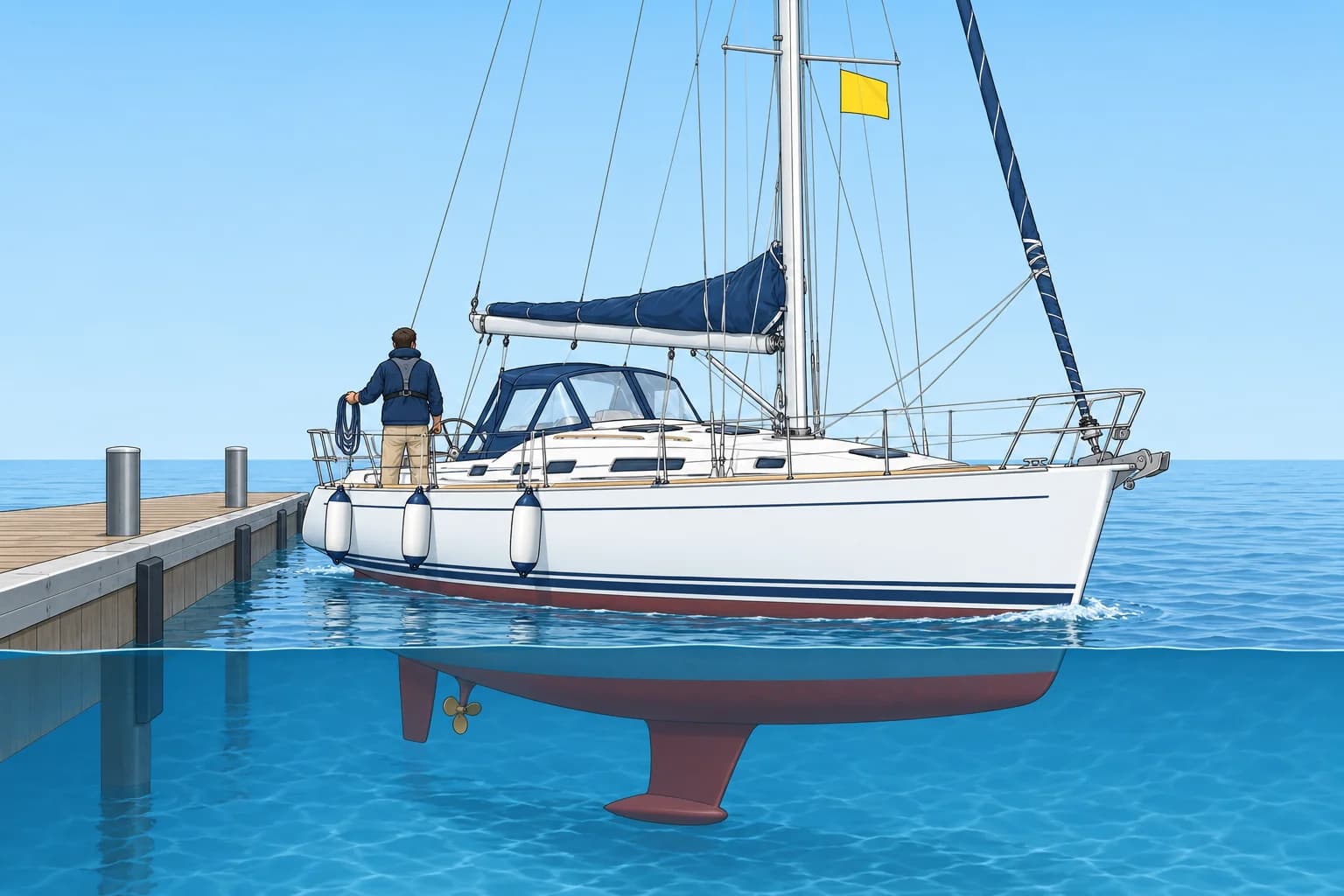
Address the port or marina by name and identify your vessel: ‘Rodney Bay Marina, this is sailing yacht Blue Heron.’ Give your berth request, dimensions, intended stay and ETA clearly. Listen to the reply and confirm the berth and how to moor. See Talking on the VHF for calling procedure and channel selection.
What to give
A marina needs your length overall (LOA), beam (width) and draught (depth from the waterline to your boat’s deepest point), the number of nights and your ETA (estimated time of arrival). Example: ‘I request a berth for three nights. Length overall one-two metres, beam four metres, draught two decimal one metres. My ETA one-five-three-zero local time.’
What you may hear
A pontoon is a floating walkway; a berth is your assigned mooring place. ‘Pontoon Charlie, berth one-four, port side to’ means put your port side beside it. ‘Moor stern-to’ means berth with your stern towards the quay. Fenders are protective cushions between your boat and the berth. If unsure, say ‘Say again’.
Formalities
Clear in means complete the required customs, immigration and health formalities. The yellow Q flag means ‘My vessel is healthy and I request free pratique’: public-health clearance, distinct from customs, immigration and other entry permissions. Ask where and when to report. Check local arrival rules, including advance notice, when the Q flag is required and whether you must remain aboard.
False friends
Some words look like Spanish, French or Italian ones but mean something else. ‘Actual’ means real; ‘present’ explicitly means current. For current draught, the SMCP wording is ‘my present draught’. A boat has fenders, not defenses. ‘Eventually’ means in the end, not possibly. ‘Alongside’ means berthed beside a quay or another vessel.
Key figures
- LOA
- Length overall
- Draught
- Vertical distance from waterline to the boat’s deepest point
- ETA
- Estimated time of arrival
- Q flag
- My vessel is healthy; I request free pratique
- Port side to
- Berth with your port side against the quay
- False friend
- SMCP current-draught report: ‘my present draught’
Remember
- Call the station, then give your vessel's name, request, size and ETA in one message.
- Size for a marina: length overall, beam and draught, with units.
- Listen for the berth, the side to and how to moor; say ‘Say again’ if unsure.
- Check local clearance rules; the Q flag requests health clearance, not customs or immigration clearance.
- Actual means real; present means current; eventually means in the end. Use fenders, not defenses.
Common mistakes
Wrong: Assume English ‘actual’ always means ‘current’.
Right: ‘Actual’ means real, while ‘present’ explicitly means current. For current draught, the SMCP wording is ‘my present draught’.
Wrong: Guess the berth number when the reply is hard to hear.
Right: Say ‘Say again’. A wrong berth or side to can mean a collision in a crowded marina.
Worked case
You are Blue Heron (13.5 m long, beam 4.2 m, draught 2.3 m), requesting two nights, ETA 1600 local. The foreign marina replies, ‘Pontoon C, berth …, port side to.’ You miss the berth number. What do you say, prepare and check before landing?
Show the answer
‘Rodney Bay Marina, this is Blue Heron. I request a berth for two nights. Length overall one-three decimal five metres, beam four decimal two metres, draught two decimal three metres. ETA one-six-zero-zero local time.’ Then: ‘Say again berth number.’ Prepare fenders and lines to port; confirm the berth before proceeding. Follow local Q-flag, clearance and remain-aboard rules; ask where and when to report.
Practice question
What does ‘berth port side to’ mean?
- Berth on the port, not the marina
- Port side against the quay
- Berth facing the port entrance
- Berth near the port office
Show the answer
Answer: B. ‘Side to’ means that side against the quay or pontoon. Prepare fenders and lines on the port side.
4 · Pilot books
Reading sailing directions and pilot books in English
Sailing directions use a precise, compact English. Learn the words for depths, dangers, marks and berthing, and read every sentence twice before you act on it.
The style
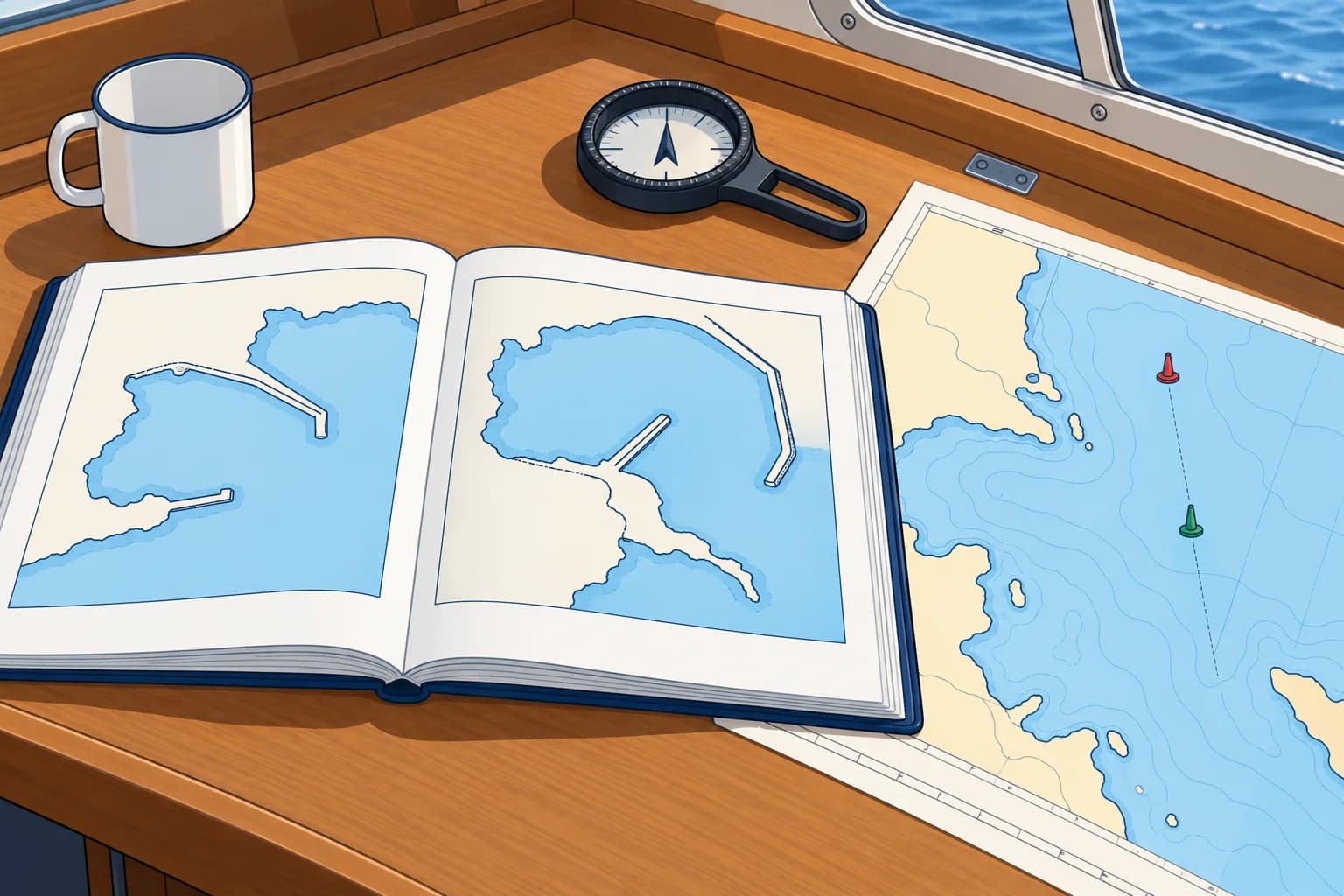
Sailing directions and yacht pilot books use concise English and standard nautical terms. This part helps you read them. See Nautical publications for the different kinds of book.
Depths and dangers
‘The bank dries 1.5 m’ means its top is 1.5 m above chart datum; exposure depends on tide. A shoal is shallow ground; least depth is its shallowest sounding. Foul ground has seabed obstructions that can snag anchors or fishing gear. ‘Swell sets into the bay with south-westerly winds’ means swell enters it then. Overfalls are short, steep breaking waves where a strong current crosses a shoal or obstruction, or meets opposing wind or current.
Marks and lines
A conspicuous object is easy to see from seaward. A leading line uses two fixed marks. Keep them in line on the charted approach; US books call this a range. Marks in line are in transit. ‘Keep the church open south of the headland’ means keep the church visibly separated from the headland on its south side.
Anchoring and berthing
‘Holding is good in sand’ means the anchor grips well there. ‘Vessels can be accommodated alongside’ means they can berth beside the quay. Reclaimed land has been won from the sea by filling. ‘Berthing is bows-to or stern-to’ means you moor with the bow or stern to the quay. ‘Prohibited anchorage’ means do not anchor there.
Read carefully
Read a pilot-book passage twice, with the chart beside it. Check the date and the corrections, and compare with the latest chart and notices: harbours change. Translate key sentences into your own words before you act.
Key figures
- Dries 1.5 m
- Top 1.5 m above chart datum; exposure depends on tide
- Foul ground
- Seabed obstructions that can snag anchors or fishing gear
- Leading line (US: range)
- Two marks in line that lead you in
- Holding
- How well an anchor grips the bottom
- Accommodated alongside
- Berthed beside the quay
- Reclaimed land
- Land won from the sea by filling
Remember
- ‘Dries 1.5 m’ is a drying height above chart datum; ‘least depth’ is the shallowest sounding.
- Foul ground can snag anchors. Overfalls form over shoals or obstructions, or where currents meet opposing wind or current.
- A leading line (US: range) brings two marks in transit to lead you in.
- Holding describes how well the anchor grips; alongside means beside the quay.
- Read every passage twice, beside the chart, and check its date and corrections.
Common mistakes
Wrong: ‘The rock dries 2 m’ means there is 2 m of water over it.
Right: Its top is 2 m above chart datum. It is exposed when the water level falls below its top.
Wrong: An ‘area being reclaimed’ is being dredged deeper.
Right: It is being filled in to make land: expect works and shallow water, not extra depth.
Worked case
The pilot book says: ‘Approach on the leading line 312°. Foul ground lies E of the line. Holding is good in sand off the beach, but a heavy swell sets in with SW winds.’ The forecast is south-west force 5. What does the passage tell you?
Show the answer
Come in with the two leading marks in line on a bearing of 312°. Foul ground east of the line can snag an anchor; check the chart for depths and other dangers. The sand off the beach holds well, but with a south-west wind a heavy swell will enter the bay, so it would be an uncomfortable and possibly unsafe anchorage tonight. Choose another shelter.
Practice question
A pilot book says ‘The reef dries 0.8 m’. What does it mean?
- There is 0.8 m of water over it at low water
- Its drying height is 0.8 m above chart datum
- It is 0.8 m deeper than the chart shows
- It dries out completely 0.8 h after high water
Show the answer
Answer: B. Drying heights are measured above chart datum. The reef is exposed when the water level falls below its top.
5 · Forecasts
Weather forecasts and warnings in English
High-seas forecasts on an ocean passage are in English. Learn their vocabulary and short style so you can turn a broadcast into a decision.
Why English
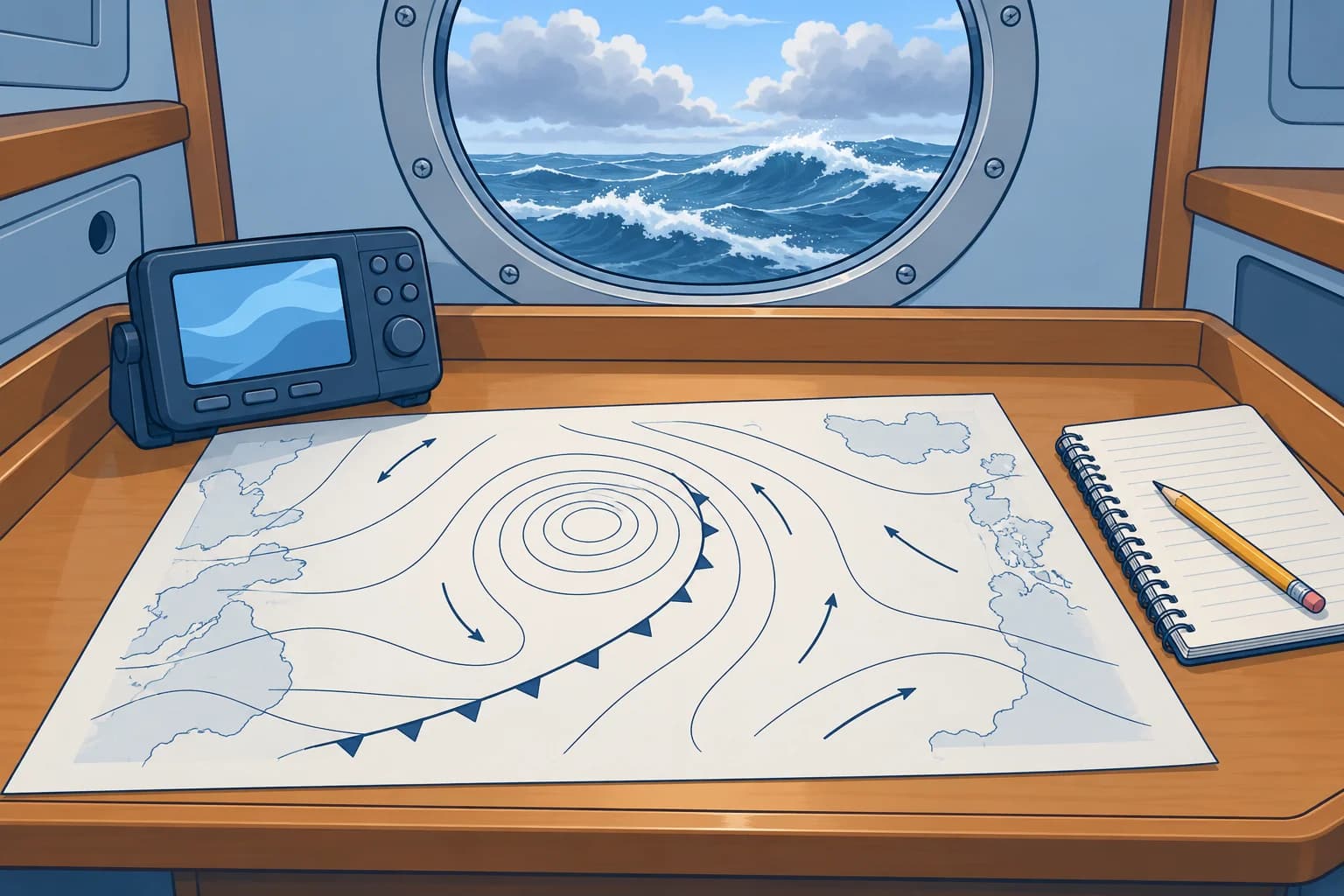
On an ocean passage, receive English high-seas forecasts and warnings for your METAREA (marine forecast region) through satellite safety services or scheduled radio broadcasts. They follow World Meteorological Organization (WMO) rules: warnings first, then a synopsis (summary of the weather situation), then the forecast for each area. The Forecast sources unit explains the format and timing words such as imminent, soon and later.
Systems
A low is deepening when its central pressure falls and filling when it rises. Wind strength also depends on the surrounding pressure pattern. A complex low has several centres. Losing its identity means becoming indistinct as a separate system, through weakening or merging. A trough is an elongated area of relatively low pressure; a ridge is an elongated area of relatively high pressure. Example: ‘Low 980 hPa near 45N 30W, moving NE 20 kt.’
Wind and sea
‘SW 6 to 8, veering NW 5 later’ gives force and direction: veering is a clockwise shift, backing anticlockwise. Cyclonic means winds turn round a low in the area. ‘Rough becoming very rough’ means wave heights increase. Beaufort names: gale force 8, severe gale 9, storm 10, violent storm 11, hurricane force 12. US high-seas forecasts give seas in metres since 2025.
Weather and visibility
Rain may be continuous; showers come and go. Squalls bring sudden strong winds; thundery warns of thunderstorms. Fog patches are local areas of fog. Visibility may be good, moderate, poor or very poor; see Forecast sources for distances. Wintry showers contain snow, sleet or hail. Freezing spray means spray can freeze on the vessel.
Tropical warnings
Read: ‘Hurricane warning. Hurricane Ana near 18.5N 55.0W. Maximum sustained winds 75 kt, gusts 90 kt.’ The centre is at 18.5°N, 55.0°W. Sustained winds are averaged winds; gusts are brief peaks. These are the cyclone’s maximum sustained winds and gusts, not a prediction at your position. Copy the position and winds separately. See Tropical storms for wind radii.
Key figures
- Deepening / filling
- Central pressure falling / rising
- Veering / backing
- Wind shifting clockwise / anticlockwise
- Beaufort names 8–10
- Gale, severe gale, storm
- Beaufort names 11–12
- Violent storm, hurricane force
- Losing its identity
- System becoming indistinct through weakening or merging
- Freezing spray
- Spray freezing on deck and rigging
Remember
- High-seas bulletins run warnings, then synopsis, then area forecasts.
- Deepening means falling central pressure; filling means rising central pressure. Neither alone determines wind strength.
- Veering is clockwise, backing anticlockwise; cyclonic means turning round a low.
- Force 8 gale, 9 severe gale, 10 storm, 11 violent storm, 12 hurricane force.
- Write numbers down as you hear them, then plot positions and times.
Common mistakes
Wrong: A filling low is getting stronger, like a sail filling with wind.
Right: Filling means the central pressure is rising; deepening means it is falling. Wind strength also depends on the surrounding pressure pattern.
Wrong: ‘Storm’ in a forecast is any rough weather.
Right: In marine forecasts ‘storm’ means Beaufort force 10. Force 8 is a gale and force 9 a severe gale.
Worked case
Mid-Atlantic, you copy: ‘Low 995 hPa near 42N 35W, deepening, moving NE 25 kt, expected 47N 27W 978 hPa by 0000 UTC. Your area: S 6 to 7, veering W 8 later. Rough becoming very rough. Rain then showers.’ Which words justify preparing for a gale?
Show the answer
The low’s central pressure falls from 995 to 978 hPa as it moves north-east. In your area expect south force 6 to 7, shifting clockwise to west and rising to gale force 8 later. Wave heights increase from rough to very rough; rain is followed by showers. Prepare for a gale because your area forecast says W 8; deepening alone does not give your local wind strength.
Practice question
What does ‘low 990, deepening’ mean?
- Its central pressure is falling
- It is moving into deeper water
- Its central pressure is rising
- It is merging with another low
Show the answer
Answer: A. A deepening low has falling central pressure. Wind strength also depends on the surrounding pressure pattern.