
Maritime English and signals · Level P3 · 5 parts · about 17 min
Standard Marine Communication Phrases (SMCP)
5 short parts: How it is built · Message markers · Replies, repeats · VTS and pilot · On-board phrases. Each part explains the idea, then gives the points to remember, the common mistakes, a worked case and a practice question; the Academy unit adds all 31 check questions.
1 · How it is built
How the SMCP is built and why it is required
The SMCP is IMO’s fixed safety English. Part A is the core every officer must use and understand; Part B adds on-board phrases.
What it is
The IMO Standard Marine Communication Phrases (SMCP) were adopted by resolution A.918(22) on 29 November 2001. They are a simplified safety English for speaking with other ships, shore stations and your own crew. They replaced the Standard Marine Navigational Vocabulary of 1985. Nautical English introduced the basics; this unit takes you to the level an officer of the watch needs.
Why you must know it
STCW table A-II/1 requires an officer of the watch to use the SMCP and to use English in written and spoken form. SOLAS V/14.4 makes English the bridge working language for bridge-to-bridge and bridge-to-shore safety communication, and between the pilot and the bridge team, unless all those directly involved share another language. The SMCP gives that English a fixed form.
General and Part A
The General section sets the rules: spelling, message markers, responses, corrections, numbers, positions, bearings, times and words to avoid. Part A1 holds external phrases: distress, urgency and safety traffic, pilotage, helicopter and icebreaker operations, and VTS. Part A2 holds on-board phrases tied to navigation: standard wheel orders, standard engine orders and phrases for the pilot on the bridge.
Part B
Part B covers further on-board phrases: handing over the watch, trim and list, alarms, occupational safety, fire, damage control, grounding, search and rescue, cargo, and passenger care. The resolution calls Part A an indispensable part of any STCW curriculum; Part B is useful supplementary training. Learn Part A as the STCW core; use Part B for your duties.
How the phrases are written
The SMCP avoids synonyms and contracted forms such as ‘I’ll’. It gives one phrase for one event, fully worded answers to yes-or-no questions, and a fixed part followed by a variable part. Under stress it uses block language that drops words such as ‘the’ and ‘is’: ‘Dangerous wreck in position …’. Distress, urgency and safety radio traffic belongs to the GMDSS module.
Key figures
- Adopted
- IMO resolution A.918(22), 29 November 2001
- Replaced
- Standard Marine Navigational Vocabulary (1985)
- Part A1
- External: distress, urgency, safety, pilotage, specials, VTS
- Part A2
- On board: wheel orders, engine orders, pilot on the bridge
- Part B
- On board: watch, safety, cargo, passengers
- SOLAS V/14.4
- English unless all directly involved share another language
Remember
- The SMCP (A.918(22), 2001) is the required safety English for an officer of the watch under STCW table A-II/1.
- Part A is external and navigation-related on-board phrases; Part B is other on-board safety phrases.
- One phrase for one event, no synonyms, no contractions, fully worded answers.
- Block language drops small words in urgent messages; meaning stays fixed.
Common mistakes
Wrong: The SMCP is a phrasebook for radio calls only.
Right: It also covers on-board communication: wheel and engine orders, the pilot on the bridge, watch handover and emergencies.
Wrong: Any clear English will do, so the exact phrase does not matter.
Right: Use the SMCP phrase whenever one fits. Fixed wording is what removes doubt between non-native speakers.
Wrong: Contractions such as ‘I’ll’ sound natural and are fine on the radio.
Right: Say ‘I will’. Contractions are easy to mishear in noise and are avoided throughout the SMCP.
Worked case
A pilot and master share a local language, but you, the officer of the watch (OOW), do not. They say knowing English wheel orders is enough for you. What language and SMCP preparation do you need for this pilotage?
Show the answer
Use English so everyone directly involved understands the safety communication. Wheel orders alone are not enough: you need the General rules, A1 external phrases for VTS and pilotage, and A2 engine orders and pilot-on-bridge phrases. Use Part B for duties such as handing over the watch.
Practice question
A colleague replaces a standard phrase with a familiar local expression. Why should you keep the SMCP wording?
- It shortens every radio transmission
- It gives a shared meaning across crews
- It removes the need to check replies
- It lets you omit details under stress
Show the answer
Answer: B. Fixed SMCP wording gives crews a shared meaning and reduces differing interpretations.
2 · Message markers
Message markers in VTS communication
A message marker tells the listener what kind of message follows. Using the wrong one can turn a suggestion into an order, or an order into a suggestion.
Why markers
A Vessel Traffic Service (VTS) is a shore service that monitors traffic and talks to ships in its area. When a standard phrase does not fit, or the purpose of a message could be misread, a message marker is spoken before the message or the relevant part. The speaker chooses whether and which marker to use. IMO VTS guidelines ask that every message to a ship makes clear whether it is information, advice, warning or instruction.
Instruction and advice
INSTRUCTION gives an order under a regulation. The sender must have authority to give that order. Follow it unless you have a conflicting safety reason; report that reason to the sender. ADVICE gives a recommendation. You decide whether to follow it, but consider it carefully. Reply to either with ‘I will …’ or ‘I will not …’ and the content in full.
Warning and information
WARNING draws immediate attention to a danger: ‘WARNING. Obstruction in the fairway.’ INFORMATION is limited to observed facts, mostly navigational and traffic information: ‘INFORMATION. MV Noname will overtake to the west of you.’ What you do about either is your decision, so plan and report your action.
Question and answer
QUESTION removes any doubt that you are asking: ‘QUESTION. What is your present maximum draft?’ ANSWER marks the reply: ‘ANSWER. My present maximum draft is one-two decimal five metres.’ An answer must not contain another question. If you need to ask back, send a separate QUESTION.
Request and intention
REQUEST asks for something to be arranged or provided: tugs, stores, permission. Never use REQUEST for navigation. For navigational permission, use QUESTION. No message marker changes your duties under the COLREGs. INTENTION announces navigational action you are about to take with your own vessel: ‘INTENTION. I will reduce my speed.’ It never announces what another vessel will do.
Key figures
- Must follow (unless unsafe)
- INSTRUCTION, from an authorised sender
- Decision stays with you
- ADVICE, WARNING, INFORMATION
- REQUEST
- Arrangements or supplies; never navigation or COLREG changes
- INTENTION
- Your own vessel’s immediate navigational action
- ANSWER
- Must not contain another question
Remember
- Markers are optional, chosen by the speaker, and spoken before the message they label.
- Follow an INSTRUCTION unless safety forbids it, and then report your reasons.
- ADVICE is a recommendation: you decide, but you consider it very carefully.
- Never use REQUEST for navigation; ask permission with a QUESTION.
Common mistakes
Wrong: ‘REQUEST. I will overtake the vessel ahead.’
Right: Navigation is not a request. Ask ‘QUESTION. Do I have permission to overtake …?’ or announce ‘INTENTION. I will …’ where no permission is needed.
Wrong: Treat a VTS ADVICE as an order you cannot question.
Right: ADVICE leaves the decision with you. Reply ‘I will …’ or ‘I will not …’ with the advice in full, and give your reason if you decline.
Wrong: Ignore an INSTRUCTION you think is unsafe.
Right: Do not just ignore it. Report your contradictory safety reasons to the sender at once.
Worked case
VTS sends ‘ADVICE. Anchor in B3.’ Your assessed draft leaves too little under-keel clearance, the gap between your keel and the seabed, there. What do you reply? Would an INSTRUCTION remove that concern?
Show the answer
‘I will not anchor in B3. Insufficient under-keel clearance.’ Report your safe alternative and coordinate it with VTS. ADVICE leaves the decision with you. An authorised INSTRUCTION must normally be followed, but a conflicting safety reason still requires you to report why you cannot comply.
Practice question
A VTS centre with legal authority sends ‘INSTRUCTION. Do not cross the fairway.’ You see a safety reason not to comply. What must you do?
- Comply anyway, since instructions are binding
- Ignore it and proceed as the master decides
- Report your safety reasons to the sender
- Ask another vessel to confirm the instruction
Show the answer
Answer: C. An instruction must be followed unless there are contradictory safety reasons, which have to be reported to the sender.
3 · Replies, repeats
Standard replies, corrections and radio checks
Answer in full, say when you need time, correct mistakes the standard way and read back what matters. Every reply closes the loop.
Replies
For a yes answer, say ‘Yes’ followed by the full phrase: ‘Yes, I have a pilot on board.’ For a no answer: ‘No, I do not require tugs.’ If you need time, say ‘Stand by’ and the interval: ‘Stand by, two minutes.’ If you cannot get the information at all, say ‘No information.’ To an instruction or advice, reply ‘I will …’, ‘I can …’, ‘I will not …’ or ‘I cannot …’ with the content in full.
Corrections and repeats
To correct yourself, say ‘Mistake’, then ‘Correction’ and the corrected part: ‘My present speed is one-four knots, mistake. Correction, my present speed is one-two knots.’ To protect a vital figure, say ‘Repeat’ and give it again: ‘My draft is one-two decimal six, repeat one-two decimal six metres.’ If you did not hear, say ‘Say again’.
Readability and channels
‘How do you read?’ is answered on a five-step scale, from ‘I read you bad’ (one) through poor, fair and good to ‘excellent’ (five). To keep a ship on a channel, say ‘Stand by on VHF channel …’; she replies ‘Standing by on VHF channel …’. To move her, say ‘Advise you change to VHF channel …’; she replies ‘Changing to VHF channel …’. ‘I am ready to receive your message’ shows readiness.
Reading back
The SMCP builds the read-back into its replies: you repeat instructions, advice and figures in full. Many VTS centres and pilots also ask you to read back. Repeat the key items exactly as received, in the same order: names, positions, times, channels and numbers. If what comes back is wrong, the sender says ‘Mistake … Correction …’ at once.
Position from a mark
Give your position as a true bearing from a named mark and a distance. If you are two nautical miles east of North Point light, report bearing zero-nine-zero degrees from that light, distance two nautical miles. Do not give the bearing of the light from your ship.
Key figures
- Need time
- ‘Stand by’ plus the interval
- Cannot obtain
- ‘No information’
- Own mistake
- ‘Mistake … Correction …’ then the corrected part
- Did not hear
- ‘Say again’
- Readability
- Bad (1), poor (2), fair (3), good (4), excellent (5)
Closing the loop on a VTS instruction
- Listen to the whole message before you key the microphone. — Answering halfway through often blocks the end of the message.
- Write down positions, times, channels and figures as you hear them. — A written note is what you read back, not your memory.
- Ask ‘Say again’ for anything unclear before accepting or acting on the message. Make sure you understand the whole instruction. — Guessing a figure is worse than asking for it.
- Reply with ‘I will …’ or ‘I will not …’ and the content in full. — The full reply proves what you understood.
- Act, then report when the action is complete if asked. — The sender can confirm the result and update the traffic picture.
Remember
- Answer ‘Yes’ or ‘No’ with the full phrase. When information is delayed, say ‘Stand by’ plus a time interval.
- Correct with ‘Mistake … Correction …’; protect vital figures with ‘Repeat’.
- Read back instructions and figures exactly, in the order received.
- Positions from a mark give the bearing FROM the mark to you.
Common mistakes
Wrong: Reply ‘Roger’ or ‘OK’ to a VTS instruction.
Right: Reply with the instruction in full: ‘I will proceed to the emergency anchorage.’ That is the read-back.
Wrong: Say ‘Stand by’ and leave the other station waiting without a time.
Right: Give the interval: ‘Stand by, five minutes.’ Then call back within it.
Wrong: Correct a wrong figure by simply giving a new one.
Right: Say ‘Mistake’, then ‘Correction’ and the corrected part, so the listener knows which figure to discard.
Worked case
VTS asks: ‘QUESTION. What is your ETA at reporting point Echo?’ Your second officer is still working it out. Then you realise you told VTS earlier that your draft was 11.8 m; it is 12.8 m. How do you handle both?
Show the answer
Say ‘Stand by, two minutes.’ Correct the draft immediately: ‘Mistake. Correction, my present maximum draft is one-two decimal eight metres. Repeat, one-two decimal eight metres.’ When the ETA is available, report: ‘ANSWER. My ETA at reporting point Echo is … UTC.’
Practice question
VTS asks for information you will have in about three minutes. What do you say?
- ‘No information.’
- ‘Stand by, three minutes.’
- ‘Say again, three minutes.’
- ‘Repeat in three minutes.’
Show the answer
Answer: B. ‘Stand by’ followed by the time interval is used when the information is not immediately available.
4 · VTS and pilot
SMCP VTS headings, reporting points and pilot boarding
SMCP VTS headings group the phrases. Pilot boarding phrases set the ladder side, its height above water, the lee and the boarding speed.
SMCP VTS headings
The 2001 SMCP groups VTS phrases under three service headings. Current VTS need not use these labels. Information covers warnings, traffic, tides and weather. Navigational assistance supports your navigation: ‘Your position is bearing … degrees, distance … from …’ or ‘You are approaching the northern limit of the fairway.’ Traffic organisation covers clearances, anchoring, waiting times and slots.
Reporting points
A reporting point is a charted position where you must call VTS. Report your name, position and the details the port asks for, often ETA and draft. VTS may say ‘Report at the next waypoint’ or ‘Do not pass reporting point … until … UTC.’ It may pass traffic: ‘MV … has reported at reporting point …’. Always use the reporting point name printed on the chart or in the official guide.
Navigation phrases
Shore radar phrases are precise. ‘Your track is diverging from the reference line’ describes the ground track. ‘Course to make good is … degrees’ is what you need over the ground. ‘You are running into danger: shallow water … of you’ calls for immediate action. If danger is immediate, take safe action without waiting to transmit. Acknowledge as soon as practicable and report your action.
Pilot request
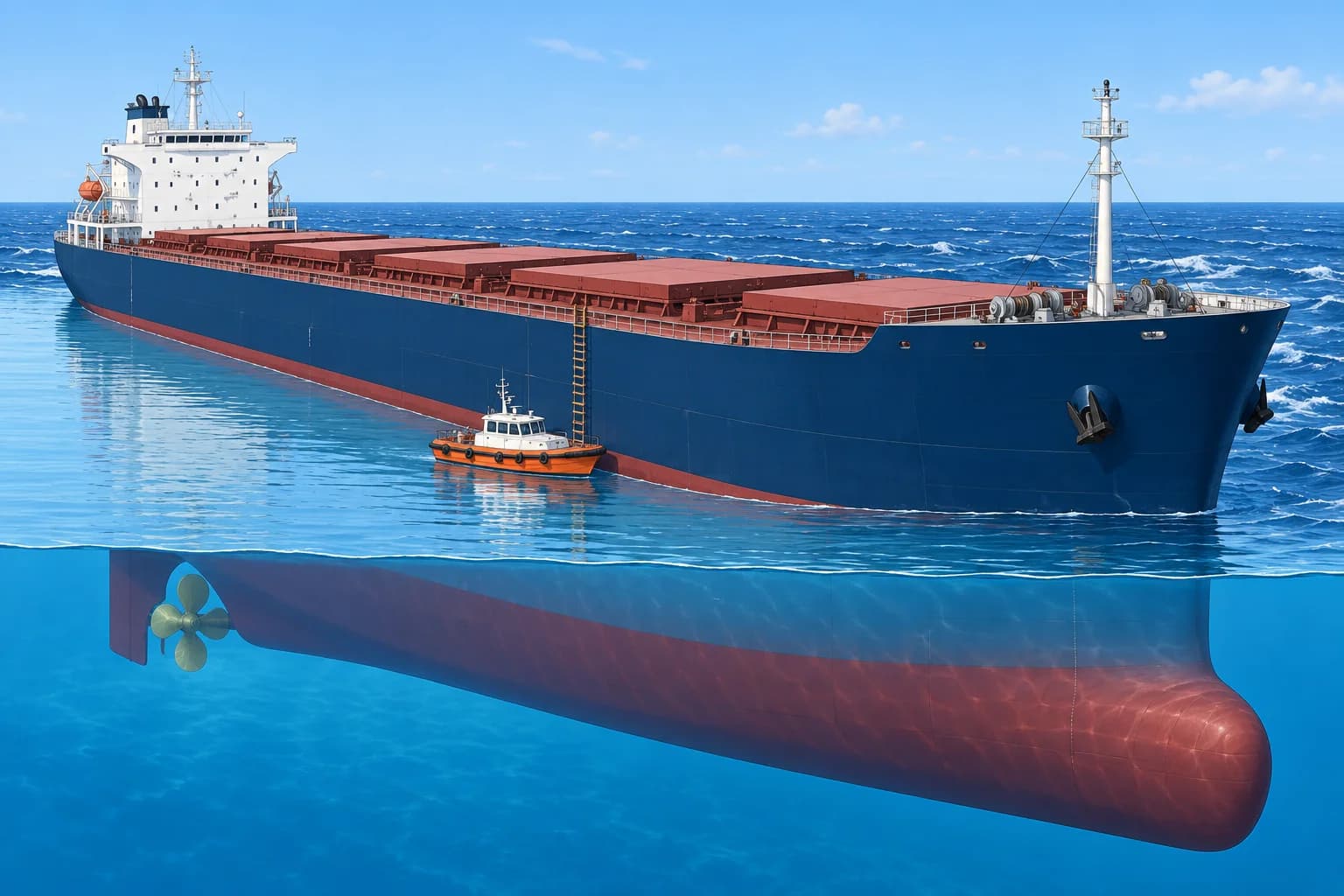
Request the pilot explicitly: ‘I require a pilot at … Pilot Station.’ Agree the boarding position and time with the pilot station or VTS. Give your arrival time: ‘My ETA at … Pilot Station is … hours local time.’ State the time basis. You may be asked your freeboard, the height of the deck edge above water, and told the ladder side and height: ‘Rig the pilot ladder on starboard side, two metres above water.’
Making a lee
The pilot boat needs calm water alongside. ‘Make a lee on your port side’ means put your port side away from wind and sea. ‘Steer … degrees to make a lee’ and ‘Keep the sea on your starboard quarter’ give the heading. ‘Make a boarding speed of … knots’ sets your speed. ‘Stop engine(s) until the pilot boat is clear’ protects the boat. If the boat reports ‘The pilot ladder is unsafe’, ask ‘What is wrong with the pilot ladder?’
Key figures
- SMCP VTS headings
- Information, navigational assistance, traffic organisation
- Ladder order
- ‘Rig the pilot ladder on … side, … metres above water.’
- Freeboard
- Height of the deck edge above the waterline
- Make a lee
- Put the boarding side away from wind and sea
- Boarding speed
- ‘Make a boarding speed of … knots.’
Pilot boarding exchange
- Request the pilot, give your ETA and confirm the boarding position. — The pilot boat plans its run to meet you there.
- Answer the freeboard question and confirm the ordered ladder side and height. — The ladder must reach the boat at the right height above the water.
- Have an officer check the ladder’s side, height and condition. Only then report ‘The pilot ladder is rigged on … side’. — The pilot trusts his life to that ladder.
- Confirm a safe heading and speed with the pilot boat, then make the lee and settle at the agreed boarding speed. — Calm water and steady speed make the transfer safe.
- Stand by on the ordered channel until the transfer is complete. — The boat may need you to alter course or stop engines at once.
Remember
- The SMCP groups VTS phrases under information, navigational assistance and traffic organisation.
- Call at every reporting point, using the reporting point name on the chart.
- The pilot station sets ladder side, height above water, the lee and the boarding speed.
- Confirm each pilot boarding order in full and report when the ladder is rigged.
Common mistakes
Wrong: ‘Make a lee on your port side’ means the port side faces the wind.
Right: It means the port side is sheltered: wind and sea are on the starboard side, so the boat comes alongside in calm water to port.
Wrong: Give pilot station ETAs in UTC without saying so, as for VTS.
Right: Pilot phrases often use local time. State which time you use: ‘… hours local time’ or ‘… UTC’.
Wrong: Report the ladder rigged as soon as it is lowered over the side.
Right: Report it rigged only after an officer has checked its side, height and condition against the order.
Worked case
The pilot station tells you: ‘Rig the pilot ladder on port side, one decimal five metres above water. Make a lee on your port side. Make a boarding speed of eight knots.’ Wind and swell are from the north-west. What do you do and say?
Show the answer
Read back all three orders. Confirm a heading that shelters port while keeping the ship in safe water; do not turn solely to make a lee. If the heading or speed would be unsafe, tell the pilot boat and agree an alternative. Have the port ladder checked at 1.5 m above water. When safely established at 8 knots, report the ladder rigged and the lee made.
Practice question
‘You are approaching the western limit of the fairway.’ Under which SMCP VTS heading does this phrase appear?
- Navigational assistance service
- Traffic organisation service
- VTS information service
- Allied emergency service
Show the answer
Answer: A. The SMCP places this phrase under navigational assistance, which supports a vessel’s own navigation, often using shore radar.
5 · On-board phrases
On-board phrases: watch, engines, anchor and lines
On board, the SMCP fixes how you hand over the watch, give engine orders and work the anchor and lines. Each order is repeated, done and reported.
Handing over
The officer handing over says ‘You have the watch now’; the relieving officer confirms ‘I have the watch now’. Brief position, course and speed, draught and under-keel clearance, compass errors, traffic, aids, equipment, weather, orders and special events. Having the conn means directing the ship’s movements; the pilot can have the conn while you keep the navigational watch. The master’s presence alone does not transfer the watch.
Engine orders
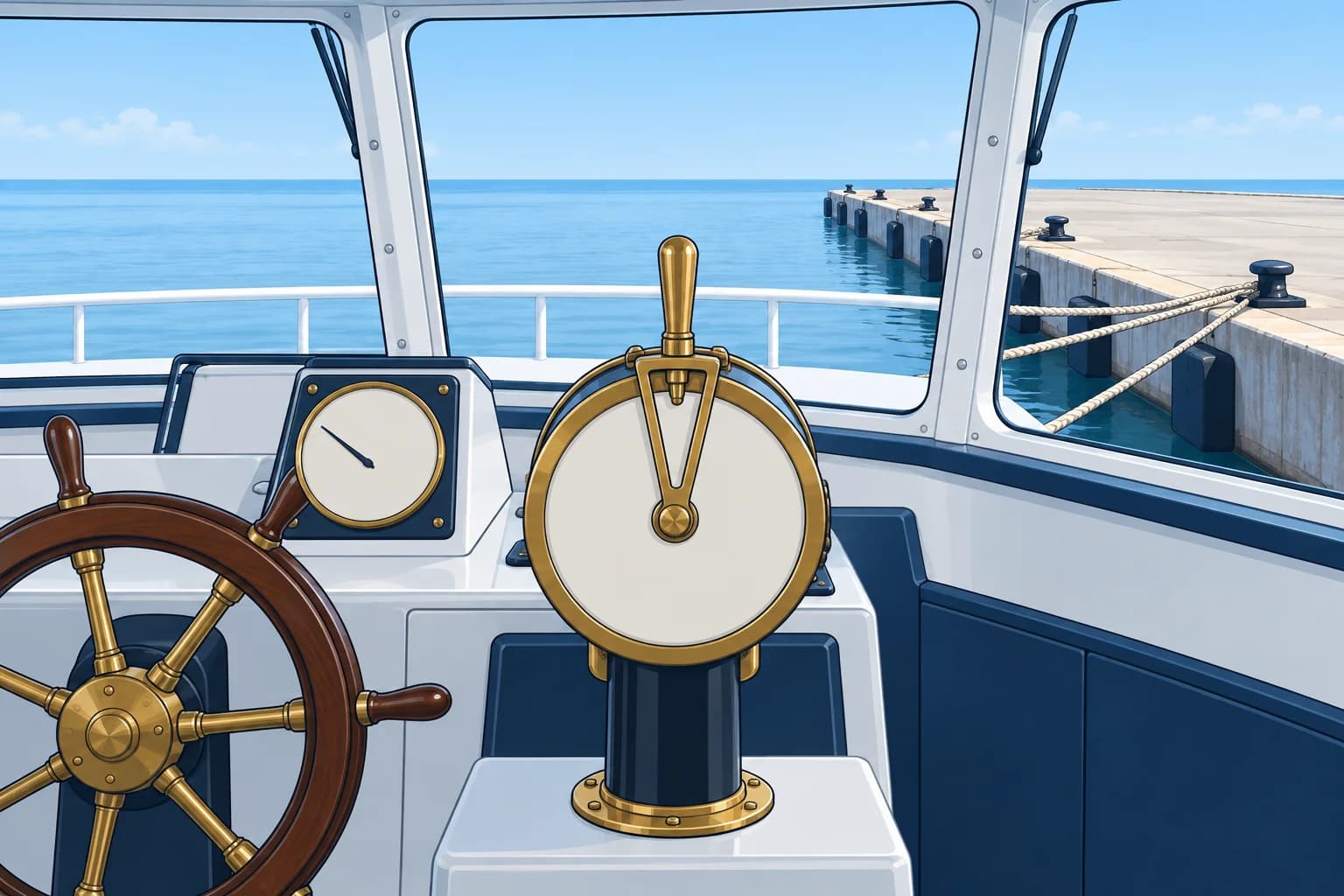
You repeat orders at the engine-order telegraph (the control used to send engine orders). The officer of the watch (OOW) checks they are carried out at once. The steps are dead slow, slow, half and full, ahead or astern; ‘Stop engine’; ‘Emergency full ahead’ or ‘astern’. ‘Stand by engine’ means engine room ready to manoeuvre and the bridge manned to relay orders. ‘Finished with engines’ means no more manoeuvring. Wheel orders are in Watch keeping for ratings.
Twin screws and thrusters
With two propellers, add ‘both’ for both shafts: ‘Slow astern both’. Name one shaft to use it alone: ‘Half ahead port’. To stop both main engines, say ‘Stop all engines’. Thruster orders are ‘Bow thruster full to port’, ‘Stern thruster half to starboard’ and ‘Bow thruster stop’. Stop a thruster with its own order.
Anchor phrases
‘Stand by port anchor’ means prepare it; ‘Let go port anchor’ means release it. A shackle is a chain length; cable means anchor chain. ‘Cable leading ahead’ means the chain runs forward; ‘up and down’ means vertically below the bow. ‘Brought up’ means the anchor holds the ship.
Mooring phrases
‘Send out the head line’ means pass the forward mooring line ashore. ‘Heave away’ means haul in. ‘Make fast fore and aft’ means secure the lines forward and aft. ‘Single up forward and aft’ means reduce to the ordered mooring lines, then await letting-go orders.
Closed loop
Every order works as a closed loop: give the order, hear it repeated, see it done, hear it reported and confirm. Bridge: ‘Half astern.’ Telegraph: ‘Half astern.’ Then: ‘Engine half astern.’ Bridge: ‘Thank you.’ If you hear no repeat, or a different order, give it again at once. Emergency phrases follow the same pattern: ‘Operate the general emergency alarm.’
Key figures
- Watch handover
- ‘You have the watch now.’ / ‘I have the watch now.’
- Engine steps
- Dead slow, slow, half, full: ahead or astern
- Stand by engine
- Engine room ready to manoeuvre; bridge manned for orders
- Twin screws
- Add ‘both’; but ‘Stop all engines’
- Finished with engines
- No more manoeuvring
- Single up
- Reduce to the lines and springs ordered before letting go
Remember
- After briefing, confirm transfer. If the master says ‘I have the watch now’, reply ‘You have the watch now’.
- Every engine order is repeated at the telegraph and checked by the OOW.
- Use ‘both’ for twin shafts, a side for one shaft, and ‘Stop all engines’ for main engines; stop thrusters separately.
- Close every loop: order, repeat, act, report, confirm.
Common mistakes
Wrong: Hand over the watch with ‘OK, she’s all yours.’
Right: Use the fixed exchange, ‘You have the watch now’ – ‘I have the watch now’, so there is no doubt who has accepted the navigational watch.
Wrong: On a twin-screw ship, order ‘Slow astern’ when you mean both engines.
Right: Say ‘Slow astern both’. Without ‘both’, the order is incomplete on a twin-screw ship.
Wrong: Accept silence after an engine order as confirmation.
Right: Expect the repeat and the report. If you do not hear them, give the order again and check the indicator.
Worked case
During berthing, both main engines are slow astern and the bow thruster is half to port. The master orders ‘Stop all engines.’ You repeat it, but the port shaft still shows astern. What do you report, and what happens to the thruster?
Show the answer
Set both main engines to stop, check their response and report: ‘Port engine still running astern.’ Do not report ‘All engines stopped’ until verified. The bow thruster remains half to port until separately ordered ‘Bow thruster stop’. Repeat that order, carry it out and report. The master confirms each report. Clarify the order if ‘stop everything’ was intended.
Practice question
The relieving officer has been briefed and is ready. What does the officer handing over say?
- ‘I have the watch now.’
- ‘You are relieved now.’
- ‘You have the watch now.’
- ‘Watch is handed over.’
Show the answer
Answer: C. The officer handing over says ‘You have the watch now’; the relieving officer confirms ‘I have the watch now’.