

Worked: running fix with the Sun, morning sight and noon latitude
1The lesson in plain words
Transfer the morning Sun line along your run to noon, then cross it with the noon latitude. Worked on 3 December 2026.
The idea
By day you often have only the Sun. Its azimuth changes through the morning. Choose two sights whose lines cross at a useful angle. Move the earlier line along your ground track for the time between, exactly as in a coastal running fix (Navigation: advanced fixes). The classic pair is a morning sight and the noon latitude (Celestial: the noon sight).
The morning line
From the worked sight: at 1142 UT, intercept 22.0 M towards 133.6° from AP 17°00′N 038°08.1′W. The intercept terminal point is 16°44.8′N 037°51.5′W. Your estimated ground track is 260°T at 6.5 kn.
Noon
The almanac gives the Sun's meridian passage at Greenwich as 1150. With your DR longitude, about 038°38′W, local noon falls about 2 h 34 min later, near 1424 UT, so start watching a few minutes early. The noon sight gives latitude 16°28.0′N at 1423 UT (Celestial: the noon sight).
The run
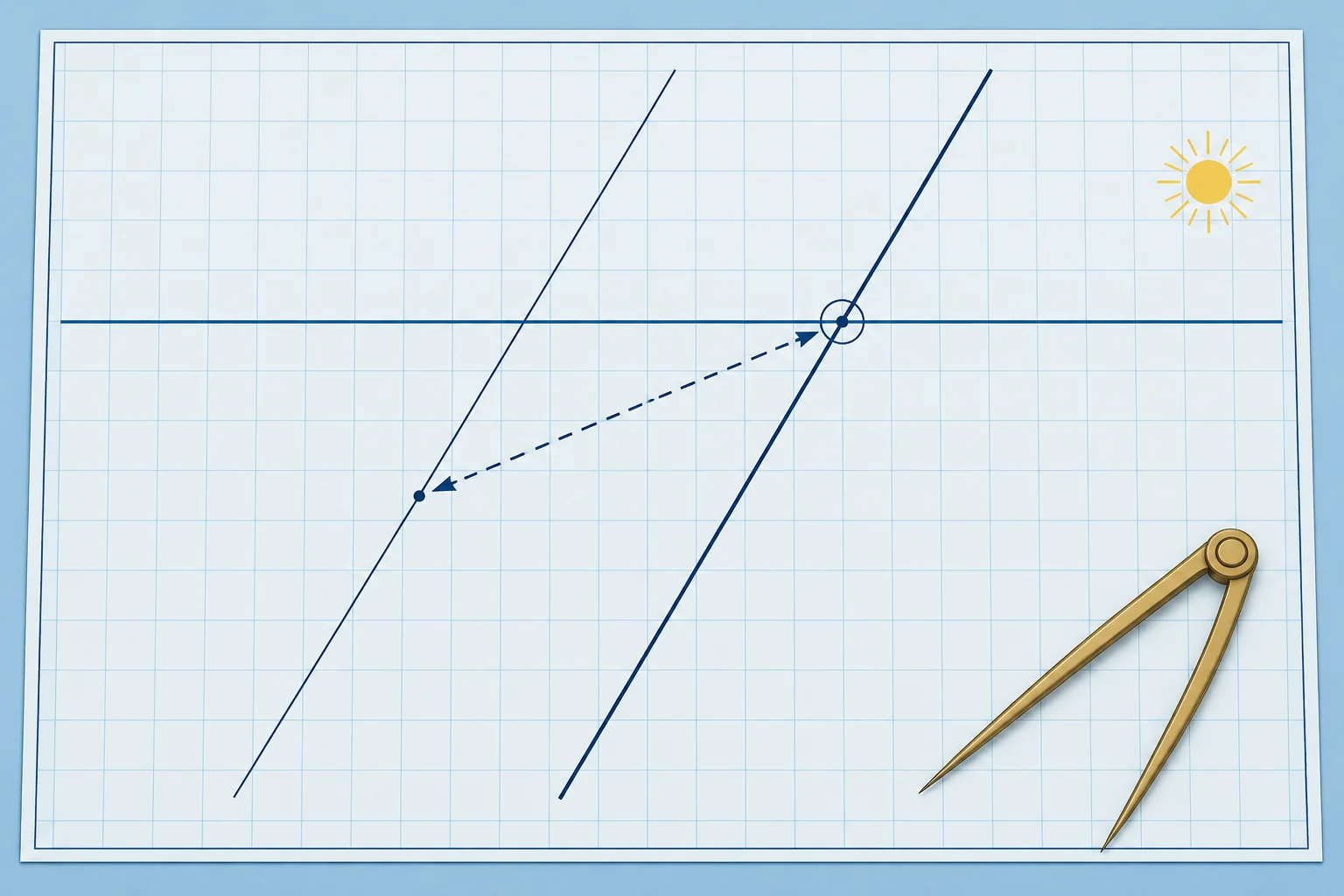
From 1142 to 1423 UT is 2 h 41 min. At 6.5 kn that is 17.4 M along 260°T. Move the intercept terminal point by that run, to 16°41.8′N 038°09.4′W. Through it, draw the morning line again, parallel to the first, with double arrowheads: a transferred position line.
The fix
The transferred line crosses latitude 16°28.0′N at 038°23′W: your running fix at 1423 UT. Your DR for that time was 16°37.0′N 038°37.9′W, so the fix is about 9 M south and 14 M east of it. Log it, and restart the DR from the fix.
Limits
The fix is only as good as the run. An unallowed current of 0.5 kn over 2 h 41 min gives a 1.3 M error in the run; its effect on the fix depends on its direction and the crossing angle. Aim for a smaller angle between the lines of at least about 30°; near 90° is best. Here it is 46.4°, with azimuths 133.6° and 180°. Judge the angle, not elapsed time: near an overhead passage, azimuth can change quickly.
2Key data
- Morning line
- 1142 UT: 22.0 M towards 133.6° from AP 17°00′N 038°08.1′W
- Noon latitude
- Given noon latitude: 16°28.0′N at 1423 UT
- Run
- 2 h 41 min at 6.5 kn = 17.4 M along 260°T
- Running fix
- 16°28.0′N 038°23′W at 1423 UT
- Angle of cut
- Azimuth 133.6° to 180°: about 46°
3Key points
- 1
Transfer the morning line by the run over the ground; cross it with the noon latitude.
- 2
Move the intercept terminal point, then draw the line parallel through it.
- 3
Aim for a smaller angle between the lines of at least about 30°; near 90° is best.
- 4
Unknown current adds error to the run; its effect on the fix depends on its direction and the crossing angle.
4Frequent mistakes
Wrong: Move the morning line along the azimuth to bring it up to noon.
Right: Move it along your ground track, 260°T here, by the distance run. The line keeps its direction.
Wrong: Take the noon latitude at the time of Greenwich meridian passage, 1150 UT.
Right: Local noon is later in west longitude: add the longitude in time. At about 38°W it falls near 1423 UT.
Wrong: Two Sun sights 20 minutes apart always give a good running fix.
Right: Judge the angle between the lines, not elapsed time. Aim for a smaller crossing angle of at least about 30°; near 90° is best.
5Practice case & exam keys
You take a morning Sun line at 0910 UT and the noon latitude at 1150 UT. You steered 250°T at 6 kn, but you later learn that the current was setting 270°T at 1 kn. How should you have transferred the morning line?
Show the answer
Use the ground run. In 2 h 40 min, you travel 16.0 M through the water along 250°T. From the intercept terminal point, lay off that vector. From its end, lay off the current vector: 2.7 M along 270°T. Through the final point, draw the morning line parallel to the original. Ignoring this westward current puts the running fix too far east.
Exam keys
- Sun-run-sun: transfer the earlier line by the ground run; cross it with the later line or noon latitude.
- Local noon (UT) ≈ Greenwich meridian passage + longitude in time (west).
- Worked 3 Dec 2026: run 17.4 M on 260°T; fix 16°28.0′N 038°23′W at 1423 UT.
- Accuracy depends on the run and the smaller angle between the lines: aim for at least about 30°, ideally near 90°.
Finish this unit
When you've read it, answer three questions. Get all three right to finish the unit; opening the page alone doesn't count.
My notes for this unit
No notes