

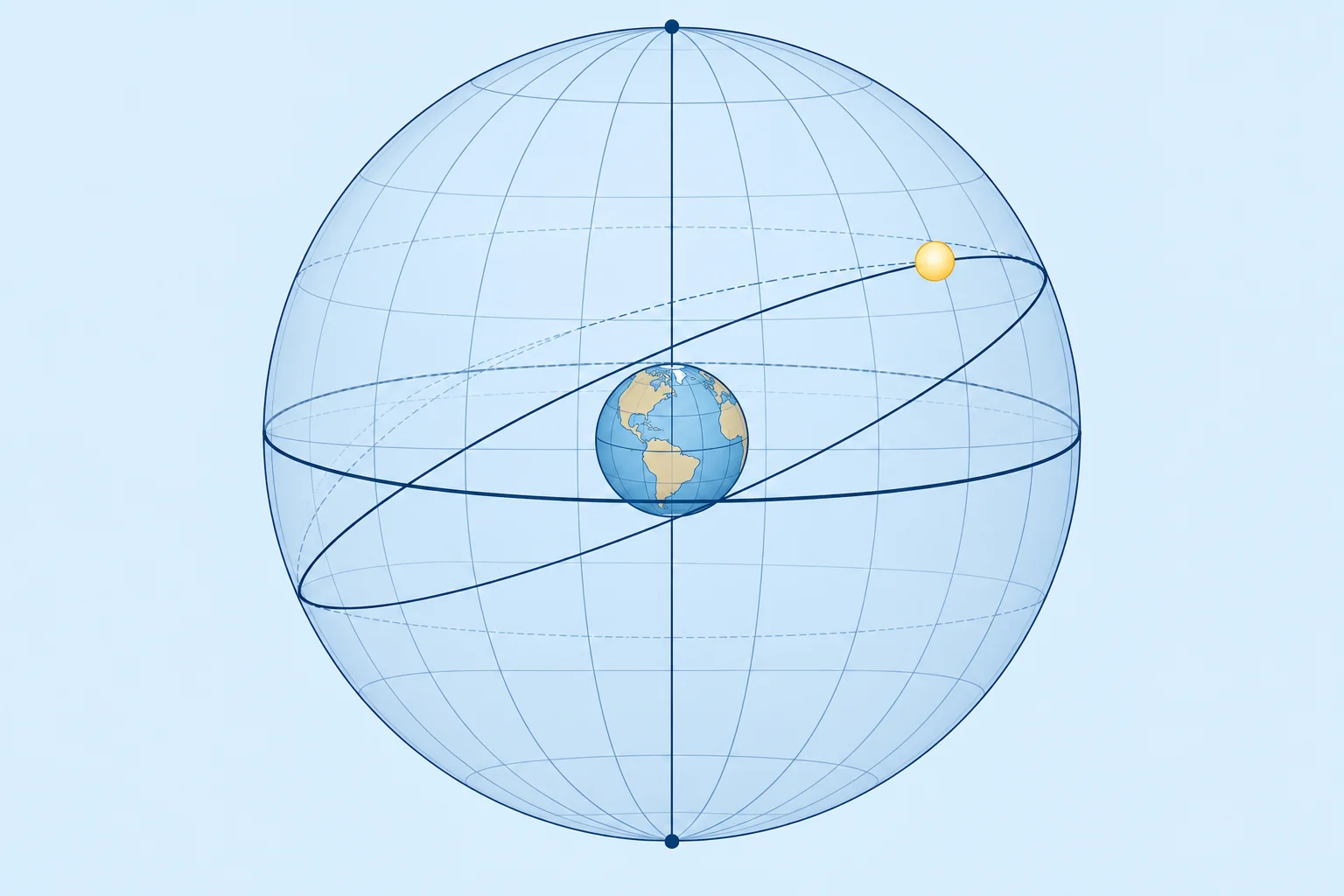
The celestial sphere: a model of the sky
1The lesson in plain words
Navigators draw every body on one huge sphere centred on the Earth. Its poles and equator are the Earth's own, projected out into the sky.
A working model
The celestial sphere is an imaginary sphere of very large radius with the Earth at its centre. Every body, the Sun, Moon, planets and stars, is drawn on its surface where you see it. Only directions matter, not distances. The model is old, but the almanac and the sight-reduction formulas use exactly this picture, so it is the right one for navigation.
Poles and equator
Extend the Earth's axis and it meets the sphere at the north and south celestial poles. Project the Earth's equator outwards and you get the celestial equator, also called the equinoctial. A great circle divides the sphere into equal halves. Half of one through both poles and a body is its hour circle, a celestial meridian. As the Earth spins eastward, this whole grid seems to turn westward once a day.
The ecliptic
Over a year the Sun moves eastward against the stars along a great circle called the ecliptic. It is tilted to the equinoctial by the obliquity, about 23°26′. So the Sun is about 23°26′ north of the celestial equator at the June solstice (21 June 2026) and 23°26′ south at the December solstice (21 December 2026).
The First Point of Aries
The ecliptic crosses the equinoctial at two points. The one the Sun passes going north, around 20 March, is the First Point of Aries, written ♈ or simply Aries. It is the zero point for star positions in the almanac. It now lies in the constellation Pisces, not Aries, because the Earth's axis slowly wobbles: precession.
Why it matters
Every point of the sphere has one point on the Earth directly beneath it. That is what turns an angle measured in the sky into a line on your chart, as the next parts show. The Polaris unit already used two of these ideas: the celestial pole and Aries (Navigation: Polaris and time).
2Key data
- Celestial poles
- The Earth's axis extended to the sphere
- Equinoctial
- The Earth's equator projected onto the sphere
- Obliquity
- About 23°26′ between ecliptic and equinoctial
- First Point of Aries
- Sun crosses the equinoctial going north, about 20 March
- Solstices 2026
- 21 June: Sun about 23°26′N; 21 December: about 23°26′S
- Spanish terms
- Esfera celeste, ecuador celeste, eclíptica, punto Aries
3Key points
- 1
The celestial sphere is centred on the Earth; only directions matter.
- 2
The equinoctial is the Earth's equator projected onto the sky.
- 3
The Sun follows the ecliptic, tilted about 23°26′ to the equinoctial.
- 4
Aries is where the Sun crosses the equinoctial northward, around 20 March.
4Frequent mistakes
Wrong: The celestial sphere is a real shell at one distance.
Right: It is a model. Stars lie at very different distances; the model keeps only their directions.
Wrong: The First Point of Aries lies in the constellation Aries.
Right: Precession has moved it into Pisces. The name is historical; it is simply the zero of star positions.
5Practice case & exam keys
A crew member asks why the Sun is high at noon in June and low in December off the Canaries, when the Earth turns the same way every day. Explain with the celestial sphere.
Show the answer
The Sun moves along the ecliptic, tilted about 23°26′ to the equinoctial. In June it is about 23°26′ north of the celestial equator, so it stands higher above a northern horizon at noon. In December it is about 23°26′ south and stands lower. Daily rotation turns the whole sphere; the Sun's yearly path changes its place on it.
Exam keys
- Celestial poles and equinoctial are the Earth's axis and equator projected onto the sphere.
- The ecliptic is the Sun's yearly path, tilted about 23°26′ to the equinoctial.
- The First Point of Aries is the Sun's northward equinox crossing, around 20 March.
- The sky appears to turn westward once a day because the Earth spins eastward.
Finish this unit
When you've read it, answer three questions. Get all three right to finish the unit; opening the page alone doesn't count.
My notes for this unit
No notes