

The PZX triangle: why a sight works
1The lesson in plain words
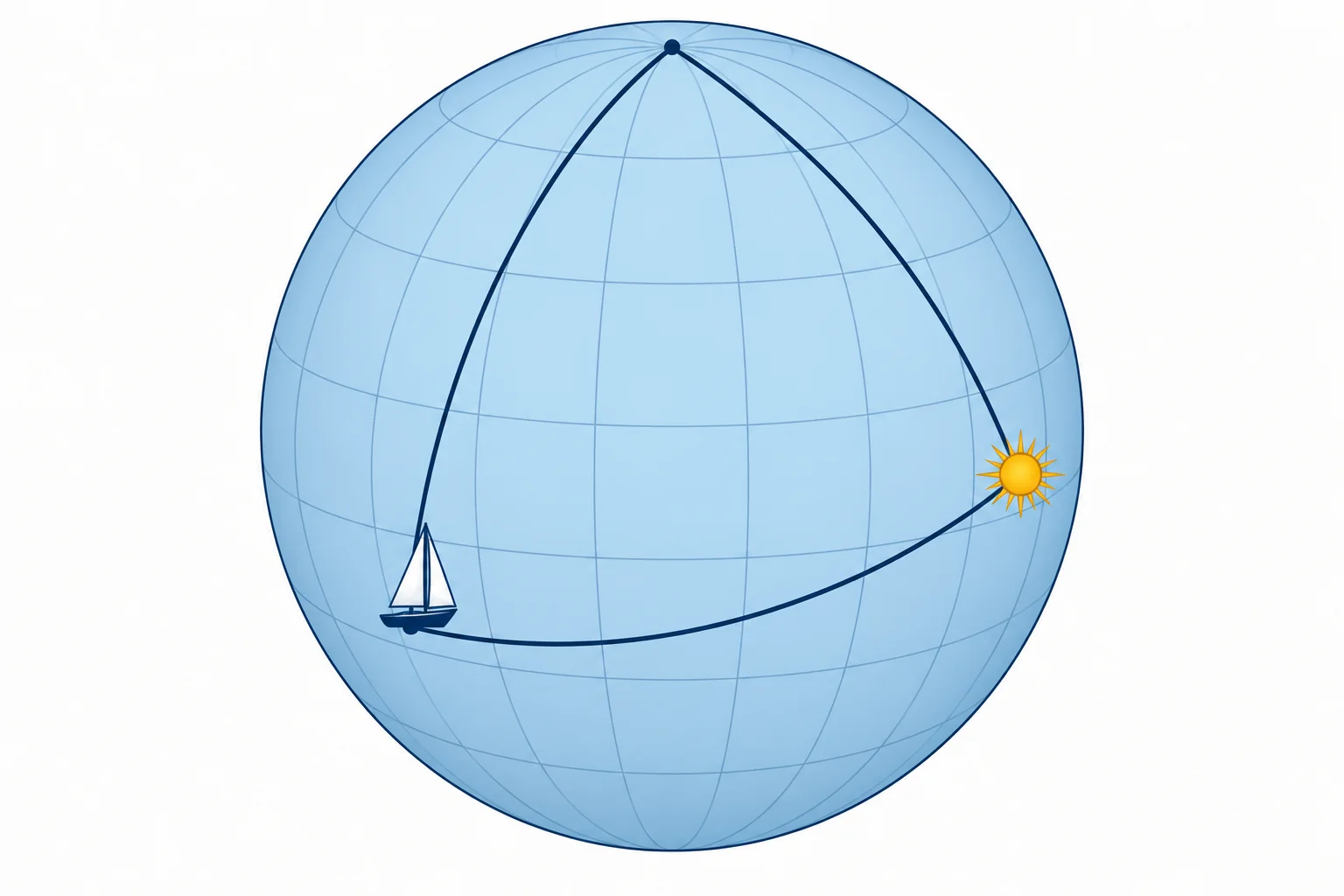
Pole, zenith and body form a spherical triangle. Your DR and the almanac give two sides; corrected sextant altitude gives the third by subtraction from 90°.
Three points
Join three points of the celestial sphere with great-circle arcs: P, the elevated pole; Z, your zenith; X, the body. This is the PZX triangle, also called the astronomical or position triangle. On the Earth the same triangle joins the pole, your position and the body's GP.
The sides
PZ = 90° − latitude, the co-latitude. PX, the polar distance, is 90° − Dec when latitude and Dec are both N or both S, or 90° + Dec when one is N and the other S. Use positive angle sizes. ZX = 90° − Ho, the zenith distance, where Ho is corrected observed altitude. PZ comes from your DR, PX from the almanac; corrected observed altitude gives ZX.
The angles
The angle at P is the meridian angle (t): equal to LHA when LHA is under 180°, named west; otherwise 360° − LHA, named east. The azimuth angle at Z runs 0–180° from the direction of the elevated pole towards the body. Name its reference north or south and its side east or west. Zn expresses the same direction clockwise from true north.
Solving it
From your DR latitude, the Dec and the LHA, spherical trigonometry gives Hc, the altitude calculated for your DR, and the azimuth Zn. Your raw sextant reading is Hs; after correction it becomes Ho, your corrected observed altitude. Comparing Ho with Hc gives the intercept, a difference used to find your position line (Celestial: sight reduction).
A special case
At upper meridian passage, LHA is 0° and P, Z and X all lie on one great circle, your meridian. The triangle collapses into a line. This is the special geometry used for the noon sight (Celestial: the noon sight). At lower passage, LHA is 180° and the points also lie on your meridian.
2Key data
- PZ
- Co-latitude = 90° − latitude
- PX
- 90° − Dec if lat/Dec both N or both S; 90° + Dec if N/S differ
- ZX
- Zenith distance = 90° − Ho (corrected observed altitude)
- Angle at P
- Meridian angle t, from LHA
- Angle at Z
- Azimuth angle, converted to true bearing Zn
- Spanish terms
- Triángulo de posición: colatitud, codeclinación, distancia cenital
3Key points
- 1
P elevated pole, Z zenith, X body.
- 2
PZ = 90° − lat; PX = 90° ∓ Dec; ZX = 90° − Ho (corrected observed altitude).
- 3
Angle at P comes from LHA; angle at Z gives the azimuth.
- 4
Your DR, Dec and LHA give Hc and Zn; Ho is your corrected observed altitude.
- 5
At upper passage (LHA 0°), the triangle lies along the meridian: the noon sight.
4Frequent mistakes
Wrong: Polar distance is always 90° − Dec.
Right: Use 90° − Dec when latitude and Dec are both N or both S; use 90° + Dec when one is N and the other S. Use positive angle sizes.
Wrong: The sextant gives the azimuth angle at Z.
Right: The sextant measures altitude. After correction, subtract it from 90° to find ZX. Solve the triangle for azimuth.
5Practice case & exam keys
Your DR latitude is 21°10′N. A body's Dec is S 21°00.2′, and your corrected altitude is 47°45.8′. Find PZ, PX and ZX.
Show the answer
PZ = 90° − 21°10′ = 68°50′. Latitude is north and declination is south, so PX = 90° + 21°00.2′ = 111°00.2′. ZX = 90° − 47°45.8′ = 42°14.2′.
Exam keys
- PZX: elevated pole, zenith, body.
- Sides: co-latitude, polar distance (90° ∓ Dec), zenith distance.
- Angle at P from LHA; angle at Z is the azimuth angle.
- At upper passage (LHA 0°), the triangle collapses: the noon-sight case.
Finish this unit
When you've read it, answer three questions. Get all three right to finish the unit; opening the page alone doesn't count.
My notes for this unit
No notes