

Altitude, azimuth and the circle of equal altitude
1The lesson in plain words
A body's altitude tells you how far you are from the point beneath it: 1′ of zenith distance is 1 nautical mile. That is why a sight gives a position line.
Your own sky
The zenith is the point directly above you; the nadir is directly below. The celestial horizon is the great circle 90° from your zenith. Its plane passes through the Earth's centre, perpendicular to your vertical. Your observer's meridian runs through the poles and your zenith. Sextant altitudes are corrected to the celestial horizon (Celestial: the sextant).
Altitude and azimuth
A body's altitude (H) is its angle above the celestial horizon, 0° to 90°. Its zenith distance (ZD) is 90° − altitude. Its azimuth (Zn) is its true bearing, 000° to 360° clockwise from true north. At meridian passage it bears north or south, unless overhead, when azimuth is undefined. Upper passage has LHA 0°; lower passage has LHA 180°.
Pole height = latitude
The elevated celestial pole, the one on your side of the equator, stands above your horizon at an altitude equal to your latitude. At 40°N it is 40° up.
The circle of equal altitude
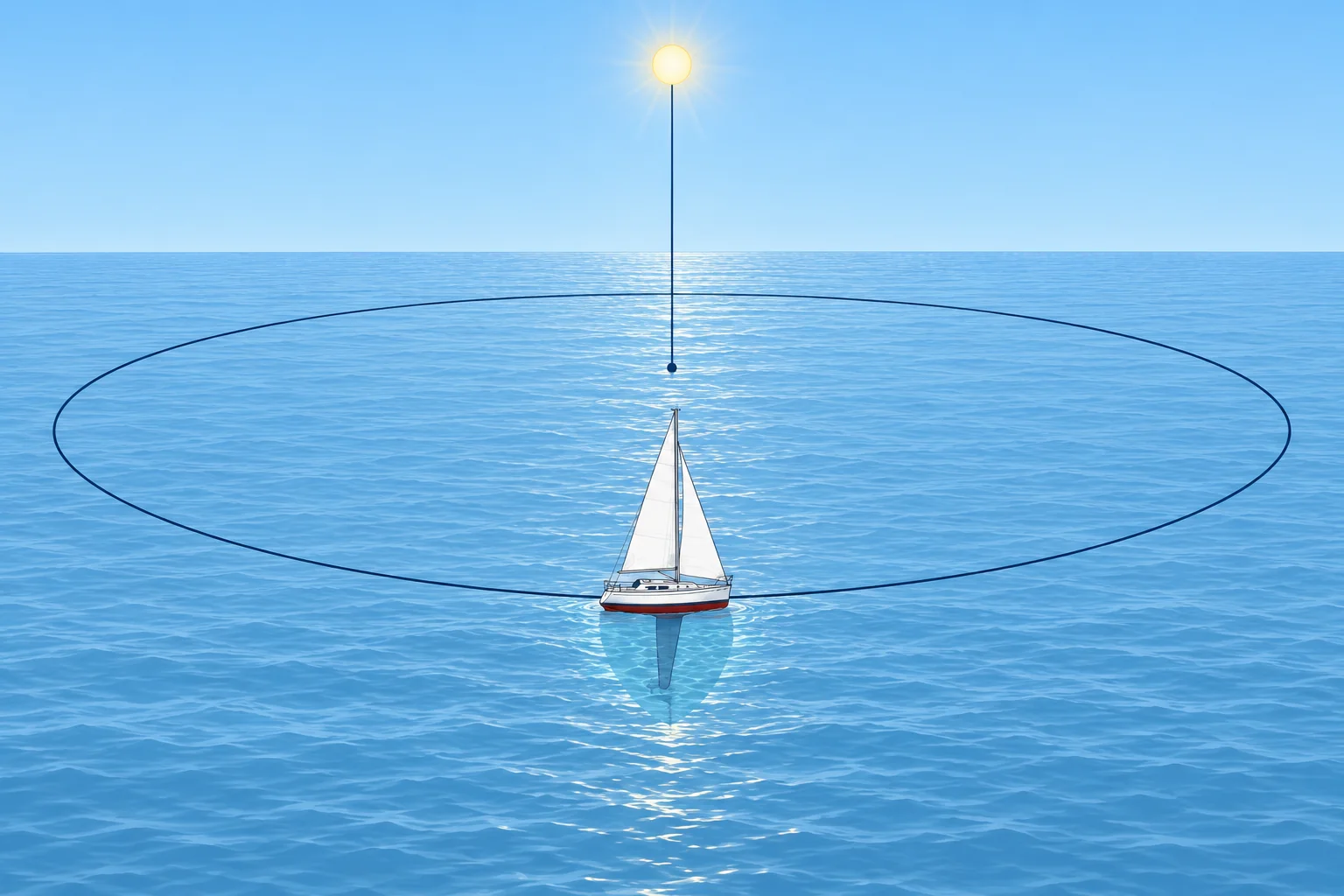
The angle between your zenith and the body equals the angle at the Earth's centre between you and the GP. Each 1′ of arc is 1 nautical mile. So everyone who measures the same altitude at the same instant stands on one circle around the GP: the circle of equal altitude. Its radius is the zenith distance in minutes, in miles.
From circle to position line
An altitude of 47°45.8′ gives a ZD of 42°14.2′: a circle of about 2,534 M radius. Your dead-reckoning (DR) position is estimated from a known position using course and distance travelled. Near it, a short arc of the circle is almost straight, at right angles to the azimuth: your position line. Time each sight: the GP moves about 15′ of longitude a minute, up to about 15 M.
2Key data
- Zenith distance
- ZD = 90° − altitude
- 1′ of arc
- 1 nautical mile on the Earth's surface
- Circle radius
- ZD in minutes = miles from the GP
- Elevated pole
- Its altitude equals your latitude
- GP motion
- 15′ of longitude a minute (up to 15 M)
- Spanish terms
- Cenit, horizonte, altura, azimut, distancia cenital
3Key points
- 1
Altitude above the celestial horizon; zenith distance = 90° − altitude.
- 2
Azimuth Zn is the body's true bearing, 000°–360°.
- 3
The elevated pole's altitude equals your latitude.
- 4
Same altitude, same instant: you are on a circle of equal altitude around the GP.
- 5
Near your DR the circle is a straight position line at right angles to the azimuth.
4Frequent mistakes
Wrong: A position line runs towards the body, along its bearing.
Right: It runs at right angles to the azimuth: it is a short piece of a circle centred on the GP.
Wrong: A few seconds of error in time do not matter for a sight.
Right: The GP moves up to about 15 M a minute. Record every sight's time to the second.
5Practice case & exam keys
You observe the Sun at an altitude of 47°45.8′ (corrected). A crew member asks: 'So where are we?' Explain what that single altitude tells you.
Show the answer
ZD = 90° − 47°45.8′ = 42°14.2′, about 2,534 M. You are somewhere on a circle of about 2,534 M radius around the Sun's GP at that instant. Near your DR, that circle is almost a straight position line at right angles to the Sun's bearing. A fix needs two nonparallel position lines referred to the same time.
Exam keys
- Altitude from the celestial horizon; ZD = 90° − altitude; azimuth is true bearing.
- Altitude of the elevated pole = latitude.
- Circle of equal altitude: centre the GP, radius ZD with 1′ = 1 M.
- Position line: at right angles to the azimuth, near the DR.
Finish this unit
When you've read it, answer three questions. Get all three right to finish the unit; opening the page alone doesn't count.
My notes for this unit
No notes