

Declination, hour angles and the geographical position
1The lesson in plain words
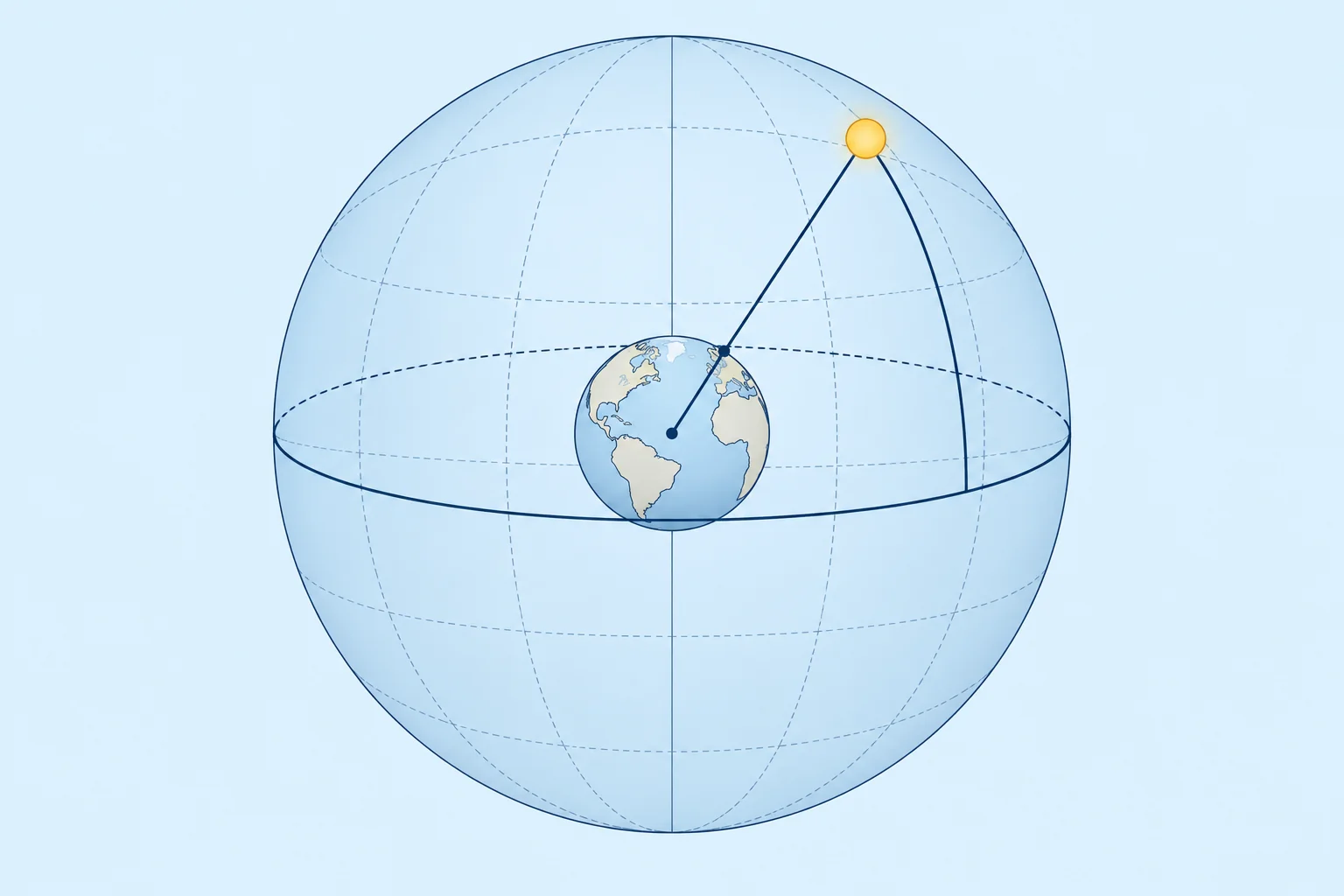
Declination is the sky's latitude; Greenwich hour angle is its longitude, always measured west. Together they give the point beneath each body.
Declination
Declination (Dec) is a body's angle north or south of the celestial equator, measured along its hour circle, 0° to 90° N or S. It is the sky's version of latitude. The Sun's declination changes slowly, by at most about 1′ an hour; a star's hardly changes in a year.
Greenwich hour angle
Greenwich hour angle (GHA) is the angle at the pole measured westward from the Greenwich meridian to the body's hour circle, 0° to 360°. It is like longitude, but always counted west. The Sun's GHA increases by about 15°00′ an hour; Aries's increases by 15°02.5′.
Local hour angle
Local hour angle (LHA) is the same angle measured westward from your meridian: LHA = GHA + east longitude, or − west longitude, adding or removing 360° to keep it from 0° to 360°. LHA 0° means the body is on your meridian. Under 180°, it is west of you; over 180°, east of you.
Sidereal hour angle
Stars keep almost fixed places against each other. So the almanac gives each star's sidereal hour angle (SHA), measured westward from Aries, and its Dec, and tabulates only GHA Aries hour by hour. Then GHA star = GHA Aries + SHA, less 360° if the sum passes 360°.
The geographical position
The point on Earth directly beneath a body is its geographical position (GP). Its latitude equals the declination. Its longitude is the GHA, west, when GHA is 180° or less; otherwise 360° − GHA, east. At 1300 UT on 26 November 2026 the Sun's GHA is 18°10.6′ and its Dec S 20°59.9′: its GP is 20°59.9′S 018°10.6′W, in the South Atlantic.
2Key data
- Declination
- 0–90° N or S of the celestial equator
- GHA
- 0–360°, measured westward from Greenwich
- LHA
- GHA + E long − W long; keep within 0–360°
- GHA of a star
- GHA Aries + SHA (− 360° if over)
- GP
- Lat = Dec; long = GHA (W) or 360° − GHA (E)
- Spanish terms
- Declinación, horario en Greenwich, horario del lugar, ángulo sidéreo
3Key points
- 1
Dec is like latitude; GHA is like longitude but always measured west, 0–360°.
- 2
LHA = GHA + E long − W long, kept between 0° and 360°.
- 3
LHA under 180°: body west of you. Over 180°: east of you.
- 4
GHA star = GHA Aries + SHA.
- 5
The GP is the point beneath the body: lat = Dec, long from GHA.
4Frequent mistakes
Wrong: GHA is measured east or west, up to 180°, like longitude.
Right: GHA is always measured westward, from 0° to 360°. Convert to east or west only for the GP.
Wrong: Add west longitude to GHA to get LHA.
Right: Subtract west longitude and add east longitude: LHA is measured from your meridian, which lies west or east of Greenwich.
Wrong: Each star's GHA is tabulated hourly in the almanac.
Right: Only GHA Aries is hourly. Add the star's SHA from the star list.
5Practice case & exam keys
At 1300 UT on 26 November 2026 the Sun's GHA is 18°10.6′, Dec S 20°59.9′. You are at 21°10′N 027°45′W. Find the Sun's GP and LHA, and say whether the Sun has crossed your meridian yet.
Show the answer
GP: latitude = Dec, 20°59.9′S. GHA is under 180°, so longitude 018°10.6′W. LHA = 18°10.6′ − 27°45.0′ = −9°34.4′, plus 360° = 350°25.6′. Over 180°, so the Sun is still east of you: your noon is still to come, about 38 minutes later.
Exam keys
- Dec: 0–90° N/S of the equinoctial. GHA: 0–360° westward from Greenwich.
- LHA = GHA + E long − W long, wrapped to 0–360°; under 180° the body is west.
- GHA star = GHA Aries + SHA.
- GP latitude = Dec; GP longitude = GHA west, or 360° − GHA east.
Finish this unit
When you've read it, answer three questions. Get all three right to finish the unit; opening the page alone doesn't count.
My notes for this unit
No notes