

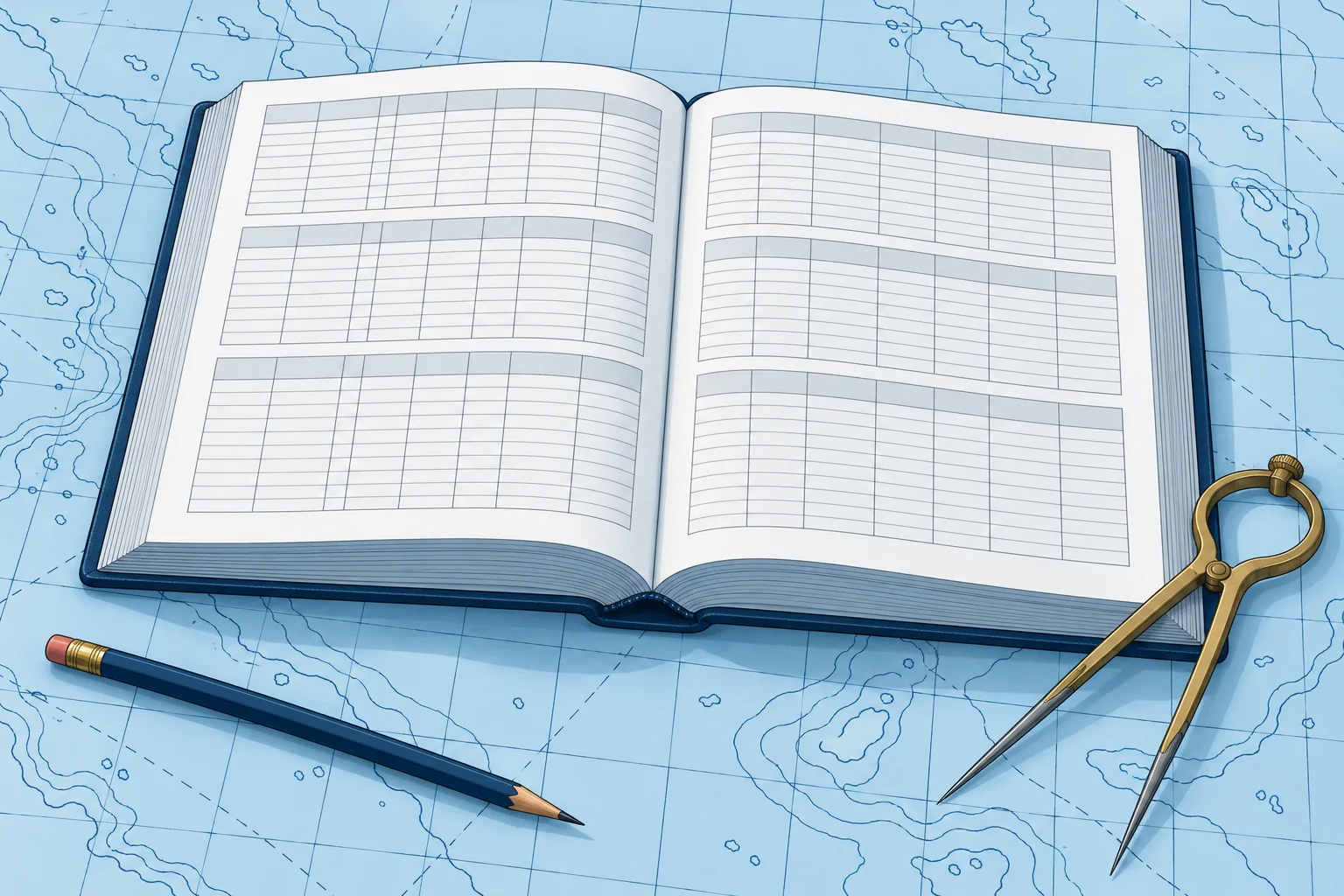
The Nautical Almanac's daily pages
1The lesson in plain words
Each opening covers three days: hourly GHA of Aries, hourly GHA and Dec of the Sun, Moon and planets, and the Sun's meridian passage.
One opening, three days
The Nautical Almanac (NP314), produced by HM Nautical Almanac Office and the US Naval Observatory, gives one double page for every three days. Left page: GHA of Aries, GHA and Dec of the four planets for every hour of UT, and the SHA and Dec of the 57 selected stars. Right page: the Sun and Moon, twilight, sunrise, sunset and moonrise.
The Sun's columns
Each hour, 00h to 23h UT, gives GHA and Dec to 0.1′. At the foot, SD is the Sun's semi-diameter: half its apparent angular diameter. d gives the Sun's mean hourly change in declination. It has no sign. With N/S labels, compare the numerical magnitudes at successive hours: add if the magnitude grows, subtract if it shrinks.
Equation of time and Mer. Pass.
In the lower corner of the right page: the Sun's equation of time at 00h and 12h, and its Mer. Pass., the local mean time of meridian passage, to the minute. When the Sun runs ahead of mean time, as in November, Mer. Pass. is before 1200; when it runs behind, as in February, it is after 1200.
Reading an entry
26 November 2026 at 10h UT: Sun GHA 333°11.2′, Dec S 20°58.5′; foot of the column d 0.5, SD 16.2′; Mer. Pass. 1147. At 11h Dec is S 20°59.0′: the Sun is moving south, so add the d correction to the S magnitude.
v and d
Between whole hours you add an increment at a standard rate (next part). For planets and the Moon the real rate differs from that standard; the hourly excess is v, printed beside them. The Sun's GHA values are adjusted so the standard rate works without v. d gives the hourly declination change for the Sun, Moon and planets; selected-star declinations have no d correction.
2Key data
- Coverage
- Three days per double page, every hour of UT
- Left page
- Aries, Venus, Mars, Jupiter, Saturn; 57 stars
- Right page
- Sun, Moon, twilight, sunrise/sunset, Mer. Pass.
- d
- Mean hourly Dec change; compare N/S magnitudes
- 26 Nov 2026, 10h
- Sun GHA 333°11.2′, Dec S 20°58.5′, d 0.5, SD 16.2′
- Spanish terms
- Almanaque Náutico (ROA): páginas diarias, horario, declinación
3Key points
- 1
One opening = three days, every hour of UT.
- 2
Sun: hourly GHA and Dec; SD and d at the foot.
- 3
With N/S labels, add the d correction if the magnitude grows next hour; subtract if it shrinks.
- 4
Mer. Pass. is the LMT of the Sun's meridian passage.
- 5
Planets and the Moon carry v; the Sun does not.
4Frequent mistakes
Wrong: d is always added because it is printed without a sign.
Right: With N/S labels, compare the numerical magnitudes at successive hours: add if the magnitude grows, subtract if it shrinks.
Wrong: Mer. Pass. is the UT of noon at your position.
Right: It is local mean time. Add west longitude in time (subtract east) to get the UT of your local noon.
5Practice case & exam keys
At 10h, Dec is S 20°58.5′; at 11h, S 20°59.0′. A crew member subtracts a 0.1′ correction from the magnitude and writes S 20°58.4′ because south is negative. Is that right?
Show the answer
No. The southward magnitude is increasing, so use S 20°58.6′. With signed numbers, −20°58.5′ − 0.1′ gives the same result. Keep your convention consistent.
Exam keys
- Three days per opening; hourly GHA of Aries, and hourly GHA/Dec of Sun, Moon and planets.
- SD and d at the foot of the Sun column; apply d to the N/S magnitude using its hourly trend.
- Mer. Pass. is LMT of the Sun's meridian passage, to the minute.
- v corrects GHA for planets and Moon; d corrects Dec for Sun, Moon and planets.
Finish this unit
When you've read it, answer three questions. Get all three right to finish the unit; opening the page alone doesn't count.
My notes for this unit
No notes