

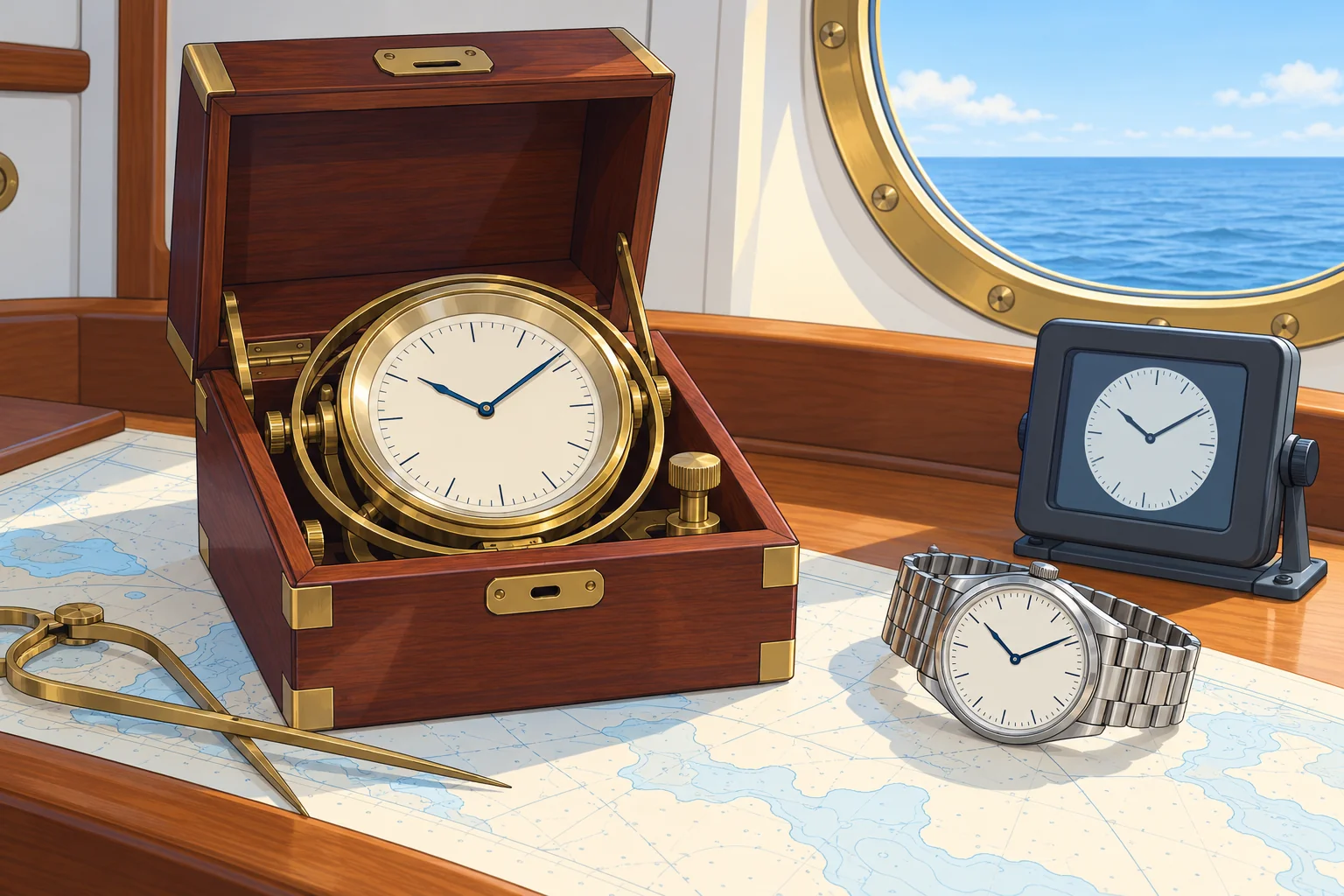
UT, the deck watch and its error
1The lesson in plain words
Every sight except the noon latitude needs its UT to the second: 4 seconds of time error is 1′ of longitude. Know your watch's error and rate.
Why time matters
The Sun's GHA changes by 15′ every minute of time, so 4 seconds of time error gives 1′ of longitude error: up to 1 M at the equator. A noon sight for latitude hardly depends on time, but every other sight needs the UT of the observation to the second.
UT and UTC
The almanac is tabulated in UT, Universal Time. Radio time signals and GNSS receivers give UTC, kept within 0.9 s of UT1, the rotation-based scale. Treat UTC as UT; the small difference, DUT1, matters only in very precise work. Zone time and the zone description are in Navigation: Polaris and time. Log all sights in UT.
Chronometer and deck watch
A chronometer is a precise clock kept below and never reset. A deck watch, or a good quartz watch, is compared with it or with GNSS and taken on deck for sights. Its error is how much it is fast or slow on UT: UT = watch − fast error, or + slow error. Write it down at every check.
Rate
A watch's rate is how much it gains or loses each day. Keep a time log of date, error and daily rate. For calculations, make fast errors and gaining rates positive; slow errors and losing rates negative. Predicted signed error = last signed error + signed daily rate × days. Positive means fast; negative means slow. A steady, known rate matters more than a small one.
Taking the time
Check the watch daily against GNSS or a radio time signal; NP282 lists time signals. A helper can read the watch when you call 'stop'. Alone, start a stopwatch at the sight. Later, read the watch and stop the stopwatch together. Subtract the elapsed time, then apply the watch error. Check AM or PM on a 12-hour dial and confirm the UT date.
2Key data
- Time and longitude
- 4 s of time = 1′ of longitude; 1 min = 15′
- UTC and UT1
- Within 0.9 s (DUT1): treat UTC as UT
- Watch error
- UT = watch − fast error, or + slow error
- Predicted error
- Signed error + signed rate × days; fast/gain +, slow/loss −
- Time signals
- Listed in ADMIRALTY List of Radio Signals NP282
- Spanish terms
- Cronómetro, estado absoluto, movimiento diario
3Key points
- 1
4 s of time = 1′ of longitude: time sights to the second.
- 2
The almanac is in UT; treat UTC from GNSS or radio as UT.
- 3
UT = watch − fast error, or + slow error.
- 4
Keep a time log: error and rate; a steady rate is what you need.
- 5
Check the hour and the date: a 12-hour dial can be 12 hours out.
4Frequent mistakes
Wrong: A watch that is fast must have its error added.
Right: Fast means it reads too late: subtract the error to get UT. Add a slow error.
Wrong: The deck watch keeps zone time, so the sight can be worked in zone time.
Right: Convert to UT before opening the almanac. Many navigators set the deck watch to UT.
5Practice case & exam keys
On 20 November 2026 your deck watch was 4 s slow on GNSS UTC, losing 1 s a day. On 26 November the GNSS fails before a morning sight. The watch reads 10-14-17 at the sight. What UT do you use?
Show the answer
Six days at 1 s a day losing adds 6 s: the watch is now 4 + 6 = 10 s slow. Add a slow error: UT = 10h 14m 17s + 10 s = 10h 14m 27s, on 26 November. An error of a few seconds in that estimate costs about 1′ of longitude per 4 s.
Exam keys
- 4 s of time = 1′ of longitude; time every sight to the second.
- The almanac uses UT; UTC within 0.9 s is treated as UT.
- Watch error: subtract fast, add slow. Rate predicts the error between checks.
- Check the hour and the date before entering the almanac.
Finish this unit
When you've read it, answer three questions. Get all three right to finish the unit; opening the page alone doesn't count.
My notes for this unit
No notes