

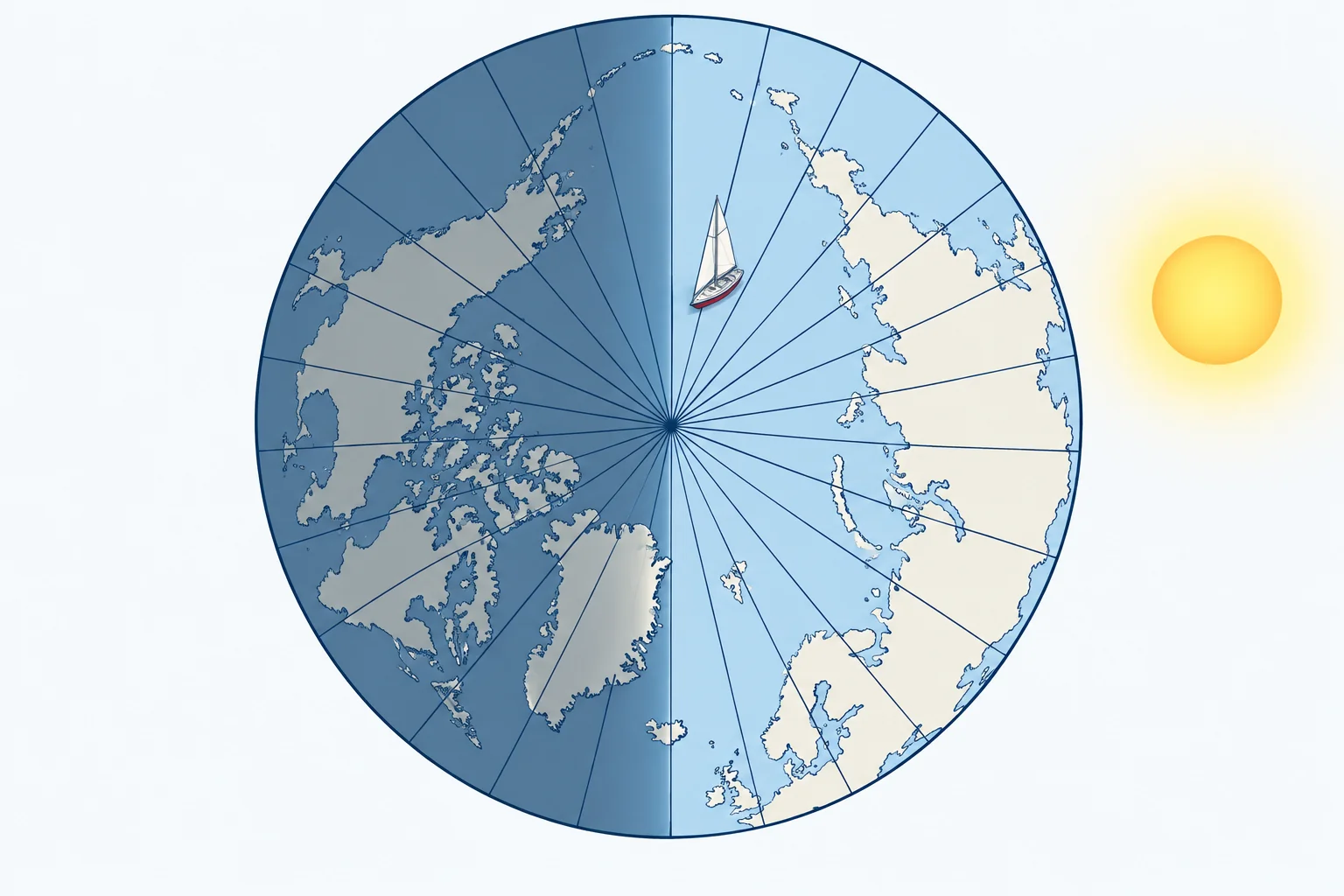
Arc to time, local mean time and the time of local noon
1The lesson in plain words
Longitude converts to time at 15° an hour. Add west longitude in time to the almanac's Mer. Pass. and you have the UT of your local noon.
Arc and time
The Earth turns 360° in 24 hours: 15° = 1 hour, 1° = 4 minutes, 15′ = 1 minute, 1′ = 4 seconds. The almanac has an arc-to-time table, but the arithmetic is easy. For 027°45′W: 27° = 1h 48m, 45′ = 3m, total 1h 51m.
Local mean time
Local mean time (LMT) is mean solar time on your own meridian: LMT = UT − west longitude in time, or + east longitude in time. It is not zone time, which is the time of the zone's central meridian (Navigation: Polaris and time). At 027°45′W, with ZD +2, LMT runs 9 minutes ahead of zone time.
Local noon
The almanac's Mer. Pass. is the LMT of the Sun's meridian passage. It changes by only seconds a day, so it holds at any longitude to the minute. So UT of local noon = Mer. Pass. + west longitude in time, or − east longitude in time.
Worked: 26 November 2026
DR at noon 21°10′N 027°45′W. Mer. Pass. 1147. Longitude in time 1h 51m, west: add. Noon is at 1338 UT. With ZD +2 the ship's clock reads 1138. Use the longitude you expect at noon: each 15′ of longitude made westward makes noon 1 minute later.
Longitude from noon
Turned round, the time of noon gives longitude: noon at 1338 UT with Mer. Pass. 1147 means 1h 51m west, 027°45′W. But near noon the Sun's altitude hardly changes for minutes, so the timing is rough: 1 minute of time is 15′ of longitude. Better longitude comes from timed sights (Celestial: sight reduction).
2Key data
- Arc to time
- 15° = 1 h; 1° = 4 min; 15′ = 1 min; 1′ = 4 s
- LMT
- UT − W long in time, or + E long in time
- UT of local noon
- Mer. Pass. + W long in time (− E)
- Worked noon
- 1147 + 1h 51m = 1338 UT; ZT 1138 at 027°45′W
- Timing and longitude
- 1 min of time = 15′ of longitude
- Spanish terms
- Hora civil del lugar, paso del Sol por el meridiano
3Key points
- 1
15° = 1 h, 1° = 4 min, 15′ = 1 min, 1′ = 4 s.
- 2
LMT is your own meridian's mean time; zone time is the zone's.
- 3
UT of noon = Mer. Pass. + W long in time (− E).
- 4
Use the DR longitude expected at noon.
- 5
Longitude from the time of noon is rough: 1 min = 15′.
4Frequent mistakes
Wrong: Local noon is at 1200 zone time.
Right: It differs by the equation of time and by your offset from the zone's central meridian: 1138 ZT in the worked example.
Wrong: Subtract west longitude in time from Mer. Pass. to get UT.
Right: West of Greenwich, noon comes later in UT: add west, subtract east.
5Practice case & exam keys
Mer. Pass. is 1156. You are now at 045°00′W but expect 045°30′W at noon, keeping ZD +3. A crew member predicts noon at 1456 UT using your present longitude. Accept the plan?
Show the answer
Use the expected noon longitude. 045°30′W equals 3h 02m, so noon is about 1458 UT, or 1158 zone time. The original forecast is two minutes early because it uses the present longitude.
Exam keys
- Arc to time: 15° = 1 h; 1′ = 4 s.
- LMT = UT − W long in time (+ E).
- UT of local noon = Mer. Pass. + W long in time (− E); then ZT = UT − ZD.
- Worked 26 Nov 2026 at 027°45′W: 1338 UT, 1138 ZT.
Finish this unit
When you've read it, answer three questions. Get all three right to finish the unit; opening the page alone doesn't count.
My notes for this unit
No notes