

Inland lights: the Great Lakes, tows and US-only signals
1The lesson in plain words
Inland differences include paired yellow towing lights, a flashing yellow light on the tow, the Great Lakes white-light option, and blue or red-and-yellow signals.
Great Lakes option
On the Great Lakes, a power-driven vessel may carry an all-round white light instead of the second masthead light and the sternlight (Inland Rule 23(e)). It sits where the second masthead light would be, with the same range. So from astern a Great Lakes freighter may show a high white light and no sternlight.
Small-craft differences
Inland Rule 23(d) keeps the under-12 m option: an all-round white light and sidelights. It has no equivalent to COLREG’s under-7 m option for vessels whose maximum speed does not exceed 7 knots. A sailing vessel under 12 m that is motor-sailing need not show the cone (Inland Rule 25(e)).
Pushing and towing alongside
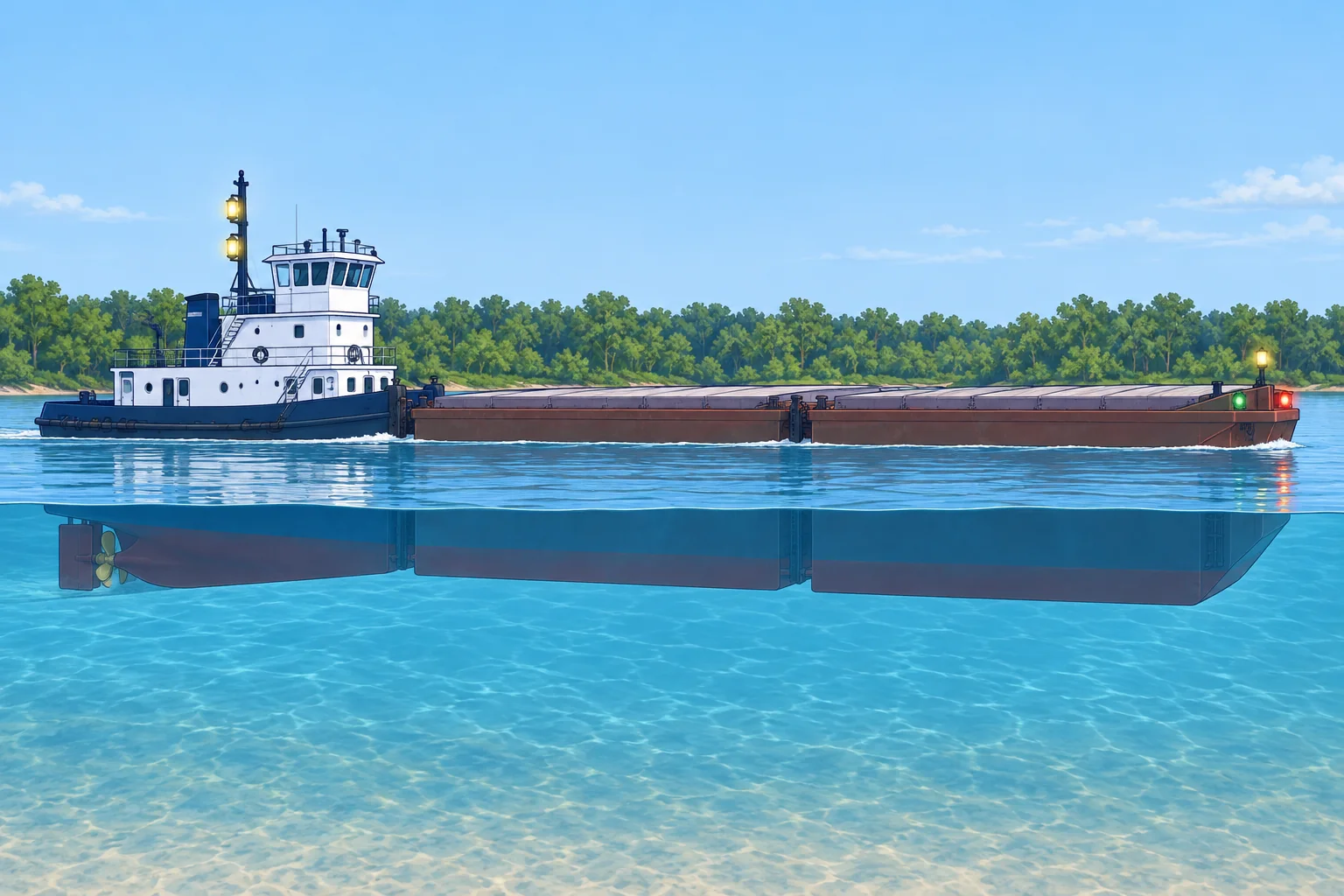
A rigidly joined tug and tow form a composite unit and show ordinary power-driven vessel lights. Otherwise, pushing ahead or towing alongside requires two masthead lights vertically, sidelights and two yellow towing lights vertically instead of a sternlight (Rule 24(c)). At 50 m or more, she also shows the other masthead light (Rule 24(d)). For non-composite vessels, Rule 24(j) omits masthead lights on Western Rivers except the Mississippi below the Huey P. Long Bridge, and on waters in 33 CFR 89.27.
The special flashing light
Outside a composite unit, a pushed tow shows sidelights and a special flashing yellow light at its forward end. An alongside tow also shows these lights forward, plus a sternlight aft (Rule 24(f)). The special light flashes 50–70 times a minute, covers 180°–225° and reaches at least 2 nautical miles. It sits as far forward as practicable on the centreline (Rule 21(g)). Look for the towboat beside or behind the tow.
Annex V and anchorages
Law-enforcement vessels may show a flashing blue light. Public-safety craft, such as rescue or regatta patrol boats, may show an alternately flashing red and yellow light, which gives no special right of way (33 CFR 88). Under 20 m, in a Coast Guard special anchorage area, you need show no anchor light and sound no fog bell (Inland Rules 30(g), 35(l)).
2Key data
- Great Lakes power-driven
- All-round white may replace 2nd masthead light and sternlight
- Non-composite pushing/alongside, outside Rule 24(j)
- 2 masthead lights (+ 3rd at ≥50 m), sidelights, 2 yellow towing lights
- Rule 24(j) waters, non-composite
- Western Rivers except below Huey P. Long Bridge; also 33 CFR 89.27
- Special flashing light
- Yellow, 50–70 per minute, 180°–225°, front of the tow
- Law enforcement
- Flashing blue light (33 CFR 88.05)
- Special anchorage, under 20 m
- No anchor light or shape; no anchor fog signal
3Key points
- 1
Two yellow towing lights in a line mean a vessel pushing ahead or towing alongside.
- 2
A flashing yellow light low and forward marks the front of a pushed tow.
- 3
Great Lakes ships may show an all-round white instead of a second masthead light and sternlight.
- 4
Flashing blue = law enforcement; red and yellow = public safety. These lights give no special right of way.
- 5
Under 20 m in a special anchorage area: no anchor light needed.
4Frequent mistakes
Wrong: The special flashing yellow light is carried by the towboat.
Right: It is carried at the forward end of the tow: the vessel pushed ahead or towed alongside.
Wrong: A red and yellow flashing patrol boat has the right of way.
Right: The light is identification only and conveys no privilege. The patrol boat follows the Inland Rules.
Wrong: Under 7 m and slower than 7 knots, an all-round white is enough on Inland waters.
Right: COLREG alone allows a power-driven vessel under 7 m, whose maximum speed does not exceed 7 knots, to show an all-round white light and, if practicable, sidelights. Inland, use the under-12 m option: an all-round white light and sidelights.
5Practice case & exam keys
At night on the Ohio River, you see sidelights and a yellow light flashing about once a second. A crew member sees no white masthead light and says it must be a small boat you can cross close ahead of. Is that a safe conclusion?
Show the answer
No. The flashing yellow light marks the forward end of a non-composite pushed or alongside tow. The towboat may be well behind it. Her two steady yellow towing lights face aft, so you need not see them from ahead. Rule 24(j) omits masthead lights for this arrangement on the Ohio River. Do not cross close ahead; keep clear and agree any passing early.
Exam keys
- Inland 24(c): non-composite pushing or towing alongside, two yellow towing lights instead of a sternlight; Rule 24(j) waters omit masthead lights.
- Special flashing light: yellow, 50–70 flashes per minute, at the forward end of the tow.
- Great Lakes: an all-round white may replace the second masthead light and sternlight.
- Annex V: blue = law enforcement; red and yellow = public safety. These lights give no special right of way.
Finish this unit
When you've read it, match the terms, then answer three questions. Get them all right to finish the unit; opening the page alone doesn't count.
My notes for this unit
No notes