

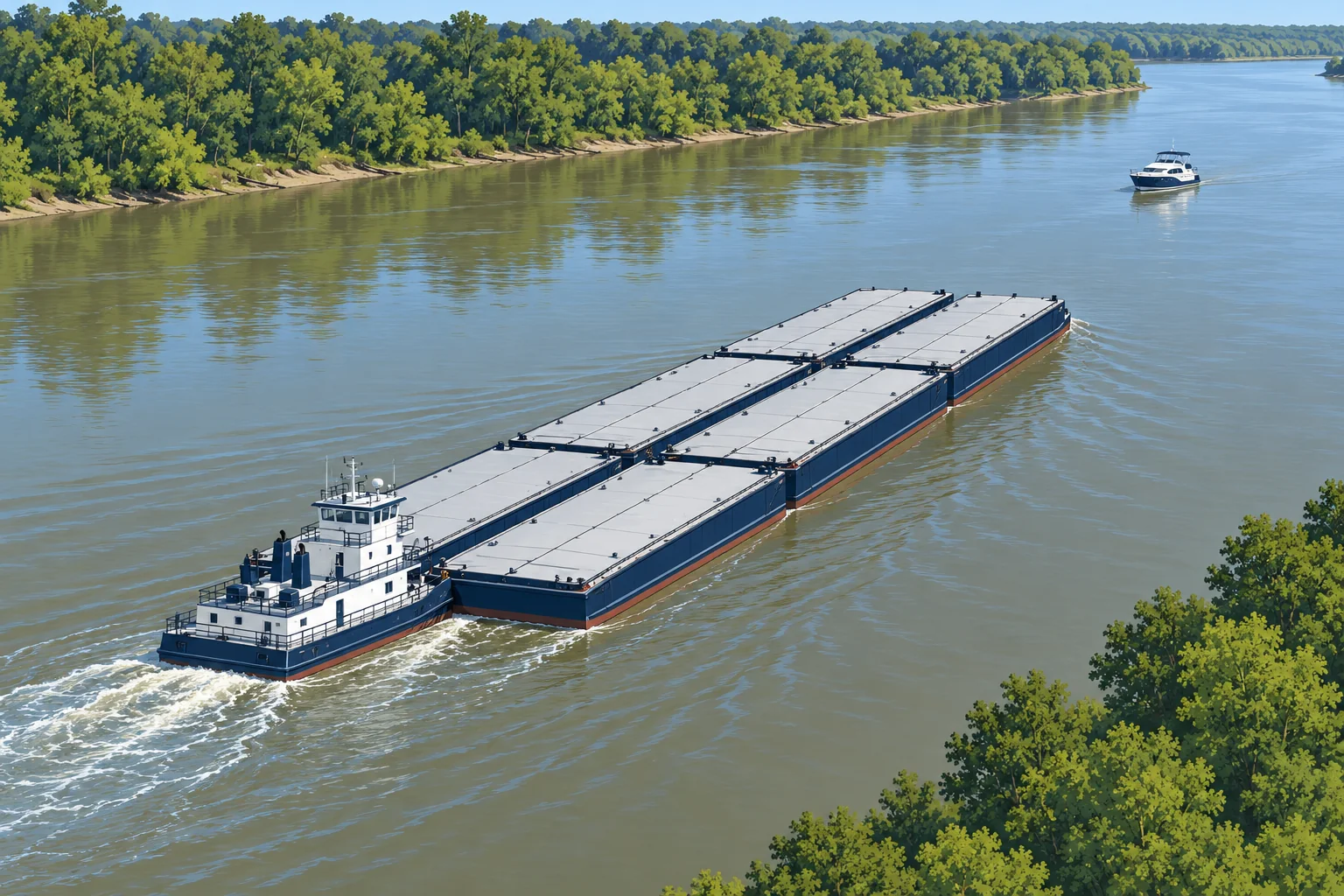
Rivers and lakes: downbound vessels and river crossings
1The lesson in plain words
On specified waters, special rules cover power-driven vessels meeting with or against the current, and power-driven vessels crossing a river.
Downbound has the right of way
On the Great Lakes, the Western Rivers and waters listed in 33 CFR 89.25, a power-driven vessel downbound with a following current has the right of way over an upbound power-driven vessel. She proposes the manner of passage and starts the whistle signals. Inland Rule 9(a)(ii) says this for narrow channels and fairways; Inland Rule 14(d) for meeting head-on.
Why the current matters
A vessel going downstream with the current, often a towboat pushing barges, has less control at low speed and needs much more room to stop. A vessel going upstream against the current can slow and almost hold her ground. When these power-driven vessels meet, the upbound vessel holds as necessary to permit safe passing (Inland Rule 9(a)(ii)).
Crossing a river
On the same waters, a power-driven vessel crossing a river keeps out of the way of a power-driven vessel going up or down it (Inland Rule 15(b)). This applies whichever side she is on. A motor ferry or small motorboat crossing gives way to a towboat coming downstream, even when the towboat is on her port side.
No constrained-by-draught
The Inland Rules have no vessel constrained by her draught: Inland Rule 28, and the matching parts of Inland Rules 3 and 18, are left blank. Deep ships in Inland channels rely on Rule 9 instead: a vessel under 20 m, or a sailing vessel, shall not impede a vessel that can safely navigate only within a narrow channel or fairway.
What stays the same
Rule 13, ordinary Rule 15 crossing encounters, and Rules 16, 17 and 19 follow COLREG; Rule 18 omits constrained-by-draught status. Compare COLREG Rules 9, 14 and 15.
2Key data
- Where
- Great Lakes, Western Rivers, waters in 33 CFR 89.25
- Power-driven, downbound with current
- Right of way over upbound power-driven vessel; proposes and signals
- Power-driven, upbound
- Holds as necessary for safe passing with downbound power-driven vessel
- Power-driven river crossing
- Gives way to power-driven vessels going up or down the river
- Constrained by her draught
- Not in the Inland Rules (Rule 28 reserved)
3Key points
- 1
Power-driven, downbound with a following current: right of way over upbound power-driven vessel; proposes and signals first.
- 2
The upbound power-driven vessel holds as necessary for safe passing with the downbound power-driven vessel.
- 3
A power-driven vessel crossing a river gives way to power-driven vessels going up or down it.
- 4
These rules apply on the Great Lakes, Western Rivers and the waters in 33 CFR 89.25.
- 5
No constrained by her draught status exists in the Inland Rules.
4Frequent mistakes
Wrong: On a river, the crossing rule works as at sea: give way to the vessel on your starboard side.
Right: On the Western Rivers, Great Lakes and listed waters, a power-driven vessel crossing the river gives way to power-driven vessels going up or down it.
Wrong: The downbound rule applies on every US river.
Right: Only on the Great Lakes, the Western Rivers and the waters listed in 33 CFR 89.25.
Wrong: An upbound vessel can carry on and let the downbound tow sort it out.
Right: When these power-driven vessels meet, the upbound vessel holds as necessary to permit a safe passing.
5Practice case & exam keys
Motoring upstream on the Mississippi, you see a towboat pushing barges coming downstream round the next bend. She sounds one short blast.
Show the answer
The downbound tow proposes port-to-port passage. If safe, answer one short blast and hold as necessary. If you doubt the plan, immediately sound at least five short and rapid blasts and take precautions. Use the local bridge-to-bridge VHF channel to resolve the plan; a radio call does not replace the doubt signal.
Exam keys
- Inland 9(a)(ii) and 14(d): a power-driven vessel downbound with a following current has right of way over an upbound power-driven vessel and proposes passage.
- The upbound power-driven vessel holds as necessary to permit safe passing.
- Inland 15(b): a power-driven vessel crossing a river keeps out of the way of power-driven vessels ascending or descending.
- Applies on the Great Lakes, Western Rivers and the waters listed in 33 CFR 89.25.
Finish this unit
When you've read it, match the terms, then answer three questions. Get them all right to finish the unit; opening the page alone doesn't count.
My notes for this unit
No notes