

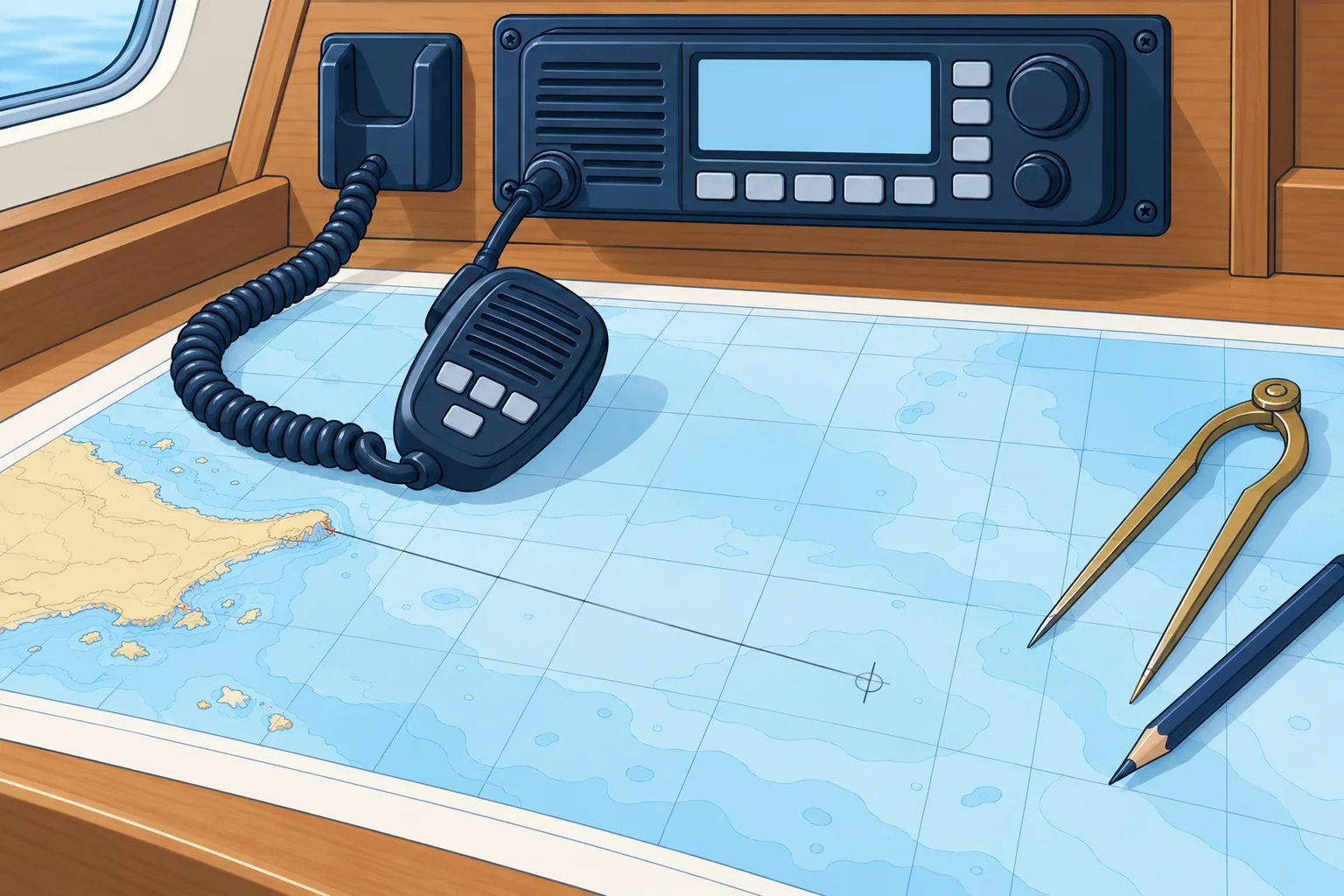
Radio English: letters, numbers, positions and times
1The lesson in plain words
On the radio, small slips with numbers cause big mistakes. Say letters, numbers, positions, bearings and times the standard way, every time.
Why a standard
English is the common language at sea, but most people using it are not native speakers. Radio adds noise and distortion. The IMO Standard Marine Communication Phrases (SMCP), adopted in 2001 as resolution A.918(22), set out simple, fixed ways to say things so that they cannot be misunderstood. This part covers the basics every skipper needs; the full SMCP has its own unit.
Letters
Use the international spelling alphabet for names and call signs. See the GMDSS module for the alphabet and practice.
Numbers
Speak numbers digit by digit: 150 is ‘one-five-zero’. Some digits are pronounced differently from everyday English, to stay clear on the radio: ZEERO, WUN, TOO, TREE, FOWER, FIFE, SIX, SEVEN, AIT, NINER, and TOUSAND for 1,000. Say decimals as ‘decimal’ or ‘point’: 2.5 is ‘two decimal five’. The exception is rudder angle in a wheel order: say ‘fifteen’, not ‘one-five’.
Positions and bearings
Give latitude and longitude in degrees and minutes, with North or South and East or West. Or give a position from a charted mark: a true bearing in 360° notation from the mark, and the distance. Example: ‘My position two-two-five degrees from Punta Anaga lighthouse, three decimal two miles.’ Courses are also in 360° notation, true unless you say otherwise.
Units and times
Give distances in nautical miles or cables (tenths of a mile), always naming the unit. Speed is in knots: plain ‘knots’ means speed through the water; say ‘ground speed’ for speed over the ground. Times are in the 24-hour clock and UTC; if you use local time, say so. Use place names as they appear on the chart or in the sailing directions.
2Key data
- Numbers
- Digit by digit: 150 = one-five-zero
- Special pronunciation
- TREE, FOWER, FIFE, AIT, NINER, TOUSAND
- Decimals
- ‘Decimal’ or ‘point’: 2.5 = two decimal five
- Position from a mark
- True bearing FROM the mark, then distance
- Speed
- Knots through the water; ‘ground speed’ over the ground
- Times
- 24-hour UTC; say if you use local time
3Key points
- 1
Use the international spelling alphabet; see the GMDSS module for practice.
- 2
Say numbers digit by digit, with the radio pronunciation such as TREE, FIFE and NINER.
- 3
A position from a mark is the true bearing from the mark, then the distance.
- 4
Name the unit for every distance; plain ‘knots’ means speed through the water.
- 5
Give times in UTC on the 24-hour clock, unless you clearly say local time.
4Frequent mistakes
Wrong: ‘My position is the lighthouse bearing 045, 3 miles.’
Right: Give the bearing from the mark: ‘My position two-two-five degrees from the lighthouse, three miles.’
Wrong: Say 150 as ‘a hundred and fifty’.
Right: Say ‘one-five-zero’: separate digits cannot be confused with 115 or 160.
Wrong: ‘ETA ten o'clock.’
Right: ‘ETA one-zero-zero-zero UTC’, or say clearly that it is local time.
5Practice case & exam keys
You must report your position by radio. The lighthouse on Punta Anaga bears 045° true from you, at 3.2 miles. Your speed through the water is 6.5 knots and your speed over the ground 5.8 knots. How do you give your position and speed?
Show the answer
The bearing from the mark is the reciprocal: 045 + 180 = 225°. Say: ‘My position two-two-five degrees from Punta Anaga lighthouse, distance three decimal two nautical miles. My speed six decimal five knots, ground speed five decimal eight knots.’
Exam keys
- SMCP: IMO resolution A.918(22), 2001; English as the common language at sea.
- Numbers digit by digit; decimals ‘decimal’ or ‘point’; radio pronunciation for 3, 4, 5, 8, 9.
- Position from a mark: true bearing from the mark, then distance.
- Distances with units; knots through the water unless ‘ground speed’; times in UTC.
Finish this unit
When you've read it, answer three questions. Get all three right to finish the unit; opening the page alone doesn't count.
My notes for this unit
No notes