

IAMSAR Volume III and the on-scene coordinator
1The lesson in plain words
Near the coast a small ship is often first on scene. Know what IAMSAR Volume III expects and how to coordinate until better-equipped help takes over.
The manual on your bridge
SOLAS chapter V, regulation 21, requires every ship to carry an up-to-date IAMSAR (International Aeronautical and Maritime Search and Rescue) Manual Volume III, the volume for mobile facilities: ships and aircraft. The current 2025 edition applies from 1 January 2026. Keep the printed book on the bridge. It explains how to respond to a distress alert, how to coordinate units on scene and how to handle emergencies on board, with checklists you can work through.
Who runs the rescue
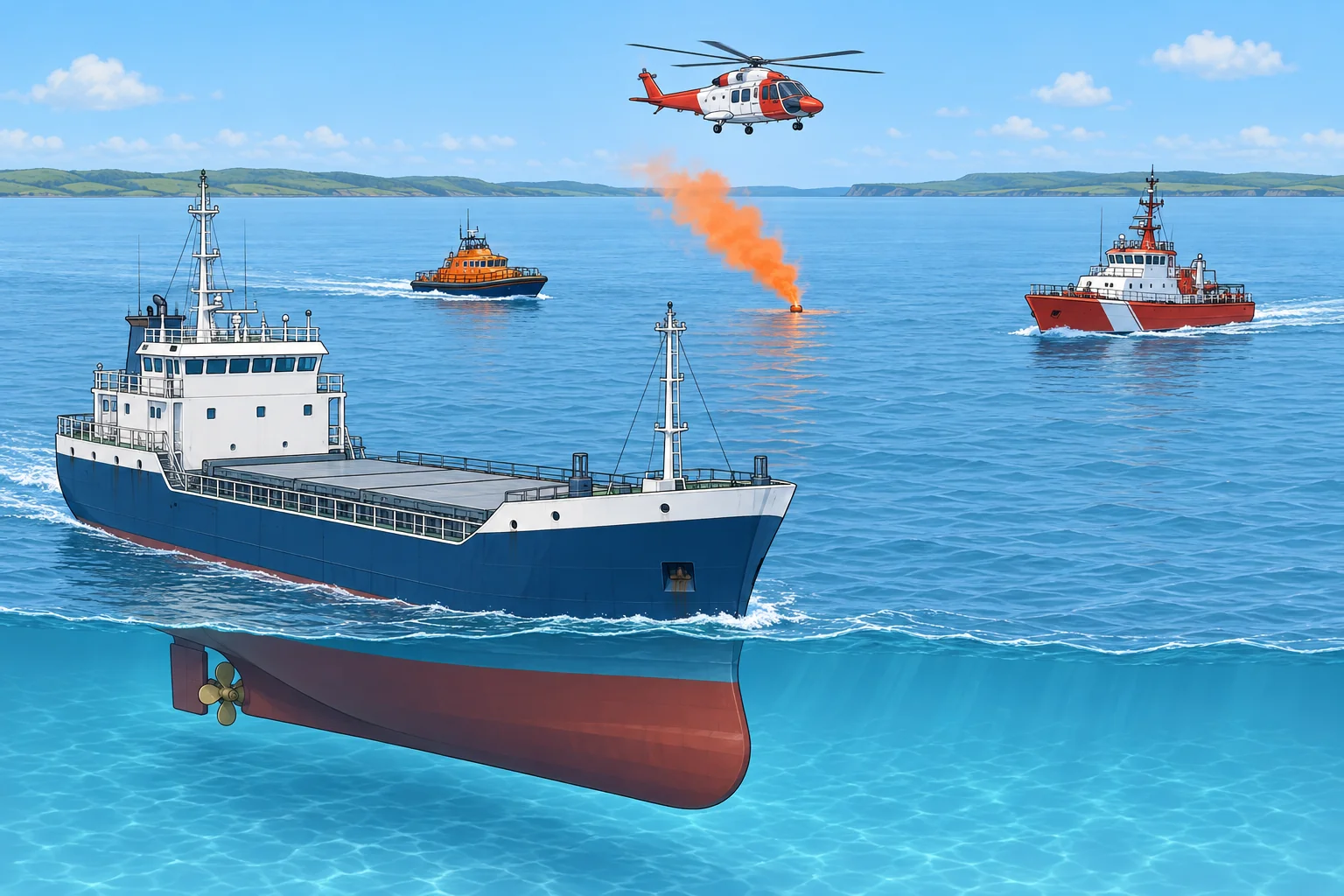
In an RCC-coordinated SAR mission, the SAR mission coordinator (SMC) at the rescue coordination centre (RCC) plans the search and calls in units. Near the coast, help may include lifeboats, coastguard boats and helicopters. The basics of the system and how to raise the alarm are in Emergencies: search and rescue. This unit covers your part at the scene.
The on-scene coordinator
When two or more units work together at the scene, one of them is the on-scene coordinator (OSC). The SMC normally names the OSC. Until then, the first unit to arrive takes the role. A coastal ship may therefore coordinate for the first hour, then hand over to a coastguard unit or lifeboat with better sensors and training. The OSC coordinates, but each master stays responsible for the safety of their own ship.
What the OSC does
The OSC carries out the SMC's search plan, or makes a simple one if none has arrived. They give each unit a pattern or area, a track spacing (the distance between neighbouring search legs) and a radio channel. They keep a plot of what each unit has searched and send regular situation reports (SITREPs) to the RCC. They warn the SMC early when weather, fuel or daylight will change the plan.
On the way
Plan with your team as you approach the scene: lookouts posted high with binoculars, the rescue boat and recovery gear ready, the sheltered side chosen and a space ready for survivors. Tell the RCC your position, speed, estimated time of arrival (ETA) and what you can offer. Leading a large multi-unit SAR case is in Emergencies: emergency response; your own ship's distress response is in Emergencies: emergency organisation.
2Key data
- IAMSAR Volume III
- Mobile facilities; carriage required by SOLAS V/21
- Current edition
- 2025 edition, applies from 1 January 2026
- OSC
- Named by the SMC; until then, the first unit on scene
- Master's duty
- Responsibility for your own ship never passes to the OSC
- Reports
- OSC sends regular SITREPs to the RCC
3Key points
- 1
Carry the current IAMSAR Volume III (2025 edition, from 1 January 2026) in print on the bridge.
- 2
The SMC at the RCC plans; the OSC coordinates the units at the scene.
- 3
Until the SMC names one, the first unit on scene acts as OSC.
- 4
As OSC you allocate patterns, spacing and channels and send SITREPs, but every master keeps command of their ship.
4Frequent mistakes
Wrong: Wait at the scene until the RCC tells you who coordinates.
Right: If you arrive first and nobody has been named, act as OSC until the SMC appoints one.
Wrong: As OSC you can order another ship into danger.
Right: The OSC coordinates. Each master decides what is safe for their own ship and crew.
Wrong: The IAMSAR book can stay in the ship's office as a PDF.
Right: Keep the current printed Volume III on the bridge, ready to use in an emergency.
5Practice case & exam keys
Your 300 GT coastal cargo ship will reach the search area for two missing fishers first. A tanker follows 20 minutes later. No OSC has been named. The tanker’s draught prevents it searching the shallow western sector. What do you do?
Show the answer
While approaching, report your position, speed, ETA and capabilities to the RCC and prepare lookouts and recovery gear. Act as OSC until the SMC names one. Give the tanker a safe task outside the shallows, with a pattern, spacing and channel. Keep a plot and send SITREPs. Each master retains responsibility for their ship; tell the RCC about limits on coverage.
Exam keys
- IAMSAR Volume III (mobile facilities) is carried under SOLAS V/21; 2025 edition from 1 January 2026.
- SMC at the RCC plans; OSC coordinates on scene; until designated, the first unit on scene acts as OSC.
- OSC duties: allocate areas, patterns, track spacing and channels; keep a plot; send SITREPs.
- Each master keeps responsibility for their own ship.
Finish this unit
When you've read it, answer three questions. Get all three right to finish the unit; opening the page alone doesn't count.
My notes for this unit
No notes