

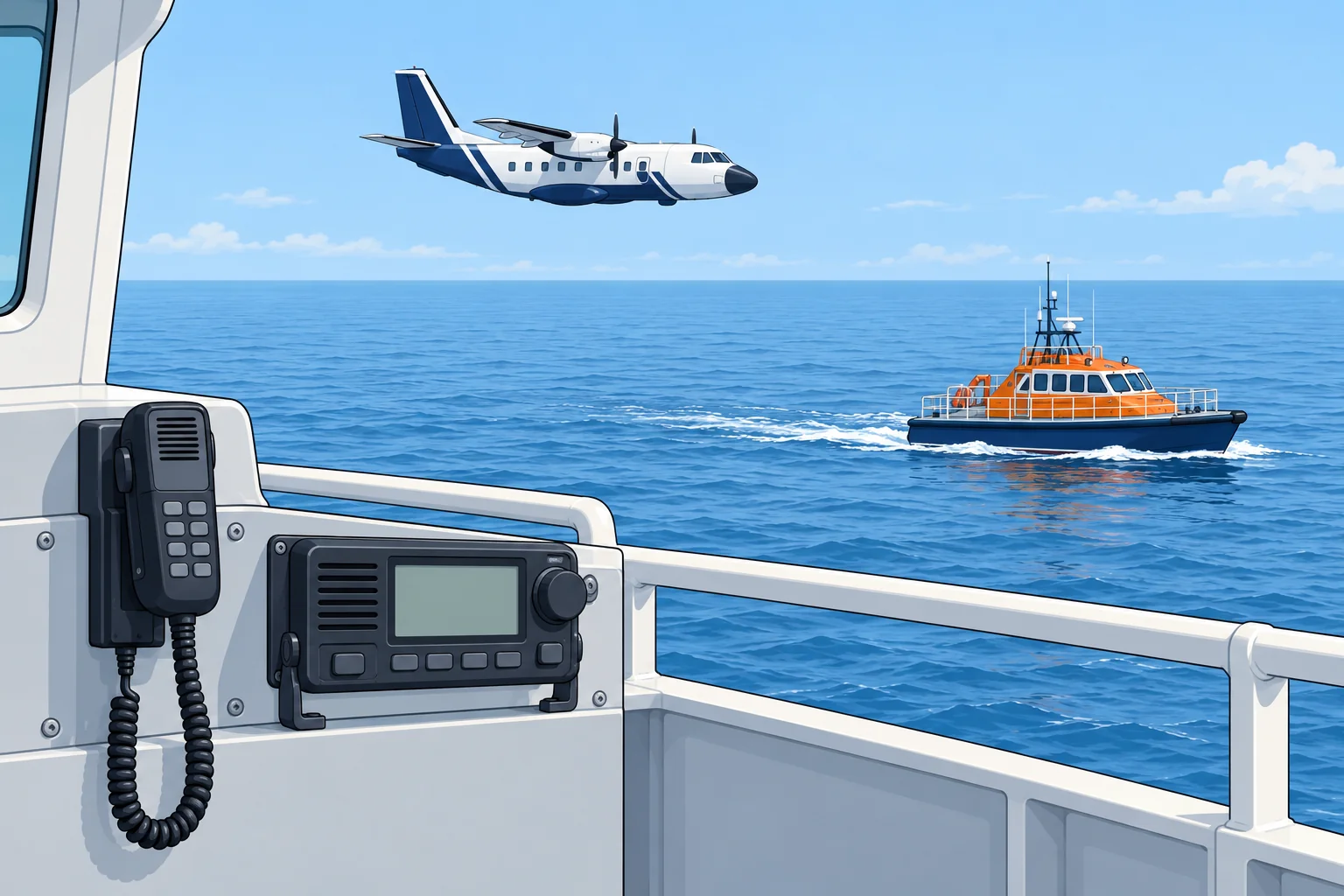
Communications on scene: VHF, DSC and aircraft
1The lesson in plain words
Alert on DSC, talk on voice. Keep watch on the on-scene channel the coordinator names, and know which frequencies reach a rescue aircraft.
DSC and voice
DSC (digital selective calling) uses VHF channel 70 for digital calls, including distress alerts; it carries no voice. Distress voice traffic uses channel 16 (156.8 MHz). On MF (medium frequency), distress voice uses 2182 kHz.
The on-scene channel
The SMC or OSC names the on-scene frequency, and every unit keeps continuous watch on it. On VHF this is usually channel 16 or an assigned working channel. Maintain channel 16 listening watch when practicable. VHF channel 06 (156.3 MHz) is the ship–aircraft channel for SAR, and many rescue aircraft can use it.
Aircraft frequencies
Aircraft work on aeronautical VHF. 121.5 MHz is the aeronautical emergency frequency and 123.1 MHz the aeronautical on-scene frequency. You need aeronautical VHF equipment to use these frequencies. Otherwise, use channel 06 if the aircraft supports marine VHF, or relay through the RCC. A helicopter briefing on deck is in Emergencies: helicopter and flares.
Say it clearly
Use plain English and SMCP phrases (Standard Marine Communication Phrases). Give positions as latitude and longitude, or as bearing and distance from datum. Repeat key figures. Report every sighting at once: what, where and when. Keep one person on the radio and log every message with its time.
SITREPs
A SITREP (situation report) keeps the RCC up to date. At least, it says who you are, where you are, what has happened, how many people are involved, what has been done and what help is needed. Send one on arrival, then at the interval the SMC sets, and at once when something important changes.
2Key data
- DSC, VHF channel 70
- DSC signalling; no voice
- Voice distress, VHF
- Channel 16, 156.8 MHz
- Ship–aircraft SAR, VHF
- Channel 06, 156.3 MHz
- Aeronautical
- 121.5 MHz emergency; 123.1 MHz on-scene
- MF voice distress
- 2182 kHz
- On-scene frequency
- Named by the SMC or OSC; all units keep watch
3Key points
- 1
Channel 70: DSC signalling; no voice. Distress voice uses channel 16.
- 2
Keep continuous watch on the assigned on-scene channel, and channel 16 listening watch when practicable.
- 3
Channel 06 links ships and SAR aircraft on marine VHF; aircraft also use 121.5 and 123.1 MHz.
- 4
Report sightings at once and send SITREPs on arrival, at set intervals and on every big change.
4Frequent mistakes
Wrong: Call the other ships on channel 70 to coordinate the search.
Right: Channel 70 carries DSC signalling; no voice. Coordinate by voice on 16 or the working channel named.
Wrong: A cargo ship can always talk to a SAR aircraft on 123.1 MHz.
Right: You need aeronautical VHF; otherwise use channel 06 if the aircraft supports marine VHF, or relay through the RCC.
Wrong: Wait until the search ends to report a sighting.
Right: Report every sighting at once with position and time; it may change the whole plan.
5Practice case & exam keys
You are OSC for two ships searching for a missing dinghy. A coastguard aircraft is coming. Your ship has no aeronautical VHF. The RCC says the aircraft can work marine VHF.
Show the answer
Keep the ships on the assigned search channel with continuous watch, and maintain channel 16 listening watch when practicable. Contact the aircraft on channel 06 using a separate voice set if available; otherwise ask the RCC to relay or agree a common channel while maintaining the search watch. Brief the aircraft on datum, coverage and sightings, and agree its task. Send the RCC an updated SITREP.
Exam keys
- Channel 70: DSC signalling; no voice. Distress voice: channel 16 (156.8 MHz); MF voice 2182 kHz.
- On-scene frequency named by the SMC or OSC; continuous watch by all units.
- Ship–aircraft: VHF channel 06 (156.3 MHz); aircraft also 121.5 MHz and 123.1 MHz.
- SITREP on arrival, at set intervals and when the situation changes.
Finish this unit
When you've read it, answer three questions. Get all three right to finish the unit; opening the page alone doesn't count.
My notes for this unit
No notes