

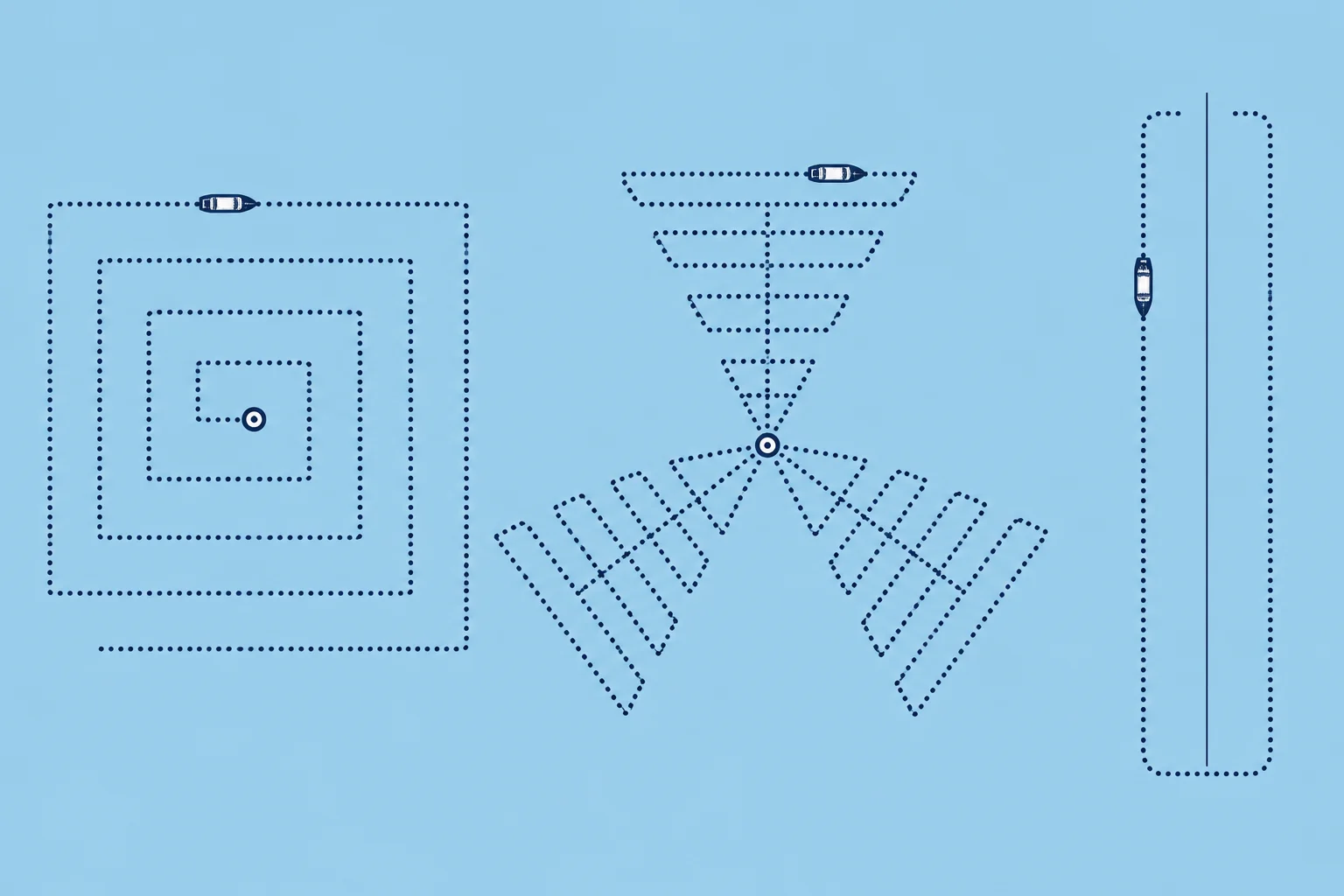
Expanding square, sector, track line and parallel sweep
1The lesson in plain words
Pick the pattern that suits what you know: a close position, a known route or a large uncertain area, then run it accurately and report it.
Expanding square (SS)
Use it when the object's position is known within close limits and it has little leeway, such as a person in the water. Start at datum. The first two legs are one track spacing long, the next two are 2S, then 3S, and so on, turning 90° the same way after every leg. Run the first leg into the wind where you can, to reduce navigation errors. It needs accurate navigation, so plot every leg. Only one ship runs it at a time.
Sector search (VS)
Use it when the position is accurate and the area small. Mark datum with a smoke float or suitable marker. Ships usually use a radius of 2 to 5 NM, where safe. Run three triangles, each starting and ending at datum. Turn 120° to starboard only at the outer points. Continue straight through datum between triangles. After three triangles, you finish at datum. If nothing is found, repeat the pattern rotated 30°.
Track line search (TS)
For a craft missing on a known route, use a track line search. TSR (return) searches one side outbound and the other back, finishing near the start. TSN (non-return) searches the route itself, returns along one side, then searches outbound along the other, finishing near the far end. Non-return describes where the search finishes; it does not mean that no leg runs back along the route.
Parallel sweep (PS)
For a large area where the position is uncertain, units search on parallel legs at the track spacing apart, often several ships abreast. The SMC or OSC sets the legs and the commence search point. Planning large coordinated searches belongs to Emergencies: emergency response.
Choose and report
Good position, small area: expanding square or sector. Known route: track line. Large area, several units: parallel sweep. Whatever the pattern, tell the OSC when you start, each leg completed and anything sighted, with its position and time.
2Step by step
Running a sector search from a ship
- 1
Update datum for drift and mark it with a smoke float or suitable marker.
A visible centre helps you navigate the pattern. Keep checking its position as drift changes.
- 2
Agree a safe radius, R, and the first heading with the OSC; check every leg and turn against the chart.
Keep clear of land and shoals and allow safe turning room. Other units must know your plan.
- 3
From datum, run R; turn 120° to starboard and run R.
The first leg reaches an outer point; the next runs across to another outer point.
- 4
Turn 120° to starboard and run 2R through datum. Turn 120° to starboard and run R.
Crossing datum completes the first triangle and starts the second. The next leg joins its outer points.
- 5
Turn 120° to starboard and run 2R through datum. Turn 120° to starboard and run R. Turn 120° to starboard and run R back to datum.
The second datum crossing starts the third triangle. Finish at datum.
- 6
If nothing is found, rotate the pattern 30° and run it again.
The new legs fall halfway between the first and cover the gaps.
3Key data
- Expanding square
- Start at datum; legs S, S, 2S, 2S, 3S…; 90° turns, same way
- Sector search, ships
- Radius usually 2–5 NM where safe; 120° starboard turns at outer points
- Second sector search
- Rotate the pattern 30°
- Track line
- TSR finishes near the start; TSN at the far end
- Parallel sweep
- Large uncertain area; parallel legs, often ships abreast
4Key points
- 1
Expanding square: from datum, legs S, S, 2S, 2S, 3S…, 90° turns the same way, first leg into the wind.
- 2
Sector search: 120° turns at outer points; straight through datum; radius usually 2–5 NM; repeat rotated 30°.
- 3
Track line: TSR searches both sides and finishes near the start; TSN searches the route and both sides, ending at the far end.
- 4
Parallel sweep for large areas; report start, legs and sightings to the OSC.
5Frequent mistakes
Wrong: Run an expanding square with two ships in the same small area.
Right: Only one ship runs a square or sector in a given area; more units would risk collision and gaps.
Wrong: Start a sector search from where you happen to be.
Right: Mark datum and start there. Turn only at outer points; continue straight through datum between triangles, then finish at datum.
Wrong: Use a parallel sweep for a person seen in the water a few minutes ago.
Right: When the position is good and the area small, a sector or expanding square finds the person faster.
6Practice case & exam keys
A yacht reports a crew member in the water 1 NM off a headland, seen ten minutes ago. Visibility is good, wind light. You are the only ship nearby; a lifeboat is 25 minutes away.
Show the answer
Update datum for drift since the sighting. Check the chart and choose a sector radius and headings that keep every leg and turn clear of the headland and shoals; 2 NM may be unsafe here. Mark datum, post lookouts and report your plan and start to the RCC. Report coverage and sightings at once. Coordinate with the lifeboat before it joins; hand over only when a new OSC is designated.
Exam keys
- Expanding square: CSP at datum; legs S, S, 2S, 2S…; 90° turns, same way; first leg into the wind.
- Sector search: 120° starboard turns at outer points; straight through datum between triangles; radius usually 2–5 NM where safe; repeat rotated 30°.
- Track line for a known route: TSR finishes near the start; TSN searches the route and both sides, finishing at the far end.
- Parallel sweep for a large uncertain area, often several ships abreast.
Finish this unit
When you've read it, answer three questions. Get all three right to finish the unit; opening the page alone doesn't count.
My notes for this unit
No notes