

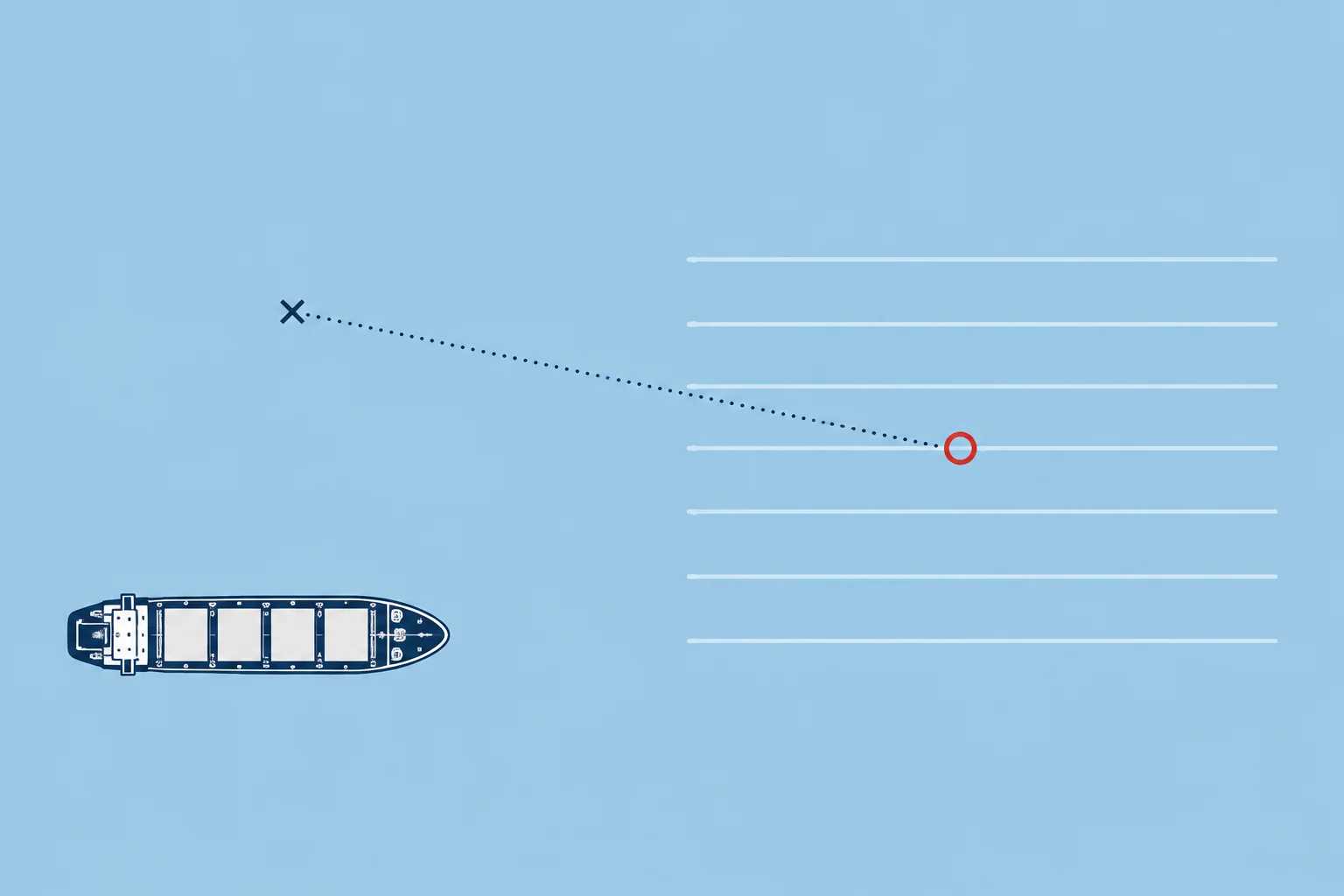
Datum, drift and track spacing
1The lesson in plain words
The casualty does not stay where it was last seen. Work out where it has drifted, then choose leg spacing that suits the object, visibility and sea.
Datum
Datum is the most probable position of the search object at a given time. It starts from the last known position and moves with drift: the total water current (tidal, wind-driven and other background currents) and leeway, the push of the wind on the object itself. A person in the water has little leeway; a liferaft without its drogue (a small sea anchor) can blow quickly downwind. Near the coast, tidal streams change every few hours, so datum must be updated as time passes.
Search area
Positions and drift are never exact, so a search area is drawn around datum. The longer since the incident, the bigger it grows. If you are OSC with no plan from the RCC, IAMSAR Volume III shows how to make a simple one: work out datum, choose a pattern and start at the commence search point (CSP), where the first leg begins.
Sweep width and track spacing
Sweep width measures search effectiveness. Imagine finding every object inside a strip along your track and none outside. Sweep width is the strip width that gives the same overall detection performance as the real search. It is not a guaranteed sighting range. Track spacing (S) is the distance between neighbouring search legs. Use IAMSAR Volume III tables for the object and visibility, then apply the weather correction. A person in the water needs closer legs than a large boat.
Time against chance
Halving track spacing roughly doubles the time needed to cover the same area at the same speed. It raises the probability of detection (POD): the chance of finding the object if it is there. With limited time, closer legs cover less area. Agree the balance with the OSC rather than tightening spacing on your own.
Lookouts
Detection depends on people. Post lookouts high, on both bridge wings and forward, each with a sector to scan and binoculars. Change them often, because attention fades. At night use searchlights and keep deck lights from dazzling the lookouts.
2Key data
- Datum
- Most probable position of the object at a given time
- Drift
- Total water current plus leeway
- Track spacing (S)
- Distance between adjacent search legs
- Spacing depends on
- Object, visibility and a weather correction factor
- CSP
- Commence search point, where the first leg starts
- POD
- Chance of finding the object if it is in the area
3Key points
- 1
Datum is where the object most probably is now: last known position moved by drift.
- 2
Drift is total water current plus leeway; near the coast, tidal streams change it every few hours.
- 3
Track spacing comes from IAMSAR tables by object and visibility, reduced for weather.
- 4
Closer legs take longer but raise the probability of detection.
4Frequent mistakes
Wrong: Search around the position given in the distress alert.
Right: Search around datum: the last known position moved by drift for the time that has passed.
Wrong: Use the same track spacing for a person in the water as for a fishing boat.
Right: A person in the water is hard to see; IAMSAR tables give much closer spacing for small objects.
Wrong: Keep the table spacing in a rough sea.
Right: Apply the weather correction: wind and waves hide small objects, so legs must be closer.
5Practice case & exam keys
A crewman fell overboard 3 hours ago. The stream has run east at 1.5 knots, but is now turning. Wind is light. Another ship proposes keeping datum fixed at the position calculated for your arrival. You are OSC. What do you decide?
Show the answer
Estimate datum about 4.5 NM east of the last known position for your arrival time; leeway is small in light wind. Do not freeze it there or keep projecting the old stream eastward. Update datum as the stream changes and report it to the RCC and searching units. Choose spacing for a person in the water using the visibility table and weather correction. Agree the CSP and post lookouts.
Exam keys
- Datum: most probable position of the object, moved from the last known position by drift.
- Drift = total water current + leeway.
- Track spacing from IAMSAR Vol III tables by object and visibility, with weather correction.
- Smaller spacing: more time, higher probability of detection.
Finish this unit
When you've read it, answer three questions. Get all three right to finish the unit; opening the page alone doesn't count.
My notes for this unit
No notes