

Planning and evaluating drills
1The lesson in plain words
A drill is only as good as its plan and its debrief: set an objective, make it real but safe, measure it, and close the loop.
Plan the year
Basic training covers how often drills happen (see Musters and alarms). As an officer you plan what they test. SOLAS asks that fire drills cover the different emergencies your ship type and cargo could face. A good yearly plan rotates fire locations, flooding, collision, enclosed-space rescue, man overboard, blackout, steering failure, pollution and medical cases, and links them to the company's ISM drill programme.
Design a drill
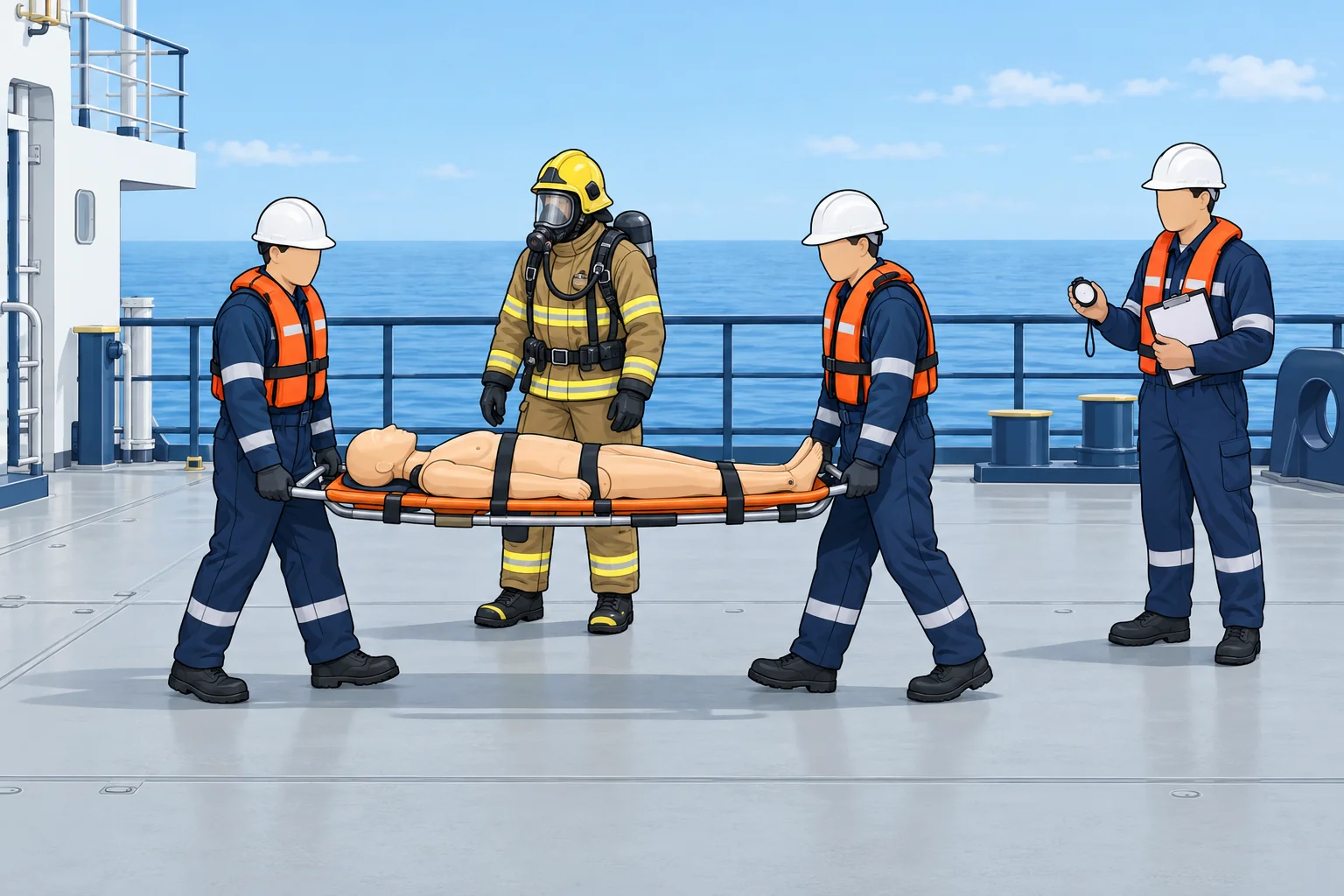
Start with an objective: what should the team be able to do at the end? Write a short scenario with a location, a time and a complication, such as a missing person or a radio that fails. Brief the safety limits: no real smoke in occupied areas, full breathing apparatus checks, and a stop word that ends the drill at once. Name an observer to record performance and stop unsafe acts.
Real but safe
Hold drills at varied times, including at night and in port when safe. Use casualty dummies and controlled training smoke only after a risk assessment. Risk-assess any obscured-vision exercise. Follow company procedures, provide supervision and safety cover, and keep escape routes clear. Follow manufacturer instructions and company safety rules for boats, enclosed spaces and hoses.
Evaluate
Judge the drill against its objective, not by whether it felt good. Typical measures: time to muster and headcount, time to deploy suitable equipment safely, whether all boundaries were found, how clear the messages were. Hold a short debrief straight away: what worked, what did not, what we change. Let everyone speak, the most junior first, before senior crew influence their answers.
Close the loop
Record the drill in the logbook, as SOLAS requires, and in the SMS. Turn findings into actions with a name and a date: repair the radio, change the muster list, retrain a team. Verify that each fix works and record closure; recheck at the next drill. Report anything that needs the company, such as a design fault, through the SMS.
2Key data
- Fire drills
- Planned for the emergencies of your ship type and cargo
- Drill programme
- ISM Code 8.2: programmes for drills and exercises
- Records
- Drills and training entered in the logbook (SOLAS III/19)
- Debrief
- Straight after; judged against the objective; actions with dates
3Key points
- 1
Plan a yearly cycle of scenarios that match your ship's risks.
- 2
Every drill has an objective, a scenario, safety limits and an observer.
- 3
Make drills realistic without creating real danger.
- 4
Measure against the objective and debrief at once, juniors first.
- 5
Record drills; assign actions with owners and dates, verify fixes and record closure.
4Frequent mistakes
Wrong: A drill went well if it finished quickly and nobody complained.
Right: It went well if it met its objective; slow or awkward moments are what the drill is for.
Wrong: Hold the debrief at the next safety meeting, when everyone has time.
Right: Debrief straight after, while details are fresh, and write actions with an owner and a date.
Wrong: For realism, run the drill without the usual breathing apparatus checks.
Right: Realism never replaces safety: full checks, safety limits and a stop word every time.
5Practice case & exam keys
Your container ship has repeated the same engine-room fire drill for a year. Musters are fast, but at a real galley fire the team took four minutes to identify a safe access route after going to the engine-room station first.
Show the answer
Plan a cycle with different locations: galley, accommodation, cargo and engine room, at varied times. Give each drill an objective, such as identifying the simulated fire, reporting a safe access route and selecting and preparing suitable equipment within a safe target time. Use an observer to measure it. Debrief at once, assign actions with owners and dates, then verify the fixes and record closure.
Exam keys
- Fire drills planned for the emergencies the ship type and cargo could face.
- Each drill: objective, scenario, safety limits, observer.
- Debrief at once; findings become actions with an owner and a date.
- Drills recorded in the logbook and the SMS (ISM 8.2).
Finish this unit
When you've read it, answer three questions. Get all three right to finish the unit; opening the page alone doesn't count.
My notes for this unit
No notes