

Proceeding to assist and preparing the ship
1The lesson in plain words
If your ship can help, SOLAS requires you to proceed with all speed. Report your ETA and prepare for safe recovery during the passage.
The duty
SOLAS V/33 requires a master at sea able to help to proceed with all speed, informing the casualty or SAR (search and rescue) service if possible. If unable, or assistance is unreasonable or unnecessary in special circumstances, log why and inform SAR. A non-requisitioned ship (not formally directed to assist) is released when told requisitioned ships are complying. Release also follows word from the casualty, SAR service or a master reaching the casualties that help is no longer needed.
Proceed and report
Tell the RCC and, if possible, the casualty: your name, position, speed and ETA (estimated time of arrival), and what you can offer. Plot the casualty's position and likely drift. Keep a watch on the distress channels and any channel the RCC assigns. Post extra lookouts and use radar and searchlights if you arrive at night.
Prepare the ship
Use the passage time. Brief the crew. Prepare the rescue boat and its crew. Rig pilot or embarkation ladders, scrambling nets (nets for climbing aboard), heaving lines and lifebuoys. Ready blankets, dry clothes, warm drinks and the hospital, and a space and list for survivors. Your ship-specific recovery plan, required by SOLAS III/17-1, says which equipment you use to bring people out of the water.
Making a lee
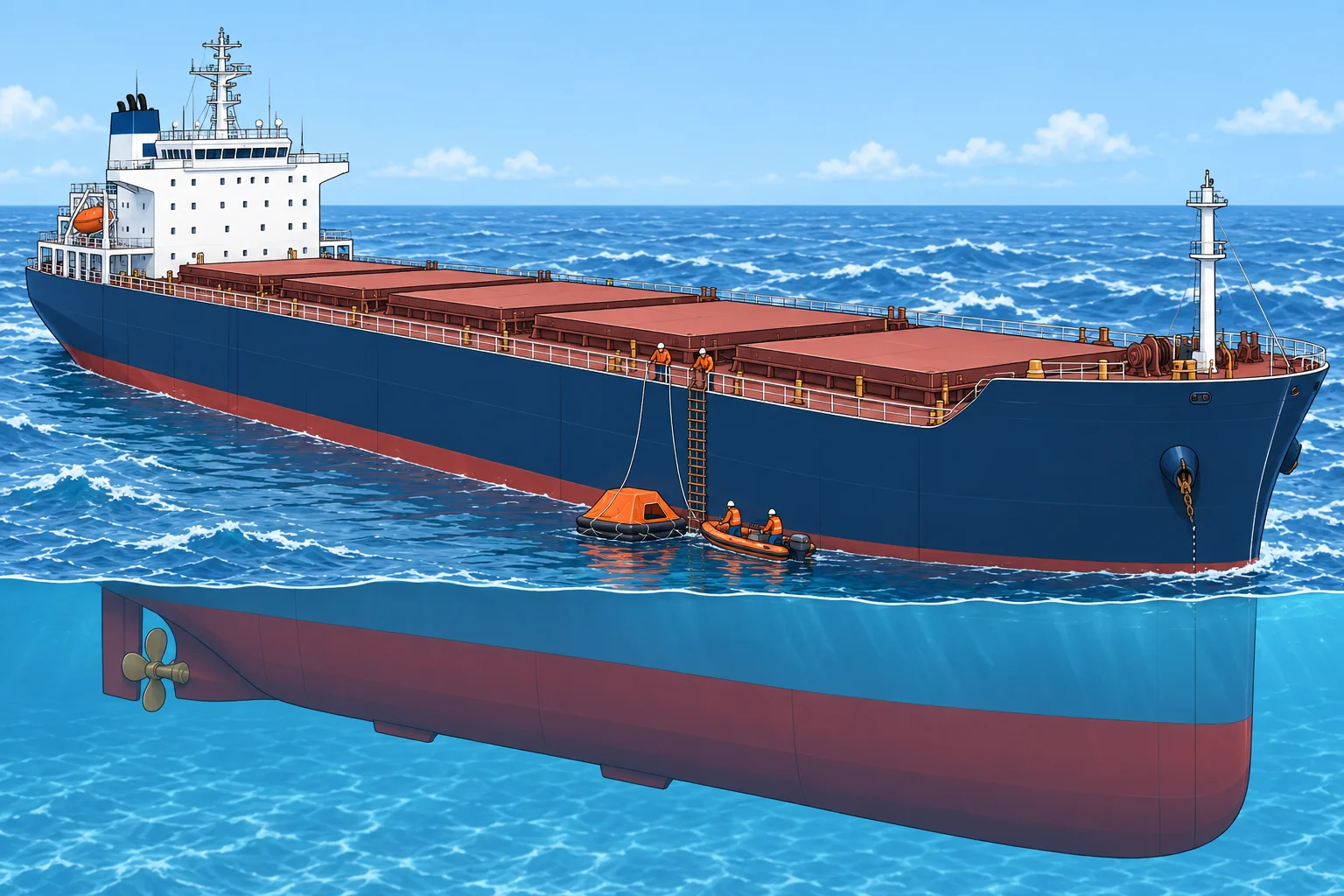
On scene, approach with care. Place the ship so that her hull shelters the survivors from wind and sea: a lee. A high-sided ship can drift down onto survivors or a raft; assess relative movement continuously and keep them clear of the hull and propeller. A liferaft or the rescue boat held at the ship's side can serve as a boarding platform.
Bringing people aboard
A person lifted upright out of cold water can collapse, so lift horizontally where you can, in a basket, net or stretcher. Do not expect exhausted survivors to climb a ladder. Count, register and care for each one and report to the RCC. Rescue includes delivery to a place of safety, where lives are no longer threatened, basic needs can be met and onward transport arranged. Coordinate this with the RCC.
2Key data
- Duty to assist
- SOLAS V/33: proceed with all speed
- If you do not go
- Log the reason and inform the SAR service
- Recovery plans
- SOLAS III/17-1; guidelines MSC.1/Circ.1447
- Recovery techniques
- IMO guide MSC.1/Circ.1182/Rev.1
- After cold immersion
- Lift horizontally where possible
- End of the rescue
- Delivery to a place of safety (guidelines MSC.167(78))
3Key points
- 1
SOLAS V/33: proceed with all speed; if you do not, log why and inform the SAR service.
- 2
Report position, speed, ETA and what you can offer to the RCC.
- 3
Use passage time to prepare boat, ladders, nets, lines, survivor care.
- 4
Make a lee and monitor relative drift: the ship may close on survivors. Keep them clear of the hull and propeller.
- 5
Lift cold survivors horizontally where possible; register and report them.
4Frequent mistakes
Wrong: Another ship is closer, so you can carry on without telling anyone.
Right: Another ship being closer does not release you. Follow SOLAS V/33 release conditions; otherwise proceed, or log and report a justified decision not to.
Wrong: Survivors in the water can climb the pilot ladder.
Right: Cold, exhausted people often cannot. Use nets, baskets or a boarding platform, and lift horizontally where possible.
5Practice case & exam keys
Your 180 m bulk carrier is 25 miles from a liferaft reported by the RCC, with four people aboard. Wind is force 5, sea moderate. ETA is in two hours. The rescue boat is serviceable.
Show the answer
Report identity, position, speed, ETA and recovery capability to the RCC. Prepare crew, recovery equipment and survivor care under the recovery plan. Assess wind, sea, drift and closing speed before making a lee; keep survivors clear of hull and propeller. Launch the rescue boat only if safe. Use suitable boarding and lifting equipment; lift cold survivors horizontally where possible. Register survivors and arrange a place of safety with the RCC.
Exam keys
- SOLAS V/33: proceed with all speed; log and report if you do not.
- Report name, position, speed, ETA and capabilities to the RCC.
- Recovery plan under SOLAS III/17-1; prepare boat, ladders, nets, lines and care.
- Lift cold survivors horizontally; deliver them to a place of safety.
Finish this unit
When you've read it, answer three questions. Get all three right to finish the unit; opening the page alone doesn't count.
My notes for this unit
No notes