

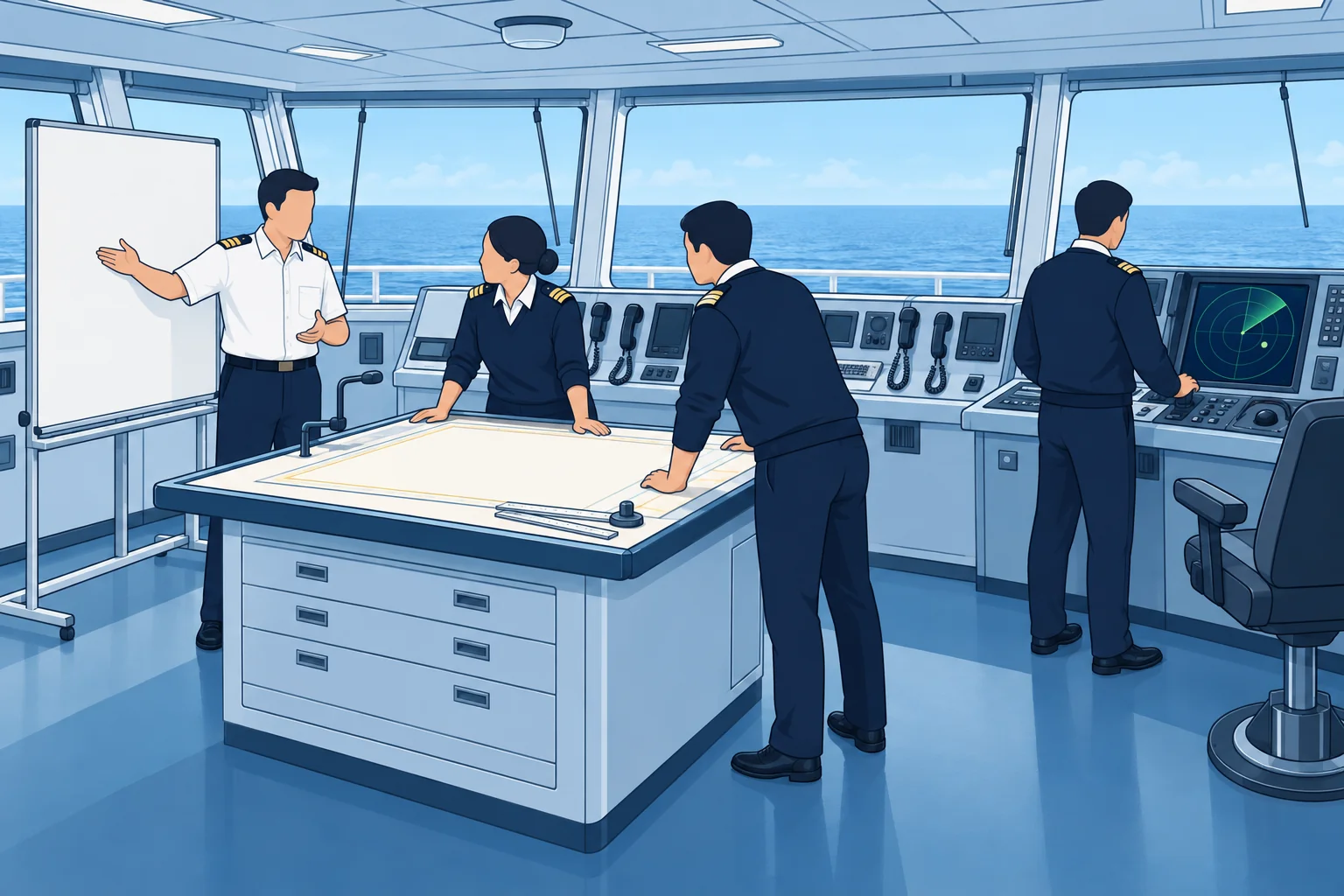
Leading the emergency response on board
1The lesson in plain words
The master decides and coordinates; others fight the fire and work the radio. Build the picture, decide out loud, and ask for help early.
The master's job
In an emergency the master holds the whole picture: people, ship, environment and the outside world. The job is to decide and coordinate, not to hold a hose or work the radio. Hand tasks to the team leaders and to a chief mate who can act as deputy. Keep your span of control small, about three to seven people reporting to you, and protect your time to think.
Build the picture
Ask for reports at a fixed rhythm and in a fixed form: what has happened, what is happening now, what is needed. Use a status board on the bridge: people missing, teams deployed, boundaries, isolations, stability, weather, outside help. Keep the ship safe as a ship too: someone must have the con (control of the ship’s movements) and keep a lookout while everyone else looks at the emergency.
Decide under pressure
Under stress people fix on their first plan and stop seeing new facts. Guard against it: say your plan aloud, ask the team what are we missing? and set a time to review it. Some decisions cannot be undone, such as releasing CO₂, flooding a hold, beaching or abandoning ship. For these, check the facts, weigh the options, decide, and record why. Welcome challenge from anyone; silence is not agreement.
Escalate early
Contact the rescue coordination centre (RCC) and company early. Use PAN-PAN for an urgent safety concern; use MAYDAY when grave and imminent danger requires immediate assistance. Do not wait for company approval. Consider tugs, salvage, refuge or evacuation early: help may take hours to arrive.
Crisis management
An emergency may require sustained crisis management: a controlled fire can leave the ship disabled, or a casualty may be days from port. Plan the next 24 hours: watch rotation and rest, food and water, power and stability, communications. Look after your own rest too: a master who has not slept for 36 hours is a risk to the ship.
2Key data
- Span of control
- About 3 to 7 people reporting to one leader
- Report format
- What happened, what is happening now, what is needed
- Irreversible decisions
- CO₂ release, flooding a hold, beaching, abandoning ship
- Early warning
- Alert RCC and company early; match priority to the danger
3Key points
- 1
The master decides and coordinates; team leaders do the tasks.
- 2
A status board and fixed-rhythm reports keep the picture current.
- 3
Say the plan aloud, invite challenge, set a review time.
- 4
Irreversible decisions: check, weigh options, decide, record why.
- 5
Warn the RCC and the company early; plan rest for a long crisis.
4Frequent mistakes
Wrong: A good master goes to the scene and leads from the front.
Right: From the scene you lose the whole picture. Stay where information comes in, usually the bridge, and lead the leaders.
Wrong: Call the RCC only when you are sure you need rescue.
Right: Warn the RCC early, using the priority the danger requires: MAYDAY for grave and imminent danger requiring immediate assistance; PAN-PAN for an urgent safety concern below that threshold. Help may take hours.
5Practice case & exam keys
Your container ship has a fire in a hold, held by CO₂ but still hot. The engine is running, the weather is worsening and the nearest port is 30 hours away. The chief mate has been on deck for 14 hours and the crew are tired.
Show the answer
Treat it as a crisis, not a short emergency. Warn the RCC early, using the priority the danger requires. Brief the company's emergency team. Set a watch rotation so the chief mate and the crew rest, with a deputy named for each post. Keep hold temperatures and boundaries on the status board with fixed reporting times. Decide with the company about the nearest suitable port or a place of refuge, and record each decision and its reasons.
Exam keys
- The master decides and coordinates; small span of control; a named deputy.
- Status board and fixed-rhythm reports; someone keeps the navigational watch.
- Irreversible decisions are checked, decided and recorded with reasons.
- Escalate early to the RCC and the company; plan rest in a long crisis.
Finish this unit
When you've read it, answer three questions. Get all three right to finish the unit; opening the page alone doesn't count.
My notes for this unit
No notes