

Search planning with the RCC
1The lesson in plain words
Understand datum, drift and detection estimates so you can follow the search plan, prepare an initial plan if needed, and report the area actually searched.
Datum
Search planning starts from the datum: the most probable position of the search object, corrected for its movement since the incident. It may be a point (a probable position), a line (possible positions along a route, adjusted for drift) or an area. The SMC computes it. As OSC you may have to make an initial estimate until a plan arrives, and you should feed back anything that improves it, such as debris sightings.
Drift
The object moves with the total water current (tidal stream, ocean current and wind-driven current) and with leeway, the push of the wind on the part above water. Leeway depends on the object. A person in the water has little; a liferaft without a drogue (a drag device that slows drift) has much more and may drift at an angle to the wind. Errors grow with time, so the search area grows the longer the case lasts.
Detection
Sweep width (W) is an effective detection width for the object and conditions, not a maximum sighting range. Use the relevant tables and correction factors. Track spacing (S) is the distance between search legs. Coverage factor C = W ÷ S: W 1.5 NM and S 3 NM give C = 0.5. Probability of detection (POD) is the chance of finding the object if it is there. With fixed effort, tighter spacing raises POD but covers less area; C = 1 does not guarantee detection.
The trade-off
The planner balances the probability of containment (POC), the chance that the object is inside the area, against POD. Their product is the probability of success (POS): POS = POC × POD. A small area searched thoroughly fails if the object is outside it; a huge area searched thinly may miss it inside. The SMC usually makes that call; your job is to follow the plan accurately and report what you really covered.
Choosing a pattern
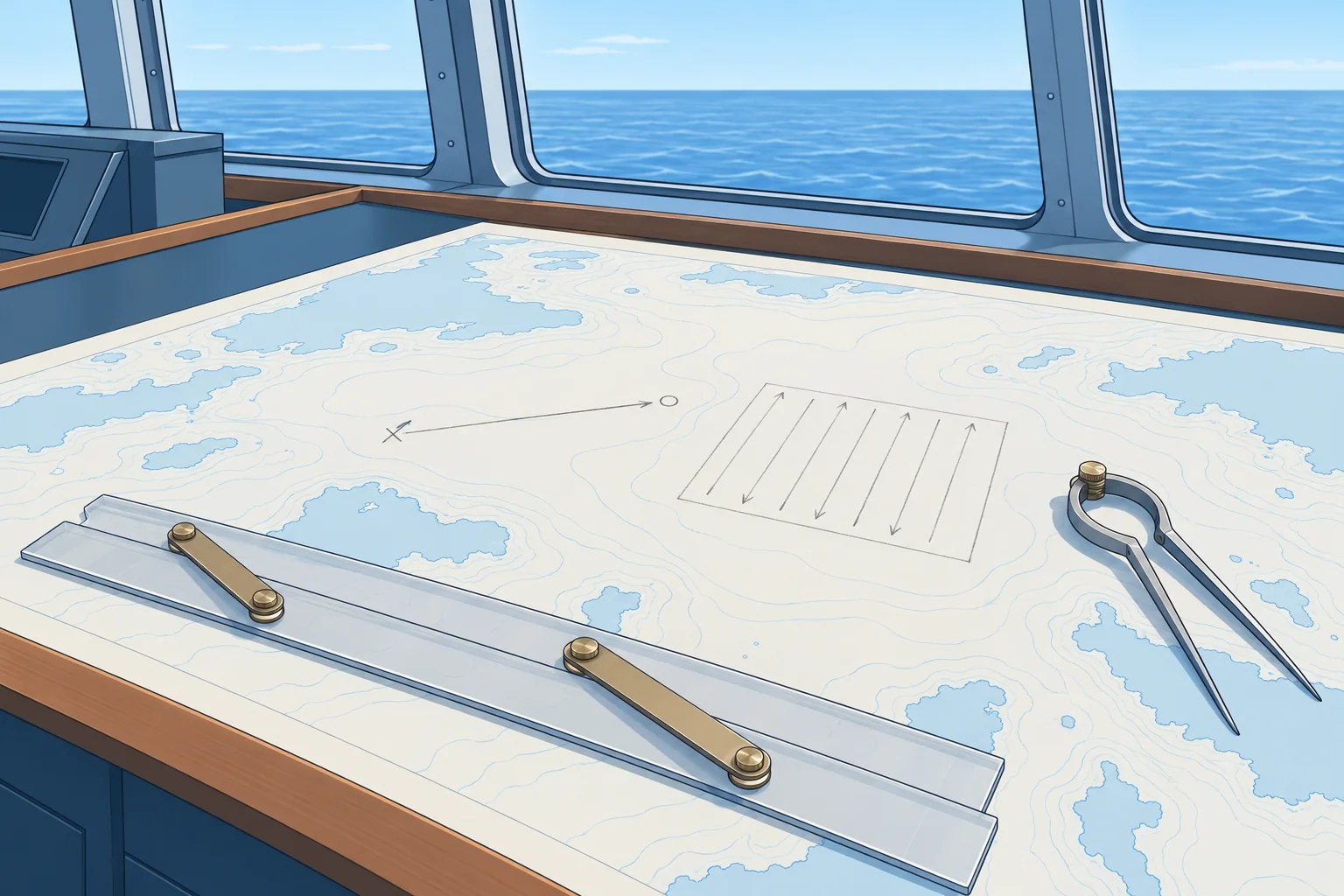
The pattern follows the datum: an expanding square or sector search for a small, well-known datum, parallel tracks for a large area, a track-line search along a route. The geometry is in Search and rescue near the coast. Here, report your actual track spacing and any legs you could not cover.
2Key data
- Datum
- Most probable position, corrected for drift
- Drift
- Total water current + leeway
- Coverage factor
- C = W ÷ S (sweep width ÷ track spacing)
- Probability of success
- POS = POC × POD
- Worked example
- W 1.5 NM, S 1.5 NM: C = 1.0; S 3 NM: C = 0.5
3Key points
- 1
The datum is the most probable position, corrected for drift since the incident.
- 2
Drift = total water current + leeway; leeway depends on the object.
- 3
C = W ÷ S; with fixed effort and conditions, tighter spacing raises POD but covers less area.
- 4
POS = POC × POD: the planner balances area against thoroughness.
- 5
Follow the plan accurately and report the area and track spacing actually searched.
4Frequent mistakes
Wrong: Search around the last known position; the object will still be there.
Right: Search around the datum, corrected for drift; errors grow with every hour.
Wrong: Report the planned track spacing even if you had to open it in bad weather.
Right: Report what you actually covered; the SMC uses it to plan the next search.
5Practice case & exam keys
The plan used W = 2 NM and S = 2 NM. Visibility falls; the relevant tables and corrections now give W = 1.5 NM. Your spacing is still 2 NM. What changes, and what do you report?
Show the answer
Coverage falls from 1.0 to 0.75 because C = W ÷ S = 1.5 ÷ 2, so detection probability falls. Tell the SMC immediately about the reduced detection conditions; do not wait for the routine SITREP. Propose tighter spacing or more units; with fixed effort, tighter spacing covers less area. Follow the updated plan. Log and report conditions, actual spacing and legs completed, including gaps.
Exam keys
- Datum: most probable position corrected for drift (point, line or area).
- Drift = total water current + leeway.
- C = W ÷ S; POS = POC × POD.
- Report actual coverage; pattern choice follows the datum.
Finish this unit
When you've read it, answer three questions. Get all three right to finish the unit; opening the page alone doesn't count.
My notes for this unit
No notes